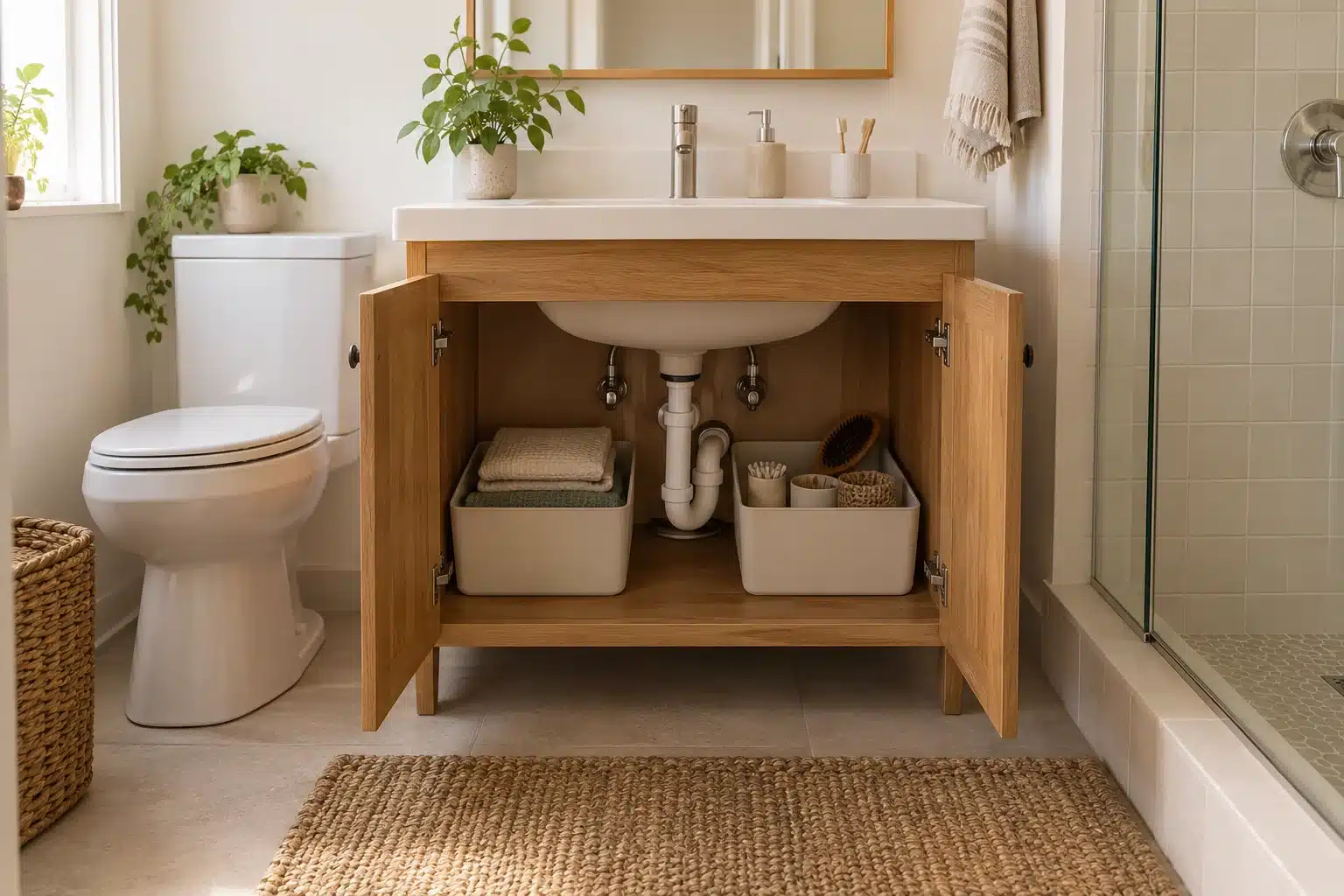
Small bathroom under-sink storage works best when the vanity holds a modest daily collection around its plumbing. Map the usable pockets, keep toiletries easy to lift out and leave a route to the shutoffs. The space below a basin needs a different plan from a plain cupboard of the same width.
This guide assumes an existing vanity cabinet. If your bathroom has a pedestal or wall-hung basin, begin with our bathroom storage guide for rooms without cabinets. Give clean and damp linens their own arrangement with our small-bathroom towel-storage guide.
In this guide
1. Check small bathroom under-sink storage before filling it
Start small bathroom under-sink storage by emptying the cabinet onto a washable surface and grouping personal-care products, cleaning supplies, spare toiletries and items that belong elsewhere. Check packaging, labels and the manufacturer’s storage instructions. A cabinet reset is a useful time to identify an empty bottle or duplicate purchase, but it is not a reason to decant everything into identical containers.
Look at the cabinet base and pipe connections before returning the contents. Dampness, swelling or a persistent odor deserves attention. EPA WaterSense’s maintenance checklist recommends checking beneath sinks for puddling, water spots and leaking pipe connections. Report or arrange repair of a suspected problem before covering the area with storage.
Clean the cabinet appropriately for its finish and let it dry. Preserve any access needed for the sink’s pop-up linkage, valves or other fittings. Avoid moving a pipe or tightening a connection just to accommodate a bin. Organizers should adapt to the installed plumbing, with repair work handled separately when needed.
2. Measure the spaces on each side of the trap
Draw the cabinet from above and from the front. Mark the sink bowl hanging into the cabinet, the trap, supply lines, valves, hinges and center divider if present. Measure the clear doorway first, then the usable pockets. The best storage may be two unequal spaces rather than a symmetrical pair of baskets.
Consider a sample vanity with a left pocket 6 inches wide and a right pocket 9 inches wide. Buying two 8-inch bins would fail on the left, even if the cabinet’s total interior width looked adequate. Different-size bins can give the wider section to bottles and the narrow section to smaller items. These are illustrative dimensions; measure your own plumbing position.
Record height at the front and back of each pocket. A shelf can fit in front of the trap but collide with the underside of the basin farther back. Include bottle pumps, bin handles and the space needed to lift a container. Check door closure with the proposed contents, since handles and toiletries can project beyond an empty bin.
Worked example: a narrow vanity with a central trap
Imagine a vanity opening 42 cm wide with a sink bowl descending into the upper space and a trap across the rear. A left pocket measures 15 cm wide, while the right has 21 cm of usable width. These are illustrative dimensions, not a model specification. A pair of 20 cm bins may look balanced in a photograph but one will not fit the left pocket. Vanity storage needs the actual opening and irregular interior.
Measure the daily bottles with pumps and caps included. A bottle 22 cm tall may stand beneath a 24 cm shelf but leave little room for a hand or its removal from a deep bin. Test the whole movement using the actual product and a suitable container. Bathroom cabinet organization should not require tilting everything forward every morning. If a short open bin helps visibility and retrieval, it may be preferable to adding a tall drawer frame.
Keep the frequent group in the most useful accessible pocket and give suitable backups a distinct limited location. Separate items whose labels or instructions require a different environment. Medicines and electrical tools should follow their own appropriate storage guidance; a free corner in the vanity does not settle that decision. Vanity storage is about assigning compatible contents as much as matching the dimensions of plastic containers.
Finally, open the vanity door as far as the neighboring toilet or wall normally allows and retrieve the daily group. An organizer passing the fully opened door in an empty-room test can fail under these real conditions. Repeat with the bathroom entrance door in its ordinary position. Useful bathroom cabinet organization preserves both movements rather than assuming every door can always stand completely open.
| Item to measure | Include | Reason |
|---|---|---|
| Cabinet opening | Hinges and center divider | Bin must pass through |
| Usable pocket | Bowl, trap and supply lines | Interior is irregular |
| Daily bottle | Pump, cap and grip space | Standing height is not retrieval height |
| Door movement | Nearby fixture and room door | Test the normal usable opening |
3. Compare small bathroom under-sink storage methods
| Method | Useful contents | Important limitation |
|---|---|---|
| Low removable bins | Daily toiletries grouped by person or task | Need a clear lifting route |
| Shallow tray | Small bottles and packets | May waste the depth of a large cabinet |
| Small drawer module | Light dry accessories | Drawer travel can hit doors or plumbing |
| Split shelf organizer | Two clear side pockets with spare height | Supports must clear the trap and valves |
| Suitable door holder | Light slim items | Uses internal closing space and needs compatible mounting |
Choose small bathroom under-sink storage after assigning its contents. A deep drawer module may make small items accessible but remove the space needed for tall daily bottles. Low open bins are often a useful starting point because they reveal whether the cabinet’s problem is lost visibility, poor retrieval or simply too much stock.
4. Arrange toiletries around the morning routine
Put the most frequently used group in the easiest pocket. This might be a personal-care bin pulled onto the vanity while getting ready, then returned. Choose a manageable container with a stable base, and keep the bottle labels visible. Leave fragile packaging and tall pump bottles upright where their makers intend them to be stored.
For a shared bathroom, divide by person when routines differ, or by task when everybody uses the same products. A small oral-care group and a hair-care group can be clearer than four nearly empty individual baskets. Avoid rigid categories that force the household to make several trips for one routine.
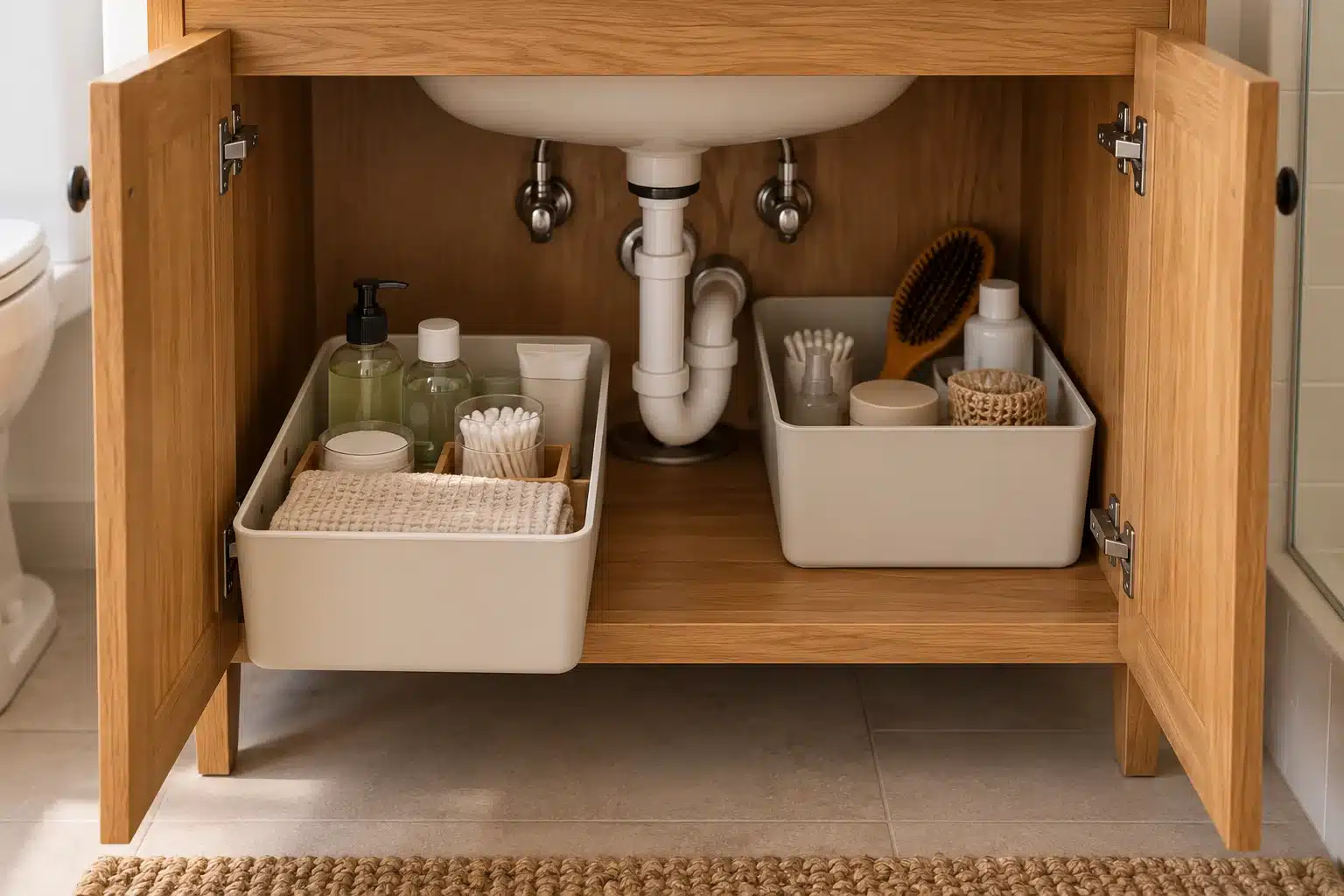
Give current products the easiest home in small bathroom under-sink storage before assigning a backup area. An open bottle should not become hidden behind its unopened replacements. Keep refills in a limited, recognizable section so you can check supplies before shopping. If a refill is too bulky for the vanity, a suitable dry location elsewhere may work better.
Give small accessories a shallow container rather than a deep bucket. Hair ties and clips disappear at the bottom of tall bins, while a tray allows a quick scan. Do not add tiny compartments until loose objects actually need them; excessive dividers can leave more plastic than useful storage space.
A budget trial for bathroom cabinet organization
Start with the products currently used in an ordinary morning and evening. Put suitable daily items together on a washable planning surface, with original information intact. Identify empty containers, duplicate refills and products that are kept but not used by the household. Bathroom cabinet organization can begin with a smaller receiving group rather than a collection of matching bins. Ask other users before relocating their daily products.
Test an existing appropriate shallow container in the best pocket. Place it where you can lift or slide it out as intended without catching plumbing. Keep the vanity storage away from pipes as structural support. If no container improves the movement, individually placed products may be a better starting point. A bin is useful when it solves visibility or return; it is unnecessary if it merely adds another object to remove.
For a shared bathroom, assign recognizable daily groups and keep shared products easy to identify. A location or simple label can do that without requiring identical containers. Give suitable backups one bounded area and check it before shopping. Bathroom cabinet organization should make returning products obvious to each user, including when someone is in a hurry. Avoid a nested system where every group has to be lifted out to reach the last bottle.
Try the arrangement for a normal week and note which products end up on the vanity top. Check whether the difficulty is reach, a high bin side, insufficient height or a conflicting door. Buy only for the remaining obstacle. An adjustable two-tier organizer still occupies a frame and needs usable retrieval space. Compare its complete installed dimensions with the existing vanity storage trial, including everything that already worked.
5. Keep medicines and electrical tools in suitable places
Medicine storage follows its label, not the name of the bathroom cabinet. FDA guidance on expiration and storage explains that appropriate conditions depend on the drug and can include temperature, humidity and light. Choose a secure location that meets those requirements, and ask a pharmacist if a particular product’s needs are unclear.
Likewise, do not assume every personal-care product benefits from the same environment. Check instructions for cosmetics, contact-lens products and other supplies. Keep original labels and closures available. A cabinet with recurring dampness is not ready for vulnerable paper packages or clean textile backups simply because a lidded box can be placed inside it.
Hair dryers, straighteners and other electrical tools need their own manufacturer-approved cooling and storage routine. Do not put a hot tool into a plastic bin or shut it in the cabinet while warm. Protect cords from tight bends and pinching doors. If the under-sink area cannot provide suitable dry storage, choose another location.
Keep bathroom cleaning products separate from personal-care items and manage access appropriately for children or pets. A decorative bin or opaque door does not secure the contents. Relocate products when the cabinet cannot meet their storage and access needs; organization cannot substitute for the required conditions.
6. Test small bathroom under-sink storage with doors open
Open the vanity doors to their ordinary usable positions, which may be limited by a nearby toilet or wall. Test whether a bin comes out without tilting over a pipe. A drawer module needs enough doorway width throughout its travel, not just when closed. If the bathroom door blocks the vanity during use, simulate both movements before committing to the layout.
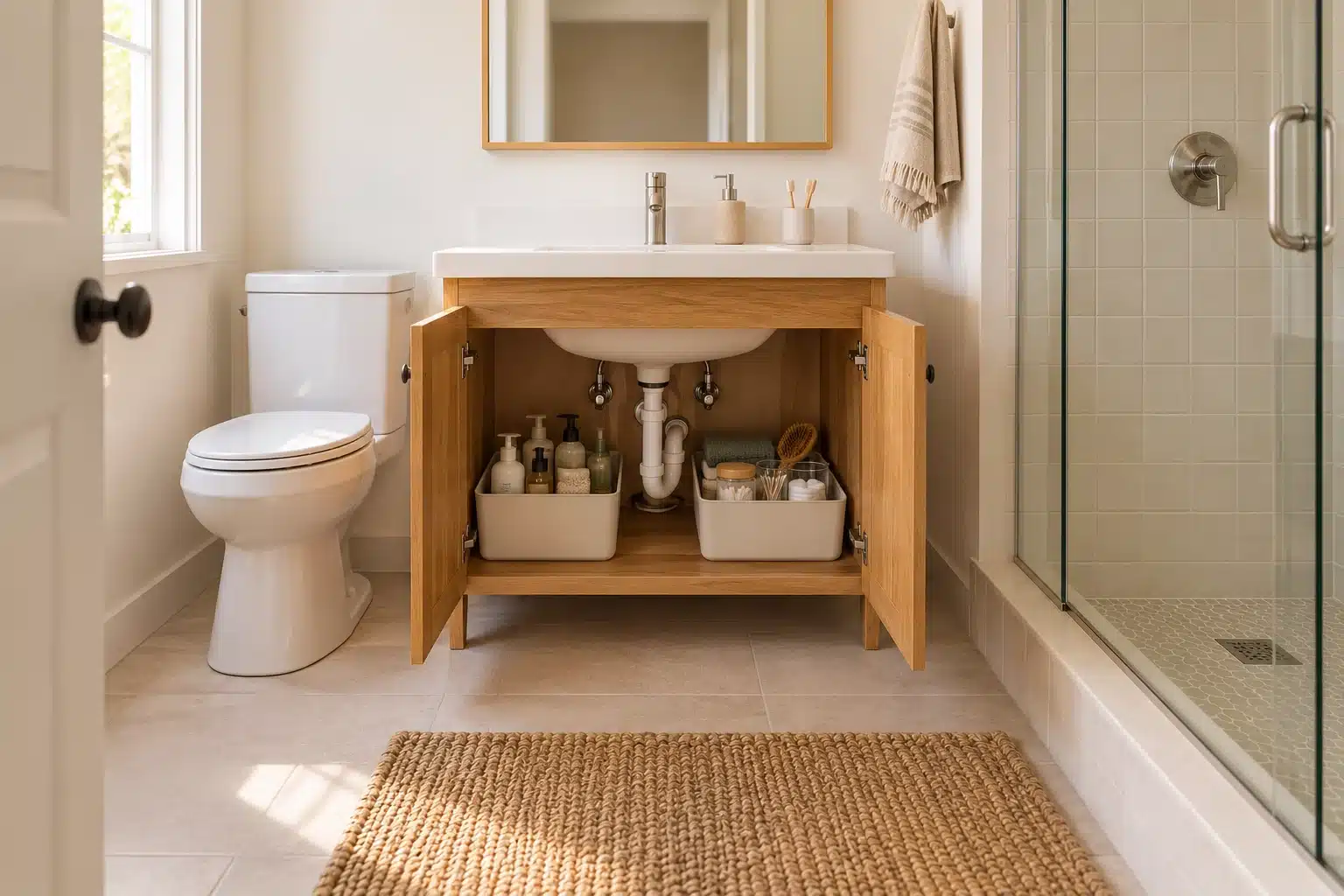
Door holders can add useful light storage where mounting is appropriate, but count their loaded projection. An over-door hook may prevent closure or mark the cabinet edge. Screw-mounted fittings require suitable material and permission. Keep the hinges within their intended use rather than loading a narrow vanity door with large bottles.
If the cabinet only opens partway, reduce the container size so it can pass through the real opening. This can be more useful than a large bin that technically fills the interior. The best-fit container is the one you can remove during the routine, not the one with the greatest listed capacity.
7. Leave service access and simplify maintenance
Place removable groups in front of service areas so they can be lifted out quickly. Keep valves and removable plumbing connections recognizable. A full-width installed shelf may require disassembly before maintenance; compare that inconvenience with the modest amount of capacity it adds. Never support an organizer on the drain or supply lines.
Keep part of the cabinet base visible, and remove bins periodically to inspect beneath them. A washable tray can simplify a small product-spill cleanup but does not solve water entry. Clean the containers when needed and return only dry contents suited to that location. Damp washcloths belong in an appropriate drying or laundry routine, not in a closed toiletries bin.
Make one test kit using the actual daily bottles, their usual container and any removable accessories. Move it through the cabinet opening, set it in its proposed pocket and bring it out again. Repeat with the vanity door open only as far as neighboring fixtures allow. This exposes retrieval problems that interior measurements alone miss.
Try small bathroom under-sink storage for a week before adding another tier. Notice whether the daily group returns easily, the spare section stays visible and the cabinet closes without pushing products inward. If something remains on the vanity because its bin is awkward, reposition that group. If everything fits except several unopened duplicates, adjust the backup quantity or its location.
Troubleshoot vanity storage by the morning task
If a daily bottle stays outside the cabinet, try its actual return movement. The location may be wrong for its size or the user, even when there is technically space. Move the frequent group forward or lower the sides of the chosen container by selecting a suitable design. Bathroom cabinet organization should reduce handling rather than demand repeated unloading of backups. Preserve access to stored labels while making the current bottle easy to reach.
If a drawer module clears the trap when closed but strikes it when pulled forward, stop and check the full travel. The closed footprint does not establish compatibility. Use model instructions and the exact cabinet geometry; do not remove structural components or rest the unit on plumbing. Vanity storage may need two independent shallow groups instead of a full-width sliding mechanism. Accept unused irregular pockets when using them makes the rest inaccessible.
If clean towels or paper packaging feel damp, reconsider the location and address the room or cabinet conditions. Do not assume a lidded bin makes a persistently unsuitable environment appropriate. Keep dry backups elsewhere when needed, and retain the cabinet for contents compatible with it. Bathroom cabinet organization should not exchange a tidy photograph for hidden moisture or supplies stored contrary to their instructions.
If cleaning the cabinet requires emptying several deep tiers, simplify the removable groups and reduce duplicate stock. Keep the base visible enough to inspect and leave recognizable service access. Record the final vanity storage plan with three groups: daily compatible products, suitable limited backups and access to preserve. Review small bathroom under-sink storage after ordinary mornings and after cleaning so the system passes both tasks.
| Daily problem | Likely fit check | One trial |
|---|---|---|
| Tall bottle remains outside | Lift height and bin sides | Move it to a suitable accessible pocket |
| Drawer catches trap | Full sliding travel | Choose independent compatible groups |
| Refills crowd current bottles | Backup quantity and receiving location | Limit or relocate suitable backups |
| Cabinet is hard to inspect | Deep tiers and service access | Use fewer removable groups |
Record the morning group and its receiving pocket
Create a bathroom cabinet organization note with one row for each user’s compatible daily group and one for shared products. Write the receiving pocket, container if used, and the tallest item that must come out. Add a separate suitable backup location. This makes the arrangement understandable when somebody replaces a bottle or returns a newly washed container.
Test vanity storage again with replacement packaging. The new product may be wider or have a taller pump even if it serves the same purpose. Keep daily toiletries in the convenient group and avoid moving backups in front of them to accommodate a new shape. A small allocation change can preserve the rest of the plan.
Keep inspection and service areas visible on the note. Bathroom cabinet organization should not depend on one person remembering which box hides a valve. Review the receiving pockets after an ordinary cleaning session, noticing which group is hardest to remove and replace. Vanity storage is finished when the daily and maintenance routines both work with the actual cabinet.
Questions about a small vanity cabinet
Are clear bins better than opaque ones?
Clear bins show contents from the side, but low opaque bins can work equally well if labels remain visible from above. Choose by retrieval, cleanability and fit. Matching appearances matter less than avoiding an inaccessible rear row.
Should I store towels under the bathroom sink?
Only if the area stays suitable and dry and the towels have easy access without crowding plumbing. A clean backup towel needs different treatment from a damp towel in use. Our towel-storage guide covers that separate drying and storage decision.
Can I fit a cabinet around a pedestal sink?
Some furniture is designed for that arrangement, but its cutout must match the actual pedestal and pipe geometry. It is a different selection from organizing an existing vanity. Check the complete dimensions, stability and installation instructions before buying.
What if there is room for only one bin?
Use it for the daily products that benefit most from nearby access, and give backups a suitable home elsewhere. One easy-to-use group is more useful than multiple miniature containers wedged between pipes.