The best towel storage for small bathrooms starts with two different jobs: letting an everyday towel dry and keeping clean backups ready. One tightly packed basket cannot do both. Before buying a rack, decide where each damp towel can hang with space around it, then find a dry location for the smaller backup supply.
You do not need to fit every household towel inside the bathroom. A nearby linen shelf may be a better home for clean extras, leaving the bathroom for what is used each day. For toiletries and other items, see our separate small bathroom storage guide without cabinets.
In this guide
Count towels by their job, not their color
Plan towel storage for small bathrooms by listing the bath towels, hand towels and washcloths actively used between wash days. Then separate the dry backups from that working set. This tells you how many drying positions the room needs. A rack advertised as holding four folded towels may provide space for only one or two towels spread out, depending on its dimensions and bar arrangement.
Measure the bathroom with doors open and closed. Include the shower door, vanity drawers and any door-mounted rack. A towel hangs below and projects beyond its support, so measure the fabric in use rather than the bare accessory. Also check whether a towel will touch a wet wall, toilet, floor or nearby toiletries.
Compare towel storage for small bathrooms
| Storage type | Useful for | Main limitation |
|---|---|---|
| Existing towel bar | Spreading a daily towel | May fit fewer towels than you need |
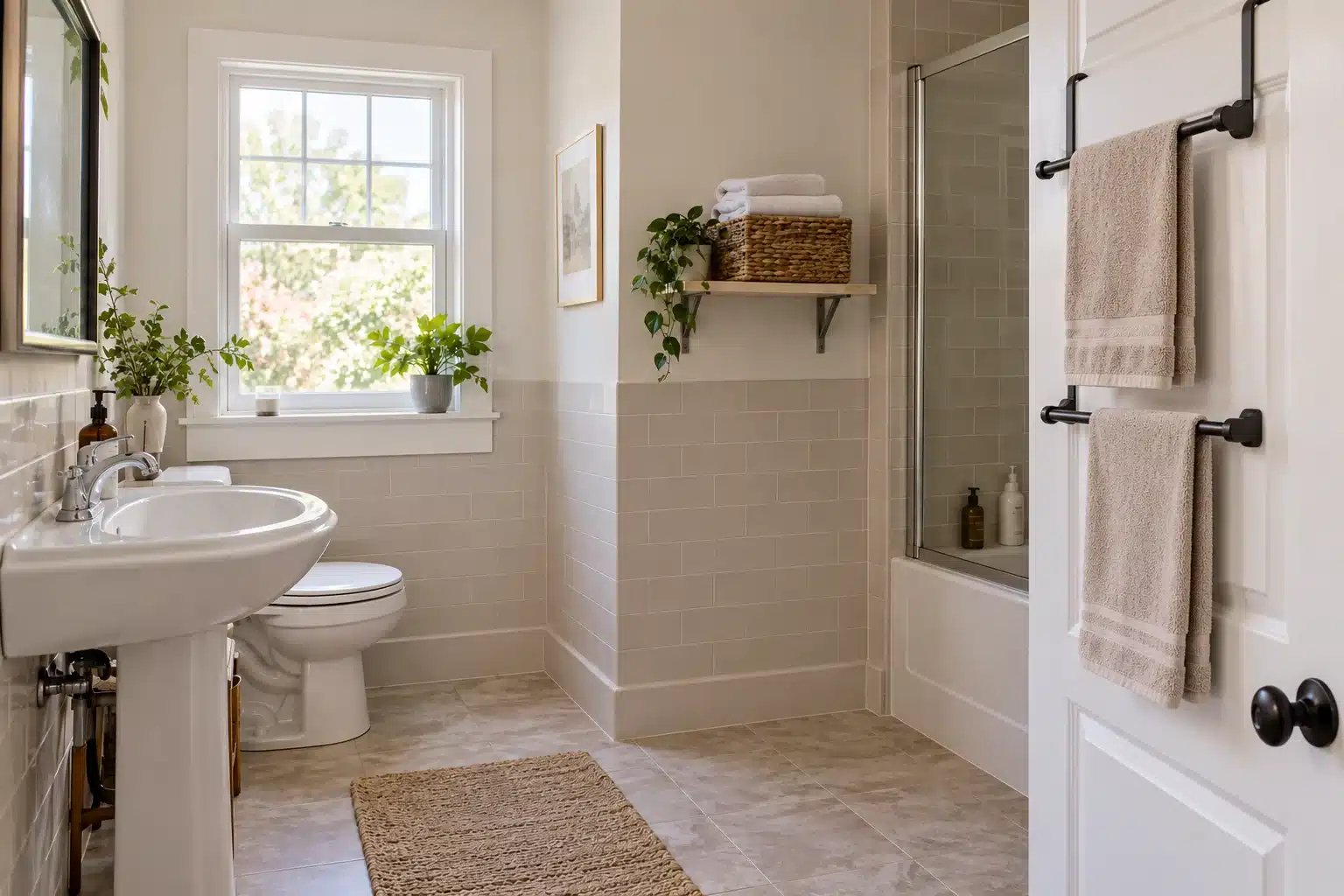
| Over-door rack | Using an otherwise empty surface | Door clearance and hardware fit |
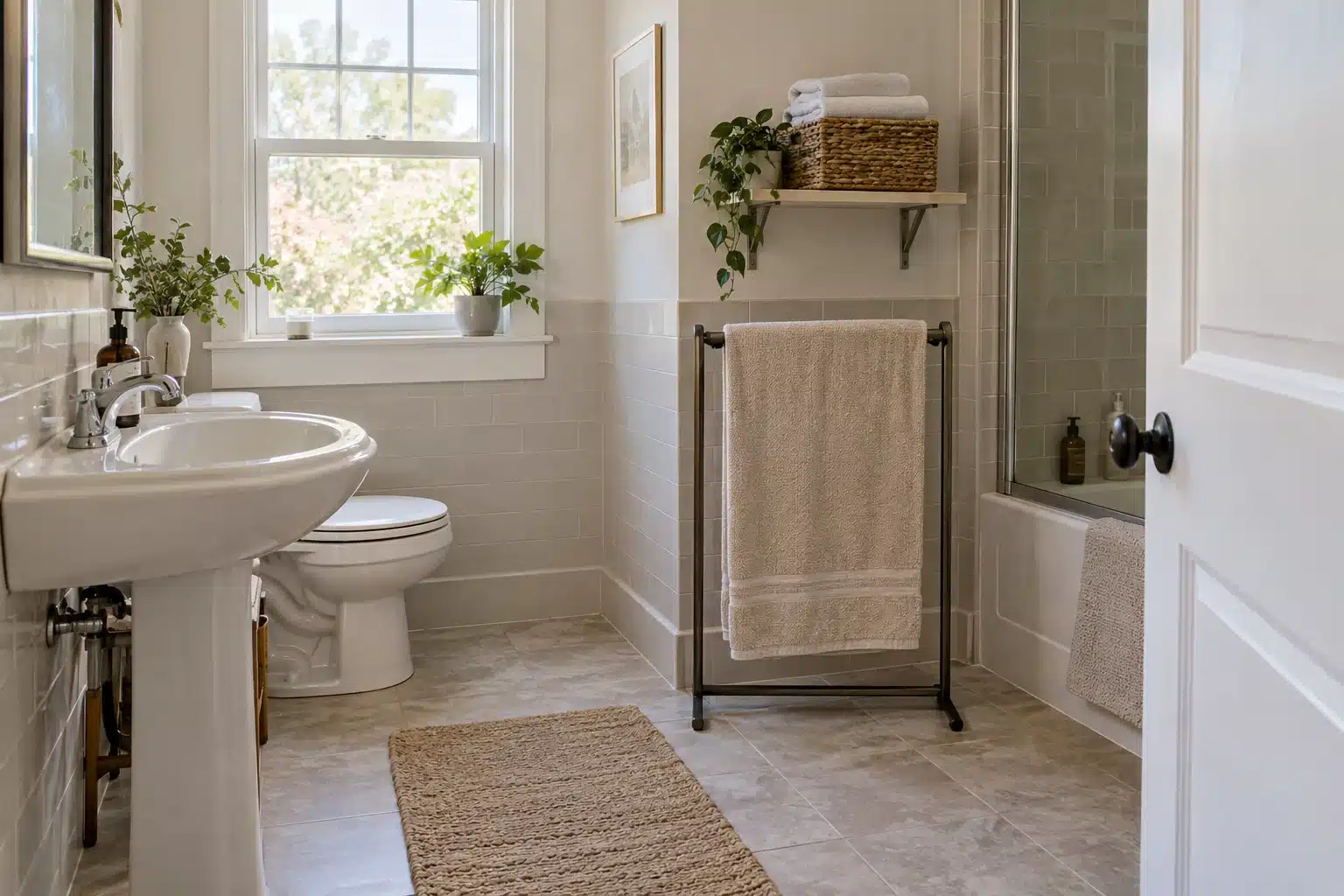
| Freestanding rack | Flexible placement | Occupied floor space and stability |
| Wall hook | Quick, individual hanging | Fabric bunching and installation requirements |
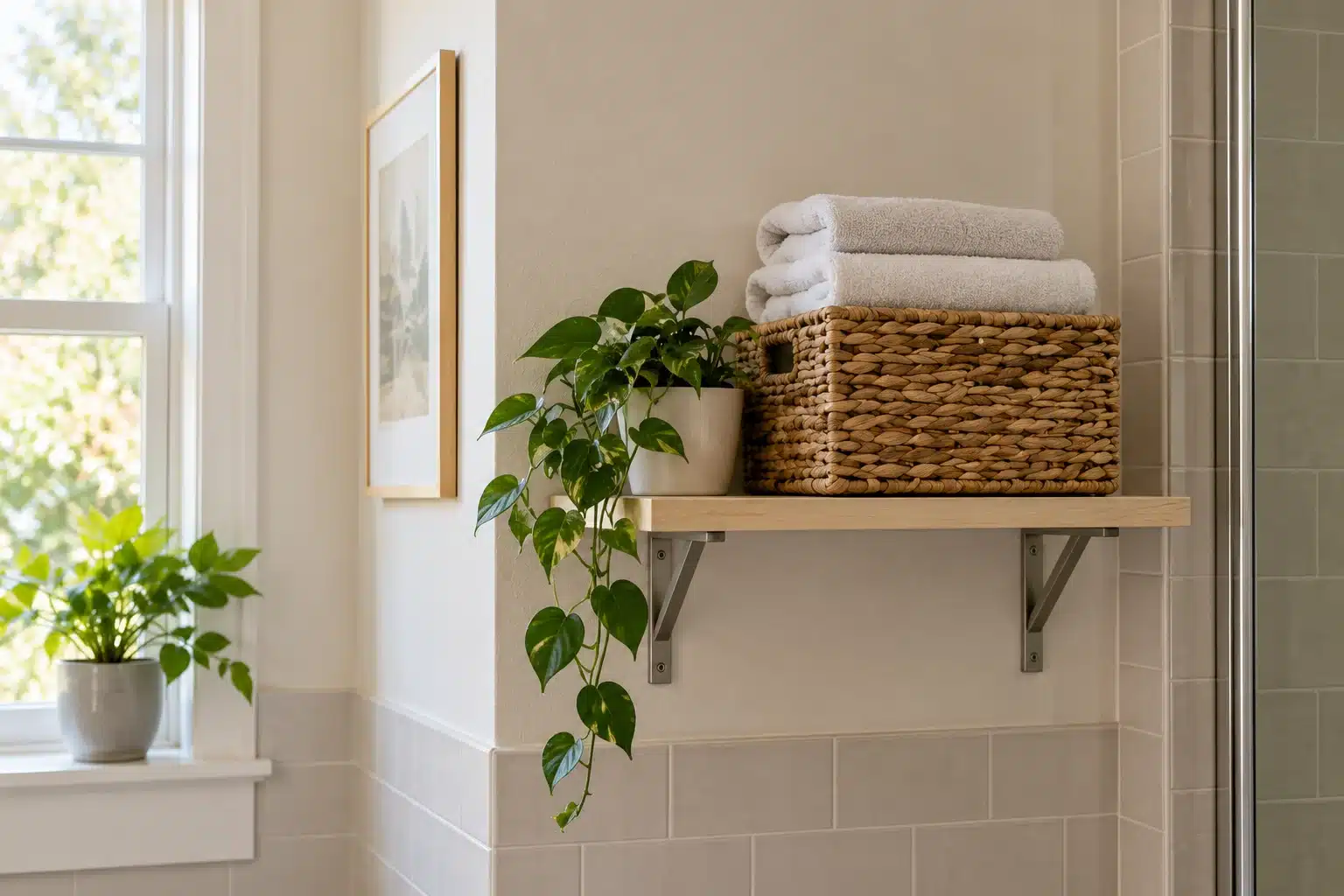
| Dry shelf or basket | Folded clean backups | Not a drying solution |
Choose towel storage for small bathrooms that works with the room’s existing circulation. If a rack only fits while the door is closed, test whether you can enter the bathroom comfortably and operate every fixture. Storage that makes routine movement awkward is a poor trade, even if it appears compact on the product page.
Worked example: two people and one existing bar
Consider two people sharing a bathroom with one towel bar and a narrow door. Each person uses one bath towel, and the household also has a hand towel plus a few clean replacements. First measure the usable bar width and each actual towel. A 45 cm bar does not provide the same spreading room as a longer one, even when a folded display photograph shows several towels. These measurements are illustrative; judge the fabric and fixture in your room.
Keep the existing bar for one working towel if that is the arrangement that allows it useful space. Compare an approved second hanging position for the other person rather than putting both into the same crowded fold. Bathroom towel storage involves hanging as well as folded storage. The second position must still allow the door to move, the towel to remain clear of wet surfaces and the user to retrieve it comfortably.
Suppose an over-door rack projects 9 cm from the closed door but the towel increases that occupied depth. Mark the rack and fabric footprint while the room is dry, then open the door fully. Check the handle, frame and nearby shower enclosure. If the towel catches the shower door, reject that position. Towel organization that works only when nobody enters the room is not a useful shared arrangement.
Finally, choose a dry shelf for a modest replacement set or place that set outside the room. Keep the hand towel in a suitable accessible position near its use. Count the jobs separately: two working bath towels, one working hand towel and clean replacements. This prevents bathroom towel storage from becoming a contest to fit the whole linen collection on one rack. The best allocation may use fewer towels inside the bathroom than the first shopping plan assumed.
| Towel group | Question to answer | Possible adjustment |
|---|---|---|
| Person one: working towel | Can it spread usefully on the existing bar? | Clear that bar of decorative towels |
| Person two: working towel | Does a second position preserve door movement? | Compare another suitable location |
| Shared hand towel | Can it be reached beside its usual use? | Keep its hanging position distinct |
| Clean replacements | Are they dry and easy to retrieve? | Use a limited shelf or nearby linen home |
7 easy ideas for towel storage for small bathrooms
A practical towel organization trial before buying
Do the first reset with what you own. Remove unused decorative towels, unfold the working towel as far as the existing bar allows and move excess clean stock to a suitable dry location. This immediately reveals whether the problem is too many stored towels or too few working drying positions. Bathroom towel storage can improve without new hardware when a decorative display was using the only functional bar.
Observe the next ordinary uses rather than setting a universal drying deadline. Fabric, room conditions, ventilation and the way a towel hangs affect the outcome. Note whether the middle remains bundled, whether towels touch each other and whether users can return them to their assigned places. Improve spacing or allocation where possible. Persistent room dampness needs attention; adding a deeper towel basket does not address moisture conditions.
For shared towel organization, agree on a simple position for each person. Existing color differences, a location label or each person using the same hook can help identification without buying a matching set. Keep the system understandable to a guest too: make clean replacements distinct from used towels and identify where used cloths belong. The point is a repeatable household routine, not an elaborate display that only one person can reconstruct.
If a purchase is still needed, name the missing job before searching. You may need a second appropriate hanging position, a shallow dry backup container or a better shelf location. Those are different bathroom towel storage decisions. Compare the complete installed or occupied footprint and all product requirements. A low-priced rack that cannot be fitted correctly has not solved the job, while a suitable existing shelf may need nothing more than a smaller towel stack.
1. Make the existing bar do its real job
Spread a daily towel as widely as the bar allows. Remove decorative towels if they occupy the only practical drying position. If two towels overlap heavily, use a second appropriate location rather than squeezing them together. A single clear bar can be more useful than an entire display of rolled towels.
2. Try an over-door rack after checking the door
Measure the door thickness, top gap and rack projection. Check compatibility with the door and frame before installation. The door should latch, open fully and avoid striking the shower or vanity. Choose a rack with appropriate capacity; repeatedly forcing an ill-fitting hook over a door can mark the finish or damage the frame.
3. Use a slim freestanding rack where it can stand safely
A stable rack avoids wall installation but uses more floor space than its narrow bars suggest. Include the feet and the hanging towel in your footprint measurement. Keep it outside splash-prone or slippery routes. Test ordinary movement past it; if you need to turn sideways or step over a base every time, choose another option.
4. Give each person an individual hook where suitable
Hooks can reduce confusion in a shared bathroom. Space them so towels are not pressed together, and hang the towel so it can open out rather than forming a dense bundle. Adhesive products need the surface, curing time and load conditions specified by their manufacturer. They are not universal substitutes for properly installed hardware.
5. Put clean backups on a dry shelf
Use a small stack you can lift without pulling everything down. A supported shelf above a suitable dry area can hold hand towels or a limited backup set. Keep heavy baskets within comfortable reach and follow shelf capacity guidance. Avoid making the top of a damp, crowded toilet tank the default linen cupboard.
6. Store overflow outside the bathroom
A bedroom drawer, hallway linen cabinet or other dry household location can hold the excess clean supply. Keep a modest bathroom set and refill it when laundry is put away. This arrangement is often more realistic than finding a permanent bathroom home for guest towels, beach towels and a full family’s entire stock.
7. Separate small cloths from bath towels
Washcloths and hand towels are easier to lose inside a large stack. Give clean small items a shallow compartment or separate basket, while providing used items with appropriate hanging or laundry space. Do not return damp used cloths to the clean backup container. The distinction should be obvious to everyone using the room.
Plan a shared bathroom without adding clutter
Shared towel storage for small bathrooms starts with two workable daily towel positions for two people. Then choose one location for the shared hand towel and one dry home for backups. Check that each user can reach their towel without crossing the other person’s space. If the bathroom cannot accommodate this, consider a suitable drying position nearby rather than forcing another rack into the circulation route.
Use two counts when comparing a rack: the number of completely dry towels it can store and the number of in-use towels it can hold with useful space around the fabric. Write down both. A product that accommodates four folded backups may not solve the drying needs of four people.
Use a simple household routine: hang the working towel after use, put used items into laundry rather than the clean basket, and replenish the backup stack when laundry returns. Color differences can help identify towels, but buying a new matching set is unnecessary. The system matters more than the styling.
- Remove unused decorative towels from drying positions.
- Choose and test the daily hanging arrangement.
- Move dry overflow to another suitable room.
- Check fabric clearance with the door and shower in use.
- Observe drying between ordinary uses and adjust spacing if necessary.
What a photograph cannot tell you
Photos of towel storage for small bathrooms may show attractive rolled towels without showing whether they were completely dry before storage. A ladder may seem narrow until its base and hanging fabric are included. Treat photos as ideas, not as proof that an arrangement works in your bathroom. The illustrations here show possible layouts, not product load ratings or a tested universal drying time.
Follow fixture and product instructions, and do not block room ventilation to gain a storage surface. If towels remain damp despite spacing, consider the room’s ventilation and household routine rather than adding more layers to the same rack. Drying behavior depends on the material and room conditions, so there is no honest one-size-fits-all timetable.
Troubleshoot bathroom towel storage one problem at a time
If towels fall from a shelf when one is removed, reduce the stack height or divide clean small cloths from large towels. Check support beneath any basket and choose one you can lift safely without leaning across a fixture. Rolling is one folding choice, but it does not create unlimited capacity or fix an awkward high shelf. Towel organization should make removal easy for the people who use the room.
If a door rack marks the frame or prevents latching, unload it and revisit compatibility. Door thickness, top gap, hooks, protective components and loaded projection all matter. Do not solve a poor fit by forcing the door or removing required parts. Compare a correctly installed alternative or a suitable position elsewhere. Rental permission and the manufacturer instructions determine what you can use; an over-door product is not automatically compatible with every door.
If clean towels keep joining the used pile, make the two locations more distinct. Reduce the backup supply inside the bathroom and give working towels recognizable hanging places. Return laundered towels to the clean home when they are ready for storage, and keep damp used cloths out of the clean basket. Bathroom towel storage fails when its visual division is ambiguous even if the available shelf space is adequate.
If the arrangement is difficult to clean around, measure the floor and wall access with towels hanging normally. A freestanding rack may have wider feet than its top bars, and a ladder may lean into the room. Choose towel organization that leaves ordinary cleaning practical. Recheck the system after a normal laundry return as well as after a shower: the former tests folded capacity, while the latter tests the working towel positions.
| Problem | Useful observation | Next change |
|---|---|---|
| Wet towels overlap | Fabric touches on one support | Give each a suitable separate position |
| Clean stack tumbles | Removal disturbs several towels | Reduce or separate the stack |
| Door will not latch | Hardware or fabric conflicts | Recheck compatibility; choose another position |
| Replacements become used pile | Locations are unclear | Separate and identify the two jobs |
Record the towel cycle, not just the shelf capacity
Write three receiving locations: where working towels hang, where clean towels return after laundry and where used items go when they leave the working set. Identify any location that depends on moving something else first. Towel organization can fail at the return stage even when the shelf holds the whole clean set. Keep those three jobs recognizable for everyone using the room.
Compare bathroom towel storage just before wash day and after laundry returns. Before wash day, check whether each working towel still has a useful hanging position. After laundry, check whether clean towels can be put away without forcing the shelf full. A plan that works at only one end of that cycle may need fewer backups in the bathroom or a different appropriate overflow location.
Record the actual support dimensions and installation information if you are considering a new rack. Include the feet or mounting hooks, not only the bars. Keep notes about frame clearance, towel projection and who can reach each position. Towel organization that works for the person shopping may need adjustment for someone else in the household. Use the existing towels for these measurements rather than guessing from a product photograph.
For clean towels stored outside the room, make replenishing part of the laundry return rather than a separate daily chore. Put a manageable bathroom set in its dry home, leaving the remainder in the appropriate receiving location. This reduces trips without moving the entire household linen collection into the room. Bathroom towel storage should reflect your wash routine and room conditions, not an arbitrary number of towels shown on a shelf.
Questions about towel storage for small bathrooms
Are baskets good for storing towels?
Yes, for a manageable supply of completely dry, clean towels. Choose a dry location and a basket that lets you retrieve one towel without emptying the whole stack. A basket is not a replacement for a drying bar or other suitable hanging position after use.
Are hooks better than towel bars?
Hooks use less wall width, while bars usually let fabric spread out more. The better choice depends on available surfaces, how many towels are used and how well they dry in the room. You can use both for different jobs, provided the mounting and spacing are appropriate.
Can I store every towel above the toilet?
Only if the storage is appropriate, stable, reachable and clear of splash or servicing requirements. It is often better to put just a small backup supply there and store the rest elsewhere. Check the shelf, hardware and nearby tank access instead of judging the arrangement by appearance alone.
What is the cheapest first improvement?
Clear the existing drying position and reduce the bathroom backup stack. Moving unused towels to another dry location may solve the congestion without any purchase. Measure before deciding that a new rack is necessary.
Keep planning the rest of the room
See storage for a bathroom without cabinets and a practical small-laundry workflow. For additional room examples, browse IKEA’s small-bathroom storage ideas; confirm individual product dimensions before buying.