Shower storage without drilling depends on the surface and load, not just the promise on a product label. Identify your wall material, count the bottles used during a normal shower and compare adhesive, suction, hanging and tension options. Choose a caddy that fits the enclosure while leaving controls and the exit easy to use.
Keep shower products separate from the rest of the room’s storage plan. Our guide to bathroom storage without cabinets covers dry supplies, while towel storage for small bathrooms deals with drying and clean backups.
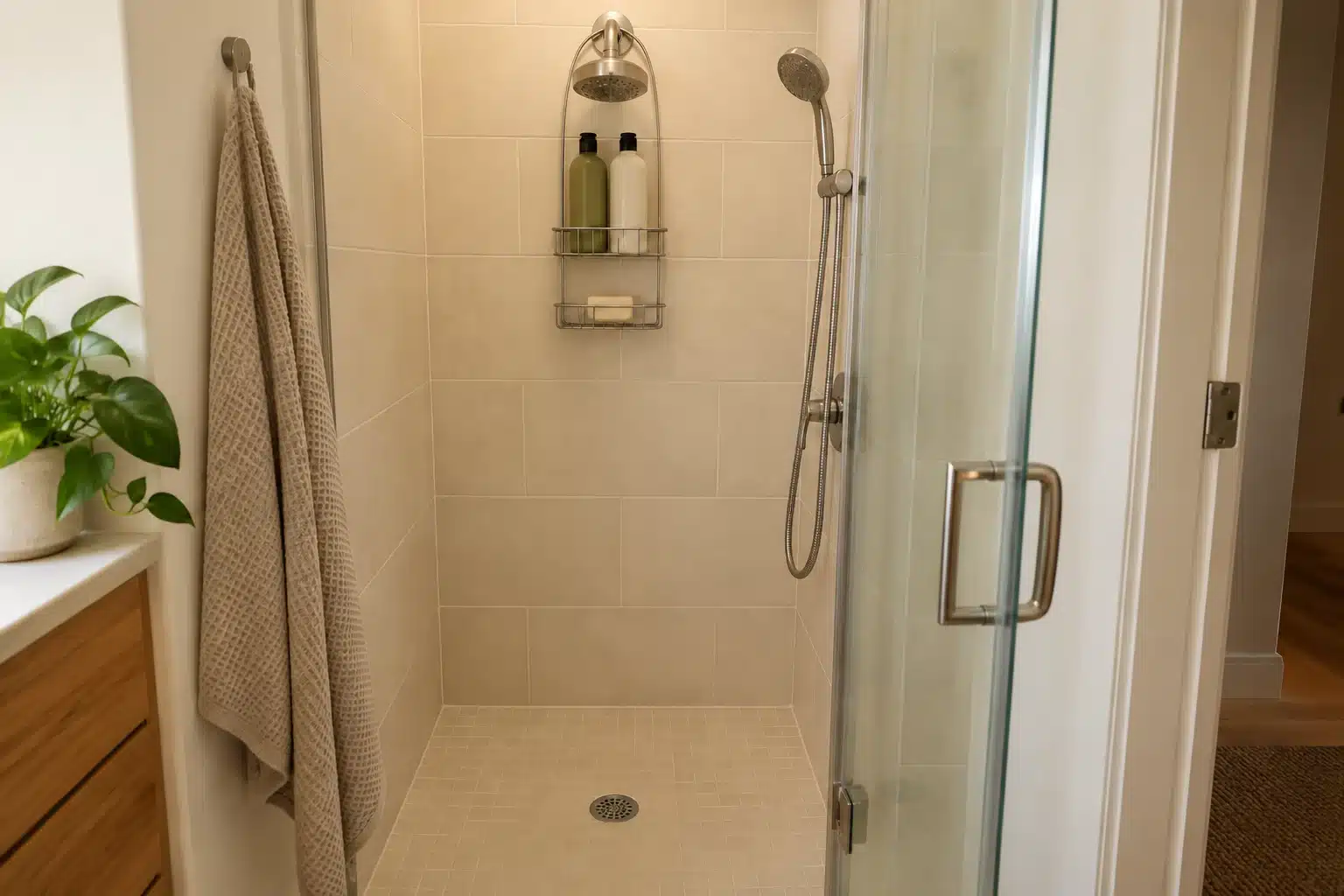
In this guide
1. Match shower storage without drilling to the surface
Before choosing shower storage without drilling, look closely at the intended location. Smooth glazed tile, textured tile, grout, glass, stone and molded shower panels have different characteristics. A mount designed for a smooth surface may fail on a textured finish even when the wall looks flat from across the room. Do not treat every material called tile as interchangeable.
Check the caddy maker’s approved and excluded surfaces, then check any care restrictions from the wall or enclosure manufacturer. An adhesive that bonds strongly can still be unsuitable for a delicate finish. Existing coatings, sealers or residues may also affect compatibility. No-drill installation is not a guarantee that every removal will leave every surface untouched.
In a rental, check the agreement for adhesive fittings and fixtures attached to the shower enclosure. A reversible-looking mount may still need permission if it can damage a finish. Use a compatible removable or freestanding option when the mounting surface cannot be established. Avoid experimenting with a heavily loaded shelf directly above your feet.
2. Compare shower storage without drilling
| Method | Useful situation | Check before choosing |
|---|---|---|
| Bathroom-rated adhesive caddy | A compatible stable wall surface | Surface restrictions, preparation, waiting time and total rated load |
| Suction caddy | A suitable smooth nonporous surface | Seal requirements, inspection and load rating |
| Hanging caddy | A fitting or enclosure approved to support it | Hook geometry, finish protection and door movement |
| Tension-pole caddy | Suitable floor and ceiling contact points | Height range, support conditions and installation method |
| Portable shower tote | No compatible mounting location | Stable temporary position and storage after drying |
Use this table to filter shower storage without drilling by your actual enclosure. Adhesive storage can be compact where the wall is suitable. A hanging unit avoids adhesive but may interfere with a door or shower hose. A tension pole makes use of a corner while occupying floor and ceiling contact points. The appropriate option depends on the enclosure you already have.
Worked example: tall pump bottles in a shallow enclosure
Imagine a shower enclosure with a smooth-looking tiled wall, a handheld hose and a door that opens inward. The largest bottle is 9 cm deep and 25 cm tall with its pump closed. A caddy shelf advertised as 10 cm deep sounds suitable, but its rail and rear mounting area reduce usable shelf depth to 8 cm. These illustrative dimensions show why exterior measurements alone cannot establish fit for shower caddies.
Measure the pump in its normal operating arrangement and the space for your hand. Consider whether the model is intended to hold a bottle while you operate its pump or whether you should lift the bottle out. No-drill shower storage must suit the actual use, not merely the bottle resting on the shelf. Follow the product instructions and avoid assuming its static load rating answers every question about added force during use.
Now compare the mounting base with the surface. A broad base may overlap grout or a textured border even where much of the wall is smooth. Check the exact approved surface and installation documentation. Shower caddies differ in attachment, preparation and removal requirements. Do not assume extra adhesive can bridge unsuitable areas or increase the rating. If the surface cannot be confirmed as compatible, choose another permitted method.
Finally, simulate the caddy projection while the enclosure is dry. Move the hose, open the door and reach for the controls. If the shelf occupies shoulder space or hits the door, a different position or shape is needed. No-drill shower storage that leaves bottles accessible but makes entry awkward has failed a daily-use check. Reducing the active bottle collection can sometimes solve the conflict with a smaller suitable caddy.
| Fit entry | Record | Compare with model information |
|---|---|---|
| Mounting surface | Material, finish and seams | Approved surfaces and contact area |
| Bottle footprint | Largest base including its shape | Usable shelf depth and width |
| Bottle operation | Pump height and hand movement | Intended use and removal route |
| Enclosure movement | Door, hose and controls | Loaded projection and placement |
3. Measure bottles and movement together
Measure shower storage without drilling around the products you use, including the largest bottle’s base and height. Include the height required to operate a pump. A shelf with enough space for a bottle may leave insufficient room for a hand above it. Check whether a shelf rail prevents the bottle sitting flat or makes a small soap container awkward to lift.
Measure the proposed caddy’s projection and shelf spacing, then simulate its footprint using a simple cardboard shape held in place while the shower is dry. Open the shower door fully and move the handheld hose through its normal route. Make sure you can reach the controls and wash without bumping a shelf. Avoid sharp projections near ordinary arm and shoulder movement.
For example, a 4-inch-deep shelf and a 4-inch-wide bottle leave no allowance for a guard rail if those figures describe external dimensions. Ask whether the listed dimensions are overall or usable shelf dimensions. There is no universal caddy height that suits every person; consider reach, balance and the people who share the shower.
4. Follow adhesive and suction instructions precisely
Use a product specifically intended for the bathroom environment and approved surface. Clean, dry and prepare the location exactly as instructed, including the required pressure and waiting period before loading. Do not replace the supplied mounting components with general household tape or extra glue. More adhesive does not establish compatibility or a higher safe load.
Command’s shower project instructions describe preparing the surface according to the package and waiting one hour before hanging or loading the products shown. That is an example for those products, not a waiting-time rule for all caddies. Use the current instructions supplied with the exact product you purchase.
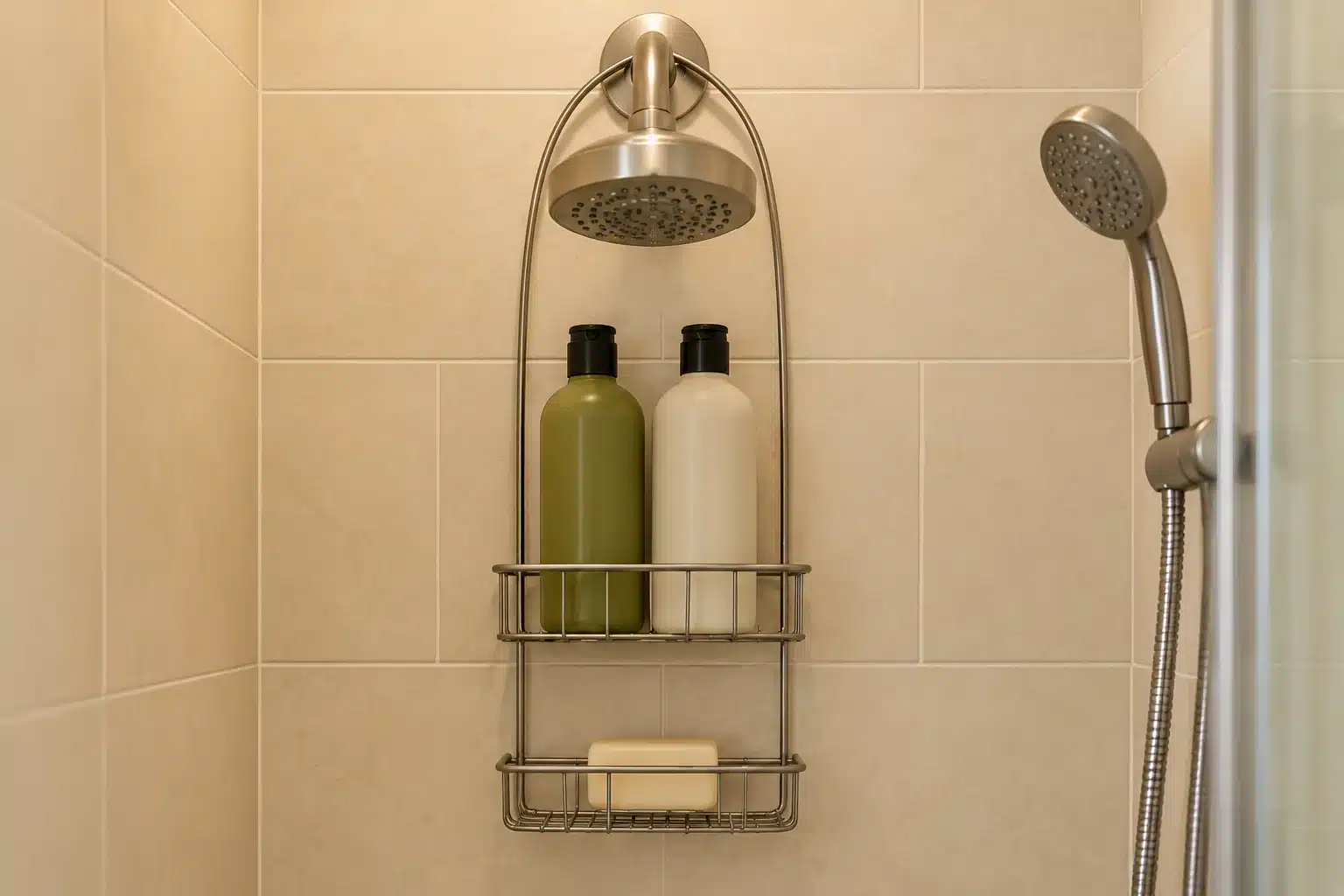
For suction storage, follow the maker’s instructions for creating and maintaining the seal. Check attachment before use and periodically thereafter, especially if the caddy moves or a cup edge lifts. Do not compensate for a poor seal by pushing on a loaded shelf. Unload it, assess the surface and reattach only as permitted.
Keep removal instructions as well as installation instructions. Some adhesives need a particular release motion and room to pull a tab; placing the mount against a ceiling edge can remove that space. Stop if removal threatens the finish and seek the manufacturer’s guidance. A no-drill product still needs a considered location.
Compare shower caddies before placing an order
Count current products by person and identify shared bottles. Keep appropriate backups in suitable dry storage outside the active shower collection. No-drill shower storage becomes easier to choose when it needs to hold the products actually used rather than every replacement bottle. Record filled sizes and weights where available; empty packages are not a useful representation of the regular load.
Compare several compatible methods only after this inventory. Adhesive shower caddies need an approved surface and installation sequence. Suction models need the permitted contact surface and a sound seal. Hanging models need a suitable support, while tension systems need compatible contact areas and height. None of these labels establishes universal suitability. Reject options that conflict with your enclosure before comparing their advertised number of shelves.
For each remaining model, check how it will be cleaned and removed. Can baskets detach as instructed? Is the release tab accessible where an adhesive design needs one? Will removal involve pushing against glass or a surface in a way the instructions do not permit? No-drill shower storage includes the eventual maintenance task, not just first-day attachment. Keep the supplied documentation available for that stage.
Consider the whole cost of a suitable arrangement: product, any approved replacement mounting components and the capacity you truly need. A larger unit is not better value if it blocks movement or requires products you do not use to fill it. A portable suitable tote may be a workable alternative when shower caddies cannot be installed compatibly, provided it has an appropriate stable position during use and a sensible drying and storage routine afterward.
5. Check hanging and tension supports separately
A hanging caddy needs a support designed or approved for the load. Do not assume a decorative shower arm, valve, curtain rod or handheld hose can serve as a storage bracket. Match the hanger to the permitted fitting and check any stabilizing components. Bottles should not swing into glass or cause the caddy to tilt toward the shower user.
For over-enclosure storage, compare hook width with the actual supported edge, including protective pads. Check door closure, rollers and seals. A hanger that prevents a door from sealing can create a water problem outside the shower. Avoid tightening or wedging a product against glass in a way its instructions do not permit.
Tension units need compatible contact surfaces and a height within the product’s supported range. Follow the pole’s assembly and tension instructions rather than extending it beyond its stops. simplehuman’s tension-caddy support page provides an instruction-sheet route for its models; consult the corresponding documentation for whichever unit you choose.
Check ceiling conditions before using a pole. A sloped, flexible or unsuitable ceiling may prevent a sound installation. Keep shelves and loads arranged as instructed, and do not treat the pole as a grab bar. Storage equipment does not provide the support of a properly selected and installed accessibility fitting.
6. Check the filled load for shower storage without drilling
Count the complete load: filled bottles, soap dish, hanging accessories and anything supported by attached hooks. A small collection of full family-size bottles may weigh more than many empty containers. Follow the listed capacity and any per-shelf restrictions, and keep weight distributed as the maker directs. Do not add more hooks to increase a rating.
Leave enough room to remove a bottle without knocking its neighbors. Keep backups in appropriate dry storage so the shower holds the active collection. If each household member uses several products, allocate a sensible shelf or group while checking the total load. A second caddy needs its own compatible installation and does not remove space conflicts.

Choose shelf shapes that allow drainage and access for cleaning. Check that soap or bottle bases do not block all the drain openings. Rinse and clean as appropriate, let detachable components dry when needed, and replace damaged mounting parts according to the instructions. Rust-resistant descriptions do not eliminate inspection or care.
7. Recognize when a no-drill caddy is a poor fit
If the surface is incompatible, the required load is too high or the installation blocks shower movement, choose another arrangement. A portable tote can bring products into the room and leave with them afterward, provided it has a stable position during use and a suitable drying routine. Reduce the active collection before adding a larger structure.
If you need storage that doubles as support while standing, address that as an accessibility installation with suitable professional advice. A caddy may look like a rail but is not designed to carry a person’s weight. The same applies to a tension pole positioned where somebody may instinctively grab it.
Before ordering, record the approved mounting surface, usable shelf depth, bottle-and-pump height, complete filled load and the door or hose movement beside it. Check those entries against the exact model documentation. If a seller provides only exterior dimensions, ask for usable shelf dimensions rather than assuming the bottles will fit.
Trial shower storage without drilling after following the installation instructions and loading within its rating. Check whether the door opens, bottles lift easily, water drains and the mount remains sound. If a caddy begins to loosen, remove the load and investigate. Do not wait for a fall simply because the product was advertised as strong or renter friendly.
A use and maintenance check for no-drill shower storage
After correct installation and the specified waiting period, load within the model limits and check normal bottle removal. Follow the manufacturer sequence rather than testing a newly attached mount early. Shower caddies should remain sound during their intended use. If the shelf moves, the suction edge lifts or mounting components loosen, remove the load and assess the installation using the product instructions.
If bottles tip when one is removed, check shelf rails, usable width and weight distribution. A tall narrow bottle and a low wide tub may need different positions. Reduce the active group if the shelf is tightly packed. No-drill shower storage works better when you can lift one item without dislodging others. Adding hooks or improvised side baskets can introduce loads or arrangements the original rating does not cover.
If water or soap residue remains in the basket, check its drainage openings and cleanability. Follow care instructions for detachable parts and surrounding surfaces. A bottle base can cover drain holes even in a caddy advertised as draining. Shower caddies still need inspection and cleaning, and descriptions such as rust resistant do not mean every mounting part or surface can be ignored indefinitely.
If the arrangement conflicts with balance, mobility or assistance needs, choose storage positions that suit those needs and seek appropriate advice for support fittings. No-drill shower storage is not a substitute for a properly selected and installed grab support. Keep the caddy out of positions where someone may instinctively rely on it to hold their weight. Review the final layout for entry, controls, retrieval, drainage and maintenance rather than appearance alone.
| Observed issue | Check first | Next action |
|---|---|---|
| Bottle will not sit flat | Usable shelf area and guard rail | Change compatible model or bottle position |
| Pump is hard to reach | Hand space and intended operation | Use permitted retrieval arrangement |
| Mount begins to move | Load and installation conditions | Unload and follow product guidance |
| Door or hose catches | Loaded projection and normal movement | Reposition or choose another suitable option |
Record the mounting method and maintenance route
Keep a record for each shower caddy containing the exact model, approved surface, specified installation sequence, load limits and removal method. Store the supplied instructions where you can retrieve them after months of use. Shower caddies with similar appearances may have different requirements; a note based on another model does not establish the correct process.
Record the active products assigned to each basket and the usable shelf dimensions. Review no-drill shower storage when a larger replacement bottle arrives or another user adds products. Check complete filled load and practical retrieval again rather than assuming a new bottle can occupy any remaining gap.
Include the cleaning route: which component detaches as instructed, how the surface behind it is reached and whether the release space remains available. Choose shower caddies with this routine in mind. If maintenance requires an improvised movement against glass or concealed mounting parts, reconsider the location. Useful no-drill shower storage preserves the instructions and access needed throughout its life.
Questions about shower caddies
Can adhesive caddies go across grout lines?
Only if the specific mounting system permits that surface and arrangement. Many products rely on continuous suitable contact. Compare the mounting base with the actual tile area before purchasing instead of assuming extra adhesive will bridge the gap.
Are suction cups the easiest rental option?
They can be convenient on compatible smooth surfaces, but seal quality and inspection matter. Textured walls or a heavy bottle collection may rule them out. Choose by your surface and use conditions, not rental status alone.
Can I press pump bottles while they stay on the shelf?
Check the product instructions. Pumping adds force beyond the bottle’s resting weight, and some arrangements are better used by lifting the bottle out. Keep normal operation within the caddy’s intended use.
How many shelves do I need?
Enough for the products in active use with space to retrieve them. Count the bottles first and measure their usable shelf arrangement. Extra tiers are not helpful if they force storage above comfortable reach or into the door path.