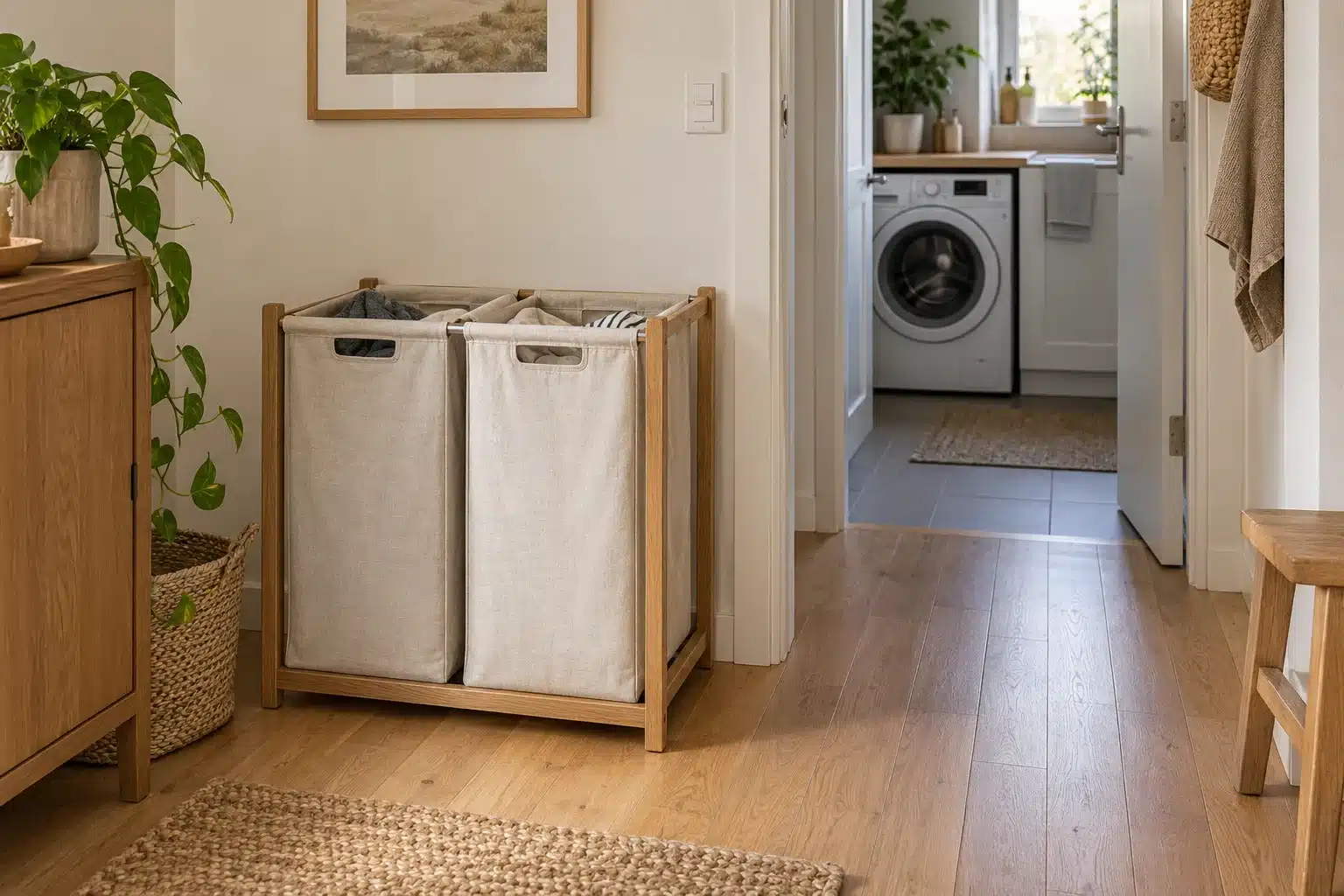
Laundry basket storage for small spaces needs to solve two jobs: containing clothes between wash days and moving them to the washer. Decide where clothes collect, how often they leave, and which container you can comfortably carry. Then fit that system into the room. A large sorting unit is not essential for a small household.
For the appliance zone itself, see our small laundry room guide with a top-loading washer. If you air-dry, include the next destination in your plan using drying clothes in a small apartment.
In this guide
1. Separate the jobs of laundry basket storage for small spaces
A hamper usually stays where clothes are removed; a carrying basket travels between rooms. One container can do both if its filled shape and handles suit the route. A fixed tall hamper with a removable liner may collect well but require a separate way to carry laundry. Identify these jobs before buying a matching set of baskets.
Sorting is another decision. Some households separate garments as they enter the hamper; others sort immediately before washing. The American Cleaning Institute’s laundry basics advises sorting by color, fabric and care instructions. A permanently divided hamper can support that task, but two compartments do not replace reading garment labels.
Write a simple path: clothes come off in the bedroom, collect in one hamper, are sorted near the washer, then return in a clean carrying basket. If several household members change in different places, a second collection point may help. Do not add separate bins for every imagined category before checking whether those categories fill at similar rates.
Give each container one main job before choosing the set. Laundry basket storage for small spaces becomes simpler when a collection hamper stays put and a manageable carrier makes the trip. If one basket can do both jobs well, use it; separate containers are useful only when they remove an actual handling problem.
2. Measure parked space and carrying space
Measure the intended parking location at the floor, at the rim and where a lid would open. Include skirting boards, doors and furniture feet. A tapered hamper may have a small base but a much wider top. The product’s maximum external dimensions matter more than the width of its narrowest section.
For a pull-out hamper, measure the whole drawer travel and where you stand to remove its liner. For a lidded basket under a counter, check how the lid opens. A container tucked tightly beneath a shelf may need complete removal every time you add a shirt. That may be acceptable for transport but annoying for everyday collection.
Then test the route with a comparable empty container held the way you carry it. Pass through the bedroom door, around furniture and along any stairs. Keep your view of the floor and steps available. The working width includes your hands and the container’s filled bulging, not just the dimension it occupies on the floor.
Record parked width, lid-open space and carrying width separately. Laundry basket storage for small spaces can fit beside a dresser yet fail through the bedroom door in your hands. Trial the ordinary route with a comparable container and keep your view of the floor clear, including where the journey crosses a threshold.
3. Compare laundry basket storage for small spaces
| Option | Works best when | Main check |
|---|---|---|
| Single slim hamper | Sorting happens on wash day | Rim size, capacity and removal access |
| Two removable bins | Two frequent categories stay separate | Combined footprint and filled carry weight |
| Hamper with removable liner | Collection location stays fixed | Liner grip, shape and washing guidance |
| Collapsible carrying basket | Transport is occasional and storage is tight | Open dimensions, lock or support mechanism |
| Rolling sorter | A level route connects collection and washer | Wheels, thresholds, parking and frame width |
| Nesting empty baskets | Several carrying baskets are genuinely needed | Nesting height and easy separation |
Two small bins allow one category to travel without moving the other. They also use two sets of walls and handles, so combined usable capacity may be lower than a single larger container in the same footprint. A rolling sorter reduces some carrying on a suitable level route but is awkward if laundry must go down stairs. Choose around the actual journey.
A collapsible basket is useful only when its folded state has an assigned home. If it sits open full of clean laundry all week, the folding feature does not release space. Likewise, nesting works for empty baskets, not occupied collection hampers. Match the feature to the stage where the container is usually empty.
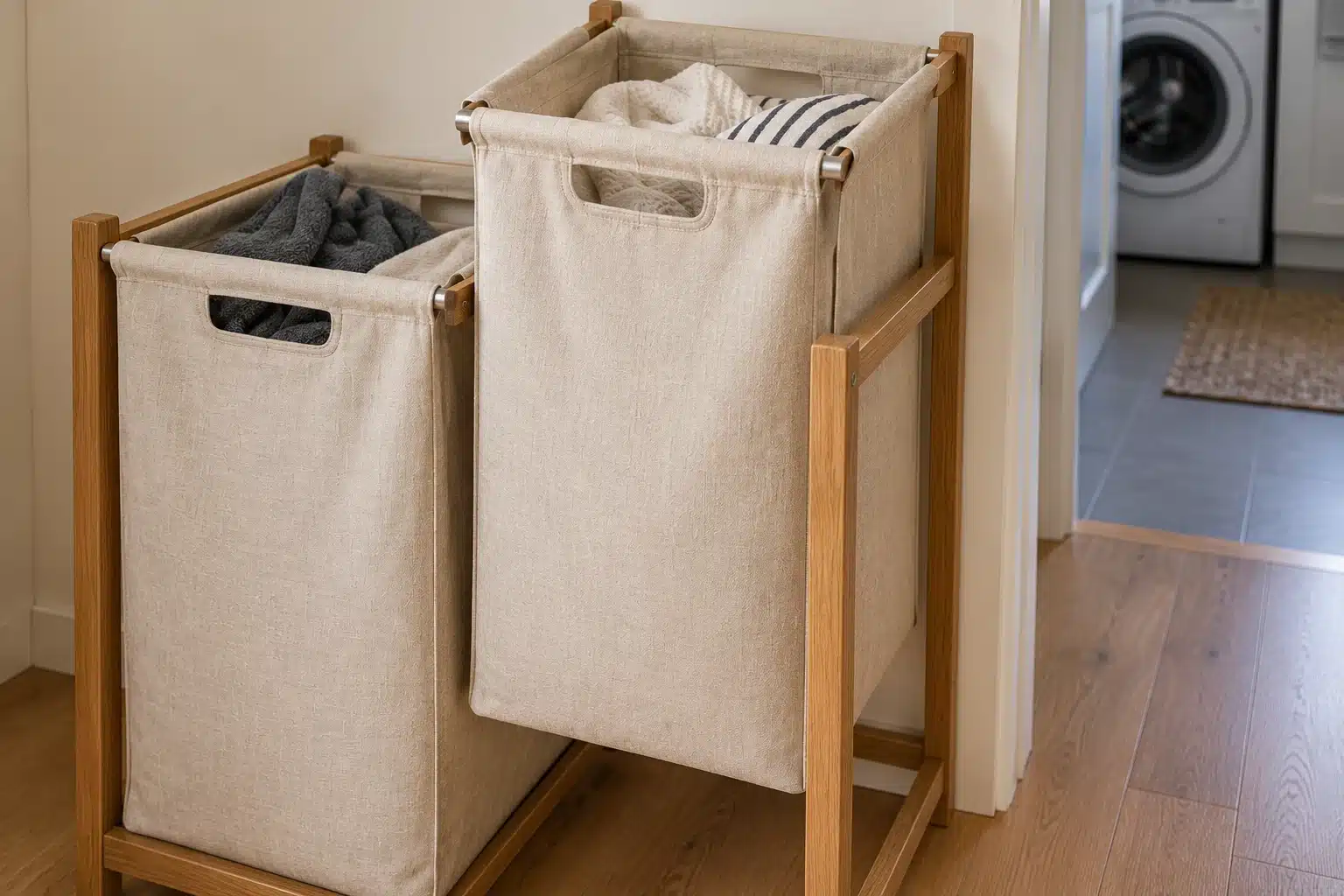
Choose the feature that releases space during your actual routine. Laundry basket storage for small spaces gains little from a folding model that always stays full. A removable liner helps only when you can lift and carry it comfortably. Compare the basket when occupied as well as when empty or collapsed.
4. Use capacity as a household planning tool
Observe one ordinary interval between wash days. Notice whether the collection container fills, overflows or stays half empty. Include towels and bedding if they normally share it. This is more useful than assuming every liter of advertised volume corresponds to a standard washer load. Different fabrics compress differently, and appliance loading depends on the machine and cycle instructions.
As a product-specific example, the IKEA SLIBB flexible basket lists 15 inches width, 11⅜ inches depth, 14⅛ inches height, 6 gallons volume and a 9-pound maximum load for this version. These figures describe separate constraints. A basket can be below its volume capacity yet exceed a stated weight limit with dense wet textiles.
Imagine a parking zone 18 inches wide and 15 inches deep. A hypothetical hamper 16 inches wide and 13 inches deep could fit when closed, but confirm its lid, handles and extraction movement. Adding a second identical hamper would require another suitable location; it would not fit simply because both are described as slim.
For a household washing every few days, a moderate hamper and a reusable carrying basket may be enough. For less frequent shared laundry-room trips, several manageable containers may suit transport better than one oversized load. Adjust capacity and frequency together. A hamper should not determine how much the washer is loaded.
Treat overflow as a question about the routine, not an automatic request for a bigger hamper. Laundry basket storage for small spaces may improve by washing one bulky category separately or shortening the collection interval. Stay within the basket and appliance instructions; advertised basket volume is not a washer loading instruction.
5. Park baskets where clothes naturally arrive
A bedroom hamper near the changing spot can prevent clothes collecting on a chair. Place it where it does not interfere with drawers, closet doors or the route from bed to door. Check the location with a full hamper. A narrow basket squeezed beside the dresser may be easy to ignore if adding clothes requires reaching behind furniture.
A bathroom collection point can be useful for garments removed before bathing, but it should not become a closed holding place for wet towels. Give damp items an appropriate drying position before ordinary collection, and deal promptly with items that need washing. A ventilated hamper does not make indefinitely damp fabric suitable for storage.
If the washer is in a hall closet, avoid treating the hallway as permanent basket parking. Keep the collection point in a room with usable space and bring the carrying basket when needed. A temporary loading position still needs to allow others to move through. The empty basket should have a destination after the load begins.
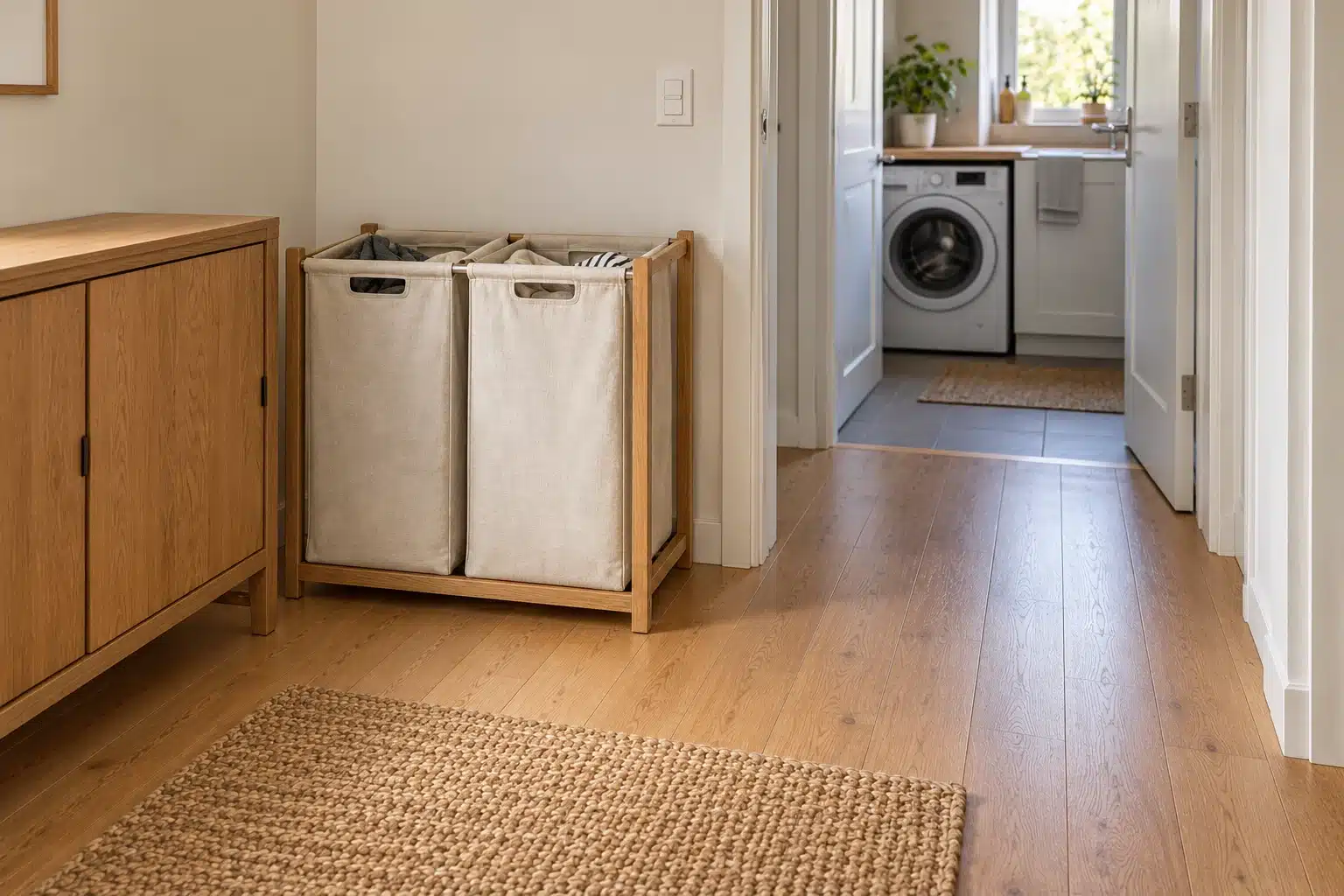
Check the collection spot with drawers and wardrobe doors open. Laundry basket storage for small spaces should be easy to use where clothes are removed, while preserving ordinary movement. If adding a shirt means pulling out furniture, change the parking position before adding a second hamper to the same awkward zone.
6. Make clean and dirty stages easy to tell apart
Choose a consistent distinction everyone understands: a labeled collection hamper, an empty transport basket cleaned as its instructions require, or separate clean and dirty containers where needed. The purpose is to avoid returning folded laundry to a visibly soiled container or mixing it with waiting garments. A decorative lid does not explain what is inside.
For two pre-sorted bins, use labels reflecting actual household instructions. “Check care label” can be a useful separate holding category for garments that do not belong in the usual cycle. Avoid assuming “lights” and “darks” covers every fabric treatment. A small wash bag can keep suitable delicate items together when their labels and washing method permit it.
Keep a missing-sock or repair area small and separate from routine collection. Otherwise the hamper becomes permanent storage for clothes that never enter a wash. When putting laundry away, return the empty carrier to its assigned place immediately. That final step prevents the basket itself from becoming another object on the bedroom floor.
Agree on what each label means to everyone using the system. Laundry basket storage for small spaces works better when the clean carrier has a consistent destination and dirty collection is identifiable. Keep repairs and care-label questions separate so the everyday hamper continues to represent laundry that is ready for the next step.
7. Check buying details and common limitations
- Confirm maximum outside width, including the rim and handles.
- Measure both assembled and folded dimensions for collapsible models.
- Check stated load guidance, especially for carrying wet textiles.
- Verify liner removal, grip and care instructions.
- Test wheels and thresholds if considering a rolling sorter.
- Check lid access and drawer travel in the parking location.
Look closely at the handle connection rather than judging only the material’s appearance. A filled liner needs a designed carrying method; drawing the opening tight does not automatically create a rated handle. Replace or stop using damaged handles as appropriate. Choose manageable loads rather than using the basket’s size as a carrying target.
Storage furniture that holds hampers brings its own requirements for mounting, stability and load. Follow those instructions and check rental permissions where needed. A pull-out unit must clear nearby doors and have a practical loading position. Do not attach a heavy basket to an ordinary cabinet door using hardware that was never designed for it.
The smallest footprint may be a poor choice if it creates constant overflow or makes the base difficult to clean. Conversely, a huge hamper can encourage delayed wash days and uncomfortable lifting. Treat overflow as evidence: perhaps the interval is too long, bulky towels need a separate routine, or the container is undersized. A second bin is only one possible response.
Save the maximum external dimensions and carrying guidance with your room notes. Before buying laundry basket storage for small spaces, compare handles, full liner removal and any folded-storage position. A unit that passes the parked fit but requires an awkward lift is a reason to trial a smaller manageable load or another design.
A basket worksheet and a shared-laundry transport example
| Record for your own room | Your notes |
|---|---|
| Where clothes are removed and normally collect | ________________________ |
| Usual interval between wash-day trips | ________________________ |
| Sorting method based on garment care instructions | ________________________ |
| Maximum outside rim, handle and lid-open dimensions | ________________________ |
| Filled carrying shape and comfortable manageable load | ________________________ |
| Bedroom doors, thresholds and any stairs on the route | ________________________ |
| Liner grip and product carrying guidance | ________________________ |
| Clean carrier and damp-item handling routine | ________________________ |
| Specific home for each empty basket | ________________________ |
Use the worksheet for the occupied container as well as its empty parking position. Laundry baskets often advertise volume, but the daily problem may be lid access or carrying shape. Record the ordinary wash interval and the actual transport route before deciding how many containers are needed. Include where the carrying basket returns after laundry is put away; that stage determines whether its footprint is temporary or permanent.
Consider a hypothetical household that carries laundry from a bedroom to a shared building facility. The collection hamper stays in the bedroom and washing happens every few days. The household already owns a carrying basket and wants to know whether a three-compartment sorter would help. They begin with one ordinary interval, noting which clothes accumulate and how they are sorted under their care instructions.
The observation shows that one bulky towel group fills quickly while the other planned compartments would remain nearly empty. A large sorting frame would occupy substantial room without making transport easier. The household compares a suitable separate towel routine with wash-day sorting from the existing hamper. They choose categories according to actual fabric treatment and wash patterns, not because laundry baskets happen to be sold in matching sets.
Next, they test the carrying basket along the whole journey while holding it normally. A narrow parked base does not establish a comfortable carry through the bedroom door. Hands and a filled container can increase the moving width, while stairs need a clear view of the steps. If a load is uncomfortable or exceeds the product guidance, divide it into manageable trips rather than treating the full basket as a target.
A removable liner is considered only if its grip, shape and carrying instructions suit that route. The household checks whether the liner can be lifted past the hamper rim without catching nearby furniture. Laundry baskets with a convenient collection opening may still need a separate transport method. The comparison includes the filled liner movement and how it is cleaned, not just how tidy the closed hamper looks beside the dresser.
On the return trip, clean laundry needs an identifiable carrier or an appropriate cleaned container according to its instructions. Give that carrier one destination near the putting-away task. A carrying basket that remains full in the hall creates a new storage problem, even if it collapses when empty. Finish a manageable batch and return the empty container before deciding that more laundry baskets are required.
For wet towels or garments, plan the appropriate drying or prompt washing step before ordinary enclosed collection. Do not depend on a decorative lid to make damp storage suitable. Keep the collection location away from clean clothing where moisture could transfer. If damp items repeatedly stall, fix that handoff rather than increasing hamper volume. The basket is a temporary holding tool, not a long-term answer for wet fabric.
Review the system after the next normal trip. If the hamper overflows, compare the wash interval, bulky-item routine and assigned capacity. If the route is awkward, compare the carrying basket shape and manageable weight. If empty laundry baskets have no home, assign one before buying extras. Choose the smallest complete system that handles the real sequence from changing clothes through sorting, transport, clean return and container storage.
Questions about laundry basket storage for small spaces
Do I need a three-compartment sorter?
Only if its categories match your regular washing and its full footprint fits. One collection hamper with wash-day sorting often uses less space. Test the routine before adding permanent compartments.
Can a basket be kept inside a closet?
Yes, if it fits the opening, is easy to use and suits the contents and location. Include clothes hanging above it and the removal route. Keep damp items from becoming trapped among clean garments.
Is a tall narrow hamper always best?
No. It may hold more within a small base, but the rim can be wider, the bottom difficult to reach and the filled load awkward. Measure the whole shape and consider a removable liner.
Where should the empty carrying basket go?
Assign it a specific shelf, nesting position or measured folded-storage gap. Confirm that it comes out easily and does not obstruct another task. The best spot is usually near its next use, provided that location is workable.