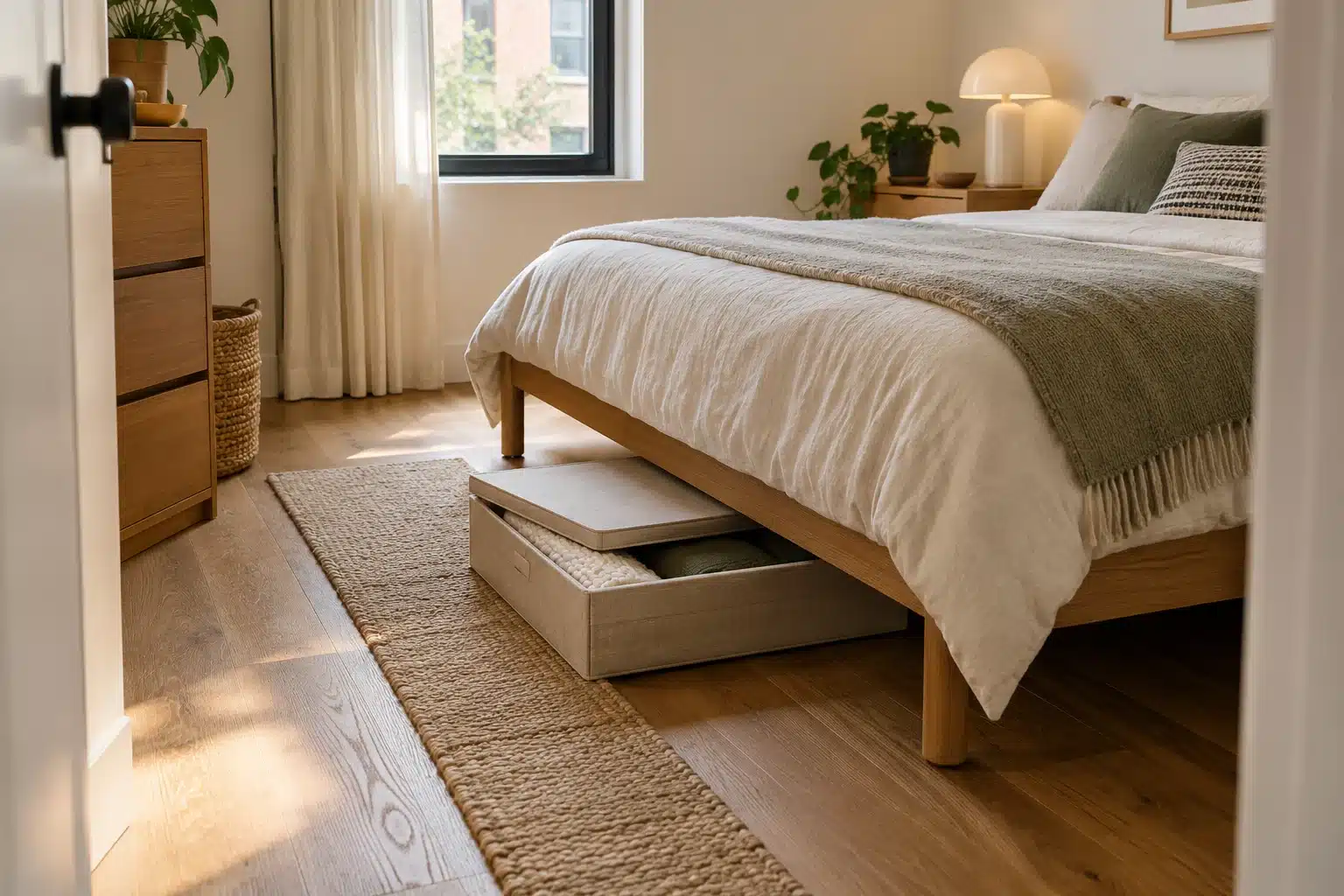
Under-bed storage for a small bedroom works when the container fits through the frame opening and comes out without moving other furniture. Measure that route before shopping, then choose a container for a particular group of belongings. A low box that you cannot reach is hidden clutter rather than useful extra storage.
This guide compares storage containers for the space beneath an existing bed. For the rest of the clothes zone, see our small bedroom storage guide without a closet. If you already have a closet, the small closet layout guide helps decide what should stay near everyday clothes.
In this guide
1. Measure under-bed storage for a small bedroom in three directions
First measure vertically from the actual floor surface to the lowest part of the insertion path. The side rail may hang below the slats. A center beam, bracket or leg may interrupt an otherwise generous opening. Measure several points, including the position where the container will eventually sit. A rug can also change the available height compared with bare floor on the opposite side.
Next measure each clear bay between supports. Do not treat the mattress size as the usable storage footprint: the frame, legs and center supports occupy some of it. Finally, measure the floor area beside the bed where the container will land. Include the bedside table, wardrobe doors and the space you need to stand or bend while opening it.
Write the dimensions as opening height, bay width, bay depth and extraction space. Sketch the bed supports as obstacles. Photographing the tape at the tightest point can help when comparing product listings, but record the number too. An overhead photograph alone will not show the low rail that catches a lid.
Keep a separate measurement for each accessible bay. Under-bed storage for a small bedroom can fail on the wall side even when the open side works. Mark the lowest point on the insertion route and the furniture that limits full extraction, so a product comparison uses the real bay rather than the mattress dimensions.
2. Match the container to access, not just capacity
| Container | Useful for | Check first |
|---|---|---|
| Low rigid box | Small garments or separated accessories | External lid and latch height; top-opening space |
| Zipped fabric case | Light folded bedding and seasonal textiles | Filled height; handle strength; care instructions |
| Wheeled tray | Items retrieved regularly | Height including wheels; floor compatibility |
| Frame-specific drawer | Integrated storage in a compatible bed | Exact frame model; drawer travel |
| Existing suitcase | Infrequent storage in a suitcase you already own | Wheels, handles and the open-lid footprint |
A zipped case often suits textiles better than assorted small objects because the contents support its shape. Rigid storage containers can hold dividers, but their lids may require complete extraction. A wheeled tray is easier to move only when its wheels suit the floor and its loaded height clears the frame. Avoid adding improvised wheels without considering stability and the change in dimensions.
Product names do not guarantee fit. For example, the IKEA SKUBB case specification lists this version at 35½ × 20¾ × 7½ inches. That identifies a specific case, not a standard clearance every bed provides. Read the product measurement section rather than confusing flat packaging dimensions with the assembled container.
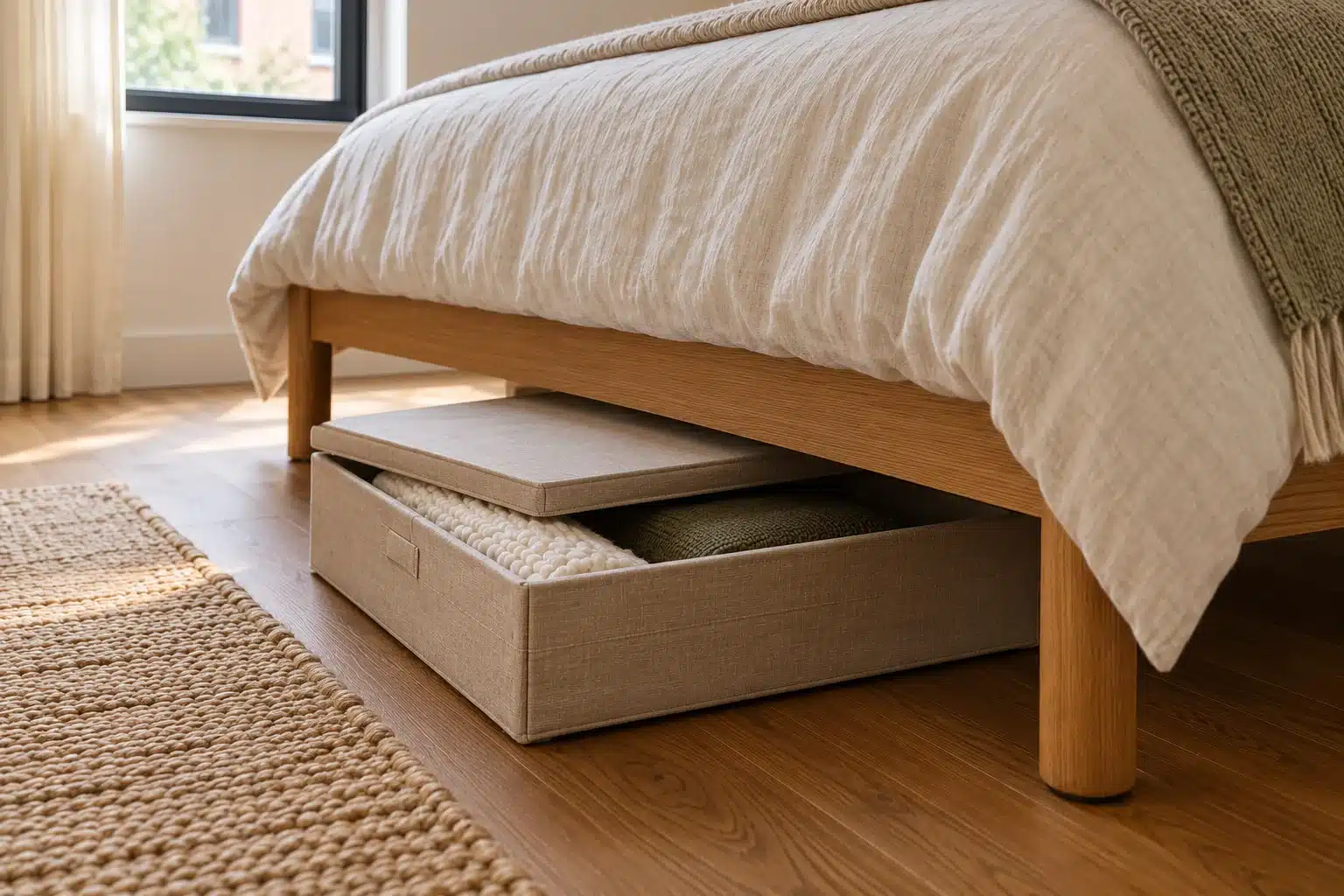
Choose the opening method before comparing capacity. For under-bed storage for a small bedroom, a front-opening case and a top-opening box need different retrieval motions. Use an existing empty container to rehearse that motion. Keep your hands clear of the frame and stop if the container catches rather than forcing it through.
3. Work through a realistic fit example
Imagine a bed with 8 inches of height beneath its side rail, a clear bay 30 inches wide and 25 inches deep, and 27 inches of free floor beside it. These are example measurements, not a recommended room standard. A hypothetical box 28 inches wide, 22 inches deep and 6 inches high may fit the bay and slide fully out. Its handle must still be accessible, and the lid must open where you retrieve it.
A 7½-inch-high fabric case looks possible by height alone, but the specific 35½-inch-wide version above would not fit this 30-inch bay in that orientation. Turning it may solve one dimension and fail another. Draw the footprint both ways before deciding. Neither forcing the case between legs nor removing bed supports is an acceptable fit adjustment.
Now imagine that a dresser reduces the pull-out space to 15 inches. The same box may store successfully yet fail daily use. A smaller container pulled out partway could work if its opening remains accessible; a hinged lid that stays trapped beneath the rail would not. Rehearse this with an empty existing box before ordering several matching storage containers.
Write a short fit result beside each candidate: fits the bay, clears the rail, opens outside the bed, and returns without moving furniture. Under-bed storage for a small bedroom is useful only when all four checks work with the intended contents. A failed opening check can rule out an otherwise plausible box before purchase.
4. Choose what belongs under the bed
Start with clean, completely dry, occasional textiles: spare sheets, a seasonal clothing capsule or guest bedding. Group storage containers by categories you can explain in a few words. If you need only a winter layer from a mixed case, you should not have to unload holiday decorations to reach it. Do not transfer damp garments directly from a drying rack into enclosed storage.
Everyday underwear can go here if bending and pulling are comfortable and reliable for you, but a reachable drawer is often easier. Heavy books and tools can create an awkward lift from floor level. Fragile items need protection appropriate to their material, and valuable documents may need a more suitable location. Under-bed space is not automatically dry or climate controlled.
Avoid using the bed as the only home for items needed in an emergency. Check the bed instructions, especially for adjustable mechanisms, powered components or a storage lift. Some beds need their underside left unobstructed. If the frame has no suitable storage bay, choose another location instead of changing the support arrangement.

Make a contents list before packing. Under-bed storage for a small bedroom works better when each case has a specific next use, such as guest sheets or off-season shirts. If an item is needed every morning, compare this low retrieval position with an existing reachable shelf before assigning it to the bed.
5. Make retrieval and cleaning part of the design
Put the handle toward the accessible side and label that end. A short label such as “guest sheets” is more useful than “miscellaneous.” Keep frequently used contents in the easiest bay. The far side against a wall can hold something occasional only if you can still retrieve and inspect it without a difficult furniture move.
Leave yourself a way to remove every container for cleaning. Sliding a loaded case repeatedly over grit can damage its base or the floor. Follow the container’s own cleaning guidance; the SKUBB example specifies vacuuming or a lint roller and says not to wash it. Other textile cases may have different care instructions, so a fabric appearance does not tell you whether machine washing is allowed.
At a seasonal change, remove one container at a time, inspect the contents and the floor, and return only items still needed. If you notice dampness or persistent mustiness, investigate the room condition before repacking. A different lid or fragrance does not correct a moisture problem. Keep this maintenance manageable by limiting the number of separate storage containers.
Trial the cleaning route with the container out and an ordinary cleaning tool in hand. Under-bed storage for a small bedroom should still let you inspect the floor and frame. If one case blocks another, reduce the number or change their orientation rather than accepting a bay you cannot maintain.
6. Check these details before buying a set
- Confirm external assembled dimensions, including wheels, hinges, latches and handles.
- Check whether a fabric case bulges above its nominal height when filled.
- Find out how the lid or zipper opens in the intended retrieval position.
- Confirm any stated load limit and whether the handle is intended for loaded carrying.
- Check floor contact materials and the manufacturer’s cleaning instructions.
- Read the return terms before buying multiple units.
Buy suitable storage containers one at a time if you cannot trial an equivalent shape. Fill it with the actual category, close it normally and use it for several retrievals. Do not judge fit while the case is empty. A duvet pushes against a lid differently from folded T-shirts, and a light demonstration does not establish a handle’s capacity.
Bed risers introduce a separate compatibility question. Check the bed and riser instructions, support points and rated capacity; do not stack loose objects beneath legs to make a box fit. Raising a bed also changes getting in and out of it and may affect other furniture. A lower container is often the simpler response to limited clearance.
Save the candidate dimensions and your trial notes together. Before buying several matching cases for under-bed storage for a small bedroom, check the first one filled, closed and in its normal retrieval position. Record any lid bulging, uncomfortable grip or floor snag so those problems are resolved before duplicating the setup.
7. Know when under-bed storage is the wrong option
If you cannot comfortably kneel, bend or pull at floor level, this space may be useful only for rare retrieval, or not at all. A helper-dependent arrangement should be deliberate. Moving daily clothes to an easier shelf can matter more than gaining theoretical capacity. Likewise, a bed against two walls may offer fewer accessible bays than its footprint suggests.
Do not calculate capacity by multiplying the whole bed footprint by its height and assuming it is usable volume. Bed supports, container walls and access reduce that number. The useful result is the set of containers you can actually retrieve. Storage succeeds when belongings have a workable home, even if part of the underside stays empty.
A deliberate empty bay is a valid result. If under-bed storage for a small bedroom requires awkward kneeling, disturbed supports or repeated furniture moves, use a reachable wardrobe zone instead. Compare the time and effort of retrieving one item, not simply how many liters a box is advertised to hold.
A bay-by-bay worksheet and a staged purchase example
| Record for your own room | Your notes |
|---|---|
| Bed model and underside instructions | ________________________ |
| Lowest obstruction along the insertion route | ________________________ |
| Clear bay width and depth between supports | ________________________ |
| Container external dimensions when loaded | ________________________ |
| Accessible handle and opening method | ________________________ |
| Full extraction footprint beside the bed | ________________________ |
| Clean, dry contents and next retrieval date | ________________________ |
| Floor contact and container care instructions | ________________________ |
| What changes when nearby drawers open | ________________________ |
Copy the fields into your notes for each accessible bay, using one measurement unit throughout. Keep the measurements for the wall side separate from the open side. Write “not checked” where a support or hidden obstruction prevents a reliable measurement rather than treating the uncertainty as extra capacity. The worksheet records your room; it does not supply a universal clearance or authorize changing a bed support.
Imagine a renter who already owns one shallow suitcase and wants to store spare sheets and occasional clothing. The budget priority is to use existing storage before buying a matching set of storage containers. The suitcase goes into the open-side bay only after its full external shape, including wheels and handles, is measured. A spare storage container with a rigid lid is trialed elsewhere to compare the retrieval motion.
First, the renter separates guest sheets from the seasonal clothing. Both groups are clean and completely dry, but they return to use at different times. Putting them in one mixed case would mean disturbing the entire contents to find a pillowcase. The trial starts with the sheets in the existing suitcase and the clothing in a suitable temporary container, without assuming that either arrangement is the final purchase.
Next, the renter rehearses retrieval with ordinary furniture still in position. The suitcase fits beneath the rail but its lid cannot open fully beside the dresser. That result changes the choice: a case with a different opening method may suit the bay better, or the sheets may belong in an existing cupboard. This is a handling failure, not a reason to move the bed permanently away from the wall.
The clothing trial reveals a different issue. A fabric storage container measures low enough when empty, but the filled top rises where bulky garments sit. The renter refolds the suitable clothes without excessive compression and closes the case normally. If the loaded shape still catches, the answer is a lower case or fewer appropriate contents, not forcing the zipper or compressing a delicate garment against its care needs.
Compare the candidates using the same contents and route. Note whether a handle is easy to grasp, whether the lid remains supported and whether the case returns without catching the floor or frame. Under-bed storage containers that work only when empty have not passed the trial. Keep any stated load and carrying instructions with the measurements, especially where a handle is intended only for pulling rather than lifting.
Make the purchase in stages. Keep the usable existing case, buy one suitable replacement only for the failed category, and repeat the loaded trial before ordering more. The cost comparison includes how many units are actually needed and whether the first candidate can be returned under the seller’s terms. There is no need to buy enough storage containers to fill every bay; use only those with clear contents and access.
After the next ordinary retrieval, review one specific problem at a time. A catching lid points to opening clearance, an uncomfortable lift points to weight or position, and a forgotten rear case points to identification or access. If inspection shows moisture or persistent mustiness, address the room condition before restocking. A successful under-bed storage arrangement leaves a repeatable route for both the contents and the cleaning tools.
Questions about under-bed storage for a small bedroom
Should boxes fit tightly against the rail?
No. Allow the practical room needed to slide the chosen container over your floor without catching. The amount depends on the frame, container and flooring; this guide does not prescribe a universal gap. Test the full route and loaded shape, not just a single tape measurement.
Can I store shoes under the bed?
Only after cleaning and drying them appropriately. Separate shoes from clean linens and use a container that suits their shape and care needs. A high ankle boot may need more height than a flat shoe, so measure the shoes in their intended position.
Do vacuum bags solve a low bed?
They can reduce the volume of suitable textiles when their care guidance permits compression, but they do not remove frame obstacles or guarantee a lasting packed height. Keep the sealed bag protected from snagging and choose a way to retrieve it. Avoid relying on compression for items that should not be stored that way.
How many containers should I use?
Choose storage containers that fit separate accessible bays and clear categories. Two easy cases can be more useful than six crowded ones. Start with the belongings that most clearly benefit from this location, then keep a plan for retrieval and cleaning.