Small bedroom storage without a closet works best when hanging clothes, folded clothes and occasional items each have a deliberate home. Start with the clothes you actually wear, choose one main storage wall, and leave space to open doors and drawers. Filling every spare corner with furniture can create more storage on paper while making the bedroom harder to live in.
This guide is for a room with no built-in closet. If you already have a small reach-in closet, our reach-in closet layout guide covers rods, shelves and the opening you can actually access.
In this guide
Measure small bedroom storage without a closet before buying
Draw a simple room outline showing the bed, doors, window and heating or ventilation features. Measure the wall you would use for clothes, but also mark the space occupied by an open wardrobe door or pulled-out drawer. Check that you can stand in front of the furniture and move between the bed and exit with the unit in use.
Use removable floor markers to test a candidate footprint without buying it. Include handles and overhanging garments on a rail. Carry a laundry basket along the ordinary route. A narrow gap that is acceptable beside a seldom-used shelf may be frustrating beside the wardrobe you open twice each day. There is no universal furniture width that suits every room or mobility need.
Count the storage your clothes need
Separate garments into hanging, folded and occasional groups. Measure the hanging length of long coats or dresses, and compare that with usable rail height. Give frequently worn clothes the most convenient positions. Identify luggage, spare bedding and off-season clothing separately, rather than assuming all of it must share the daily wardrobe.
| Furniture | Best role | Measure or check |
|---|---|---|
| Freestanding wardrobe | Enclosed hanging plus shelves | Internal depth, hanging length, doors and anchoring |
| Clothing rail | A limited hanging collection | Footprint with garments, rated load and stability |
| Dresser | Folded everyday clothes | Open drawer access and tip-over prevention |
| Under-bed containers | Occasional items | Clear height, bed supports and pull-out route |
| Existing shelf | Light folded overflow | Safe support and reach |
Use this comparison to choose a combination, not a shopping list. A wardrobe with useful drawers may remove the need for a separate dresser. A rail can work for a small clothing collection but does not protect contents from dust like an enclosed cabinet.
7 storage solutions for a bedroom without a closet
1. Choose one main clothes wall
Place the largest everyday storage piece where it can be used comfortably. Group compatible furniture along this zone rather than scattering wardrobes, baskets and rails around the bed. A single clothes wall simplifies returning laundry and makes it easier to judge how much capacity remains.
Sketch the daily return route to this wall. Small bedroom storage without a closet should give clean clothes an obvious destination without crossing an open drawer or moving a hamper. Test the main unit in use, not only its outline against the wall.
2. Use a wardrobe when enclosure matters
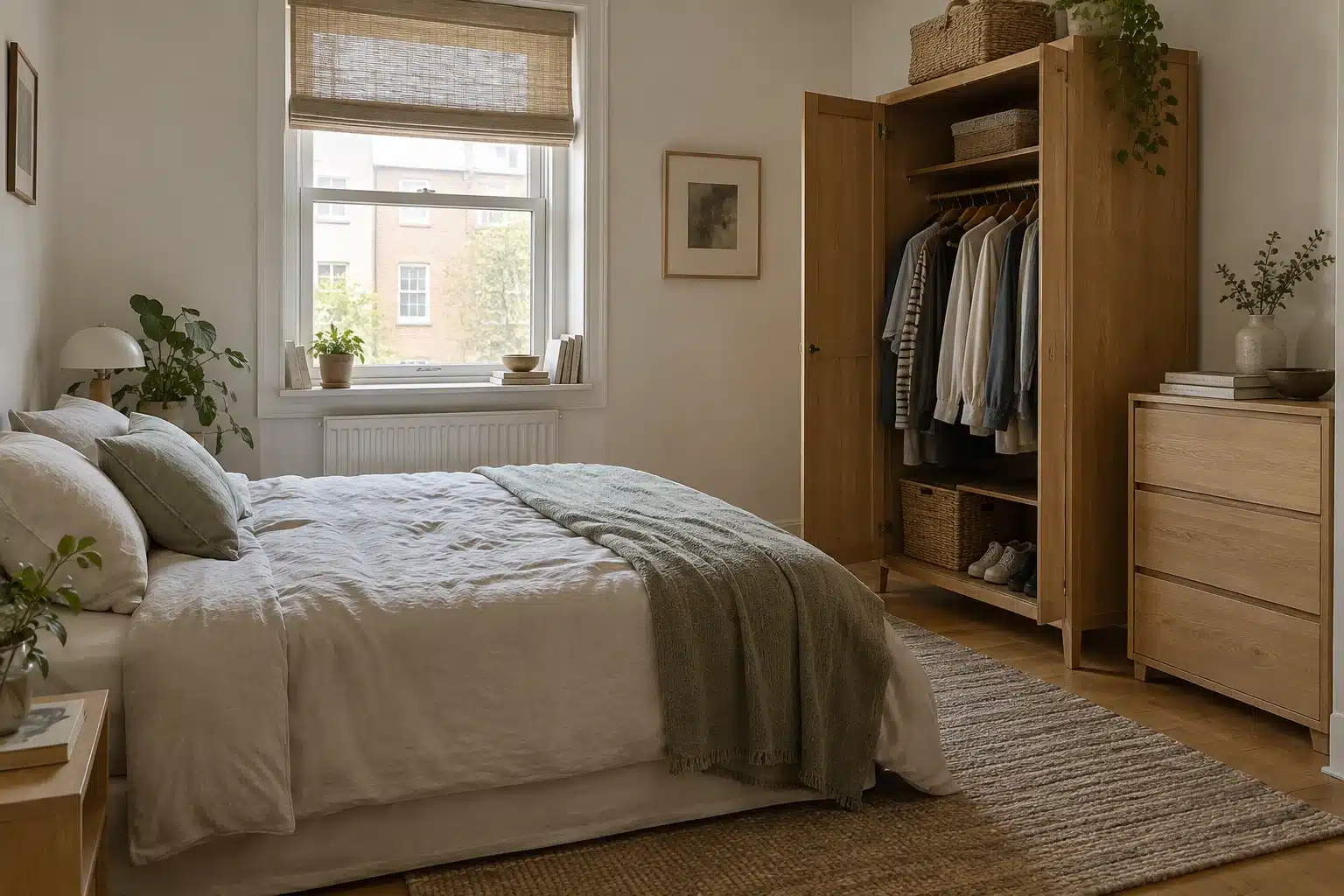
Look at internal fittings before the exterior photograph. Check hanging depth, shelf spacing and whether the door can open beside the bed. Adjustable fittings may help accommodate different garment lengths. Follow the manufacturer’s assembly and anchoring instructions; rental restrictions are a reason to discuss installation with the owner, not to omit required safety hardware.
Compare the internal hanging length with your longest garment. Small bedroom storage without a closet needs a workable clothes arrangement inside the unit as well as a fitting exterior. Keep the assembly and restraint requirements with your notes before committing to a particular wardrobe.
3. Keep an open rail deliberately small
A rail suits frequently worn hanging garments when an enclosed unit is not practical. Load it within its rated capacity, distribute weight appropriately and leave it on a stable surface. Keep the collection limited; hanging a second row of clothes over the frame can obstruct the path and make the unit unstable. Open storage also needs more regular dust attention.
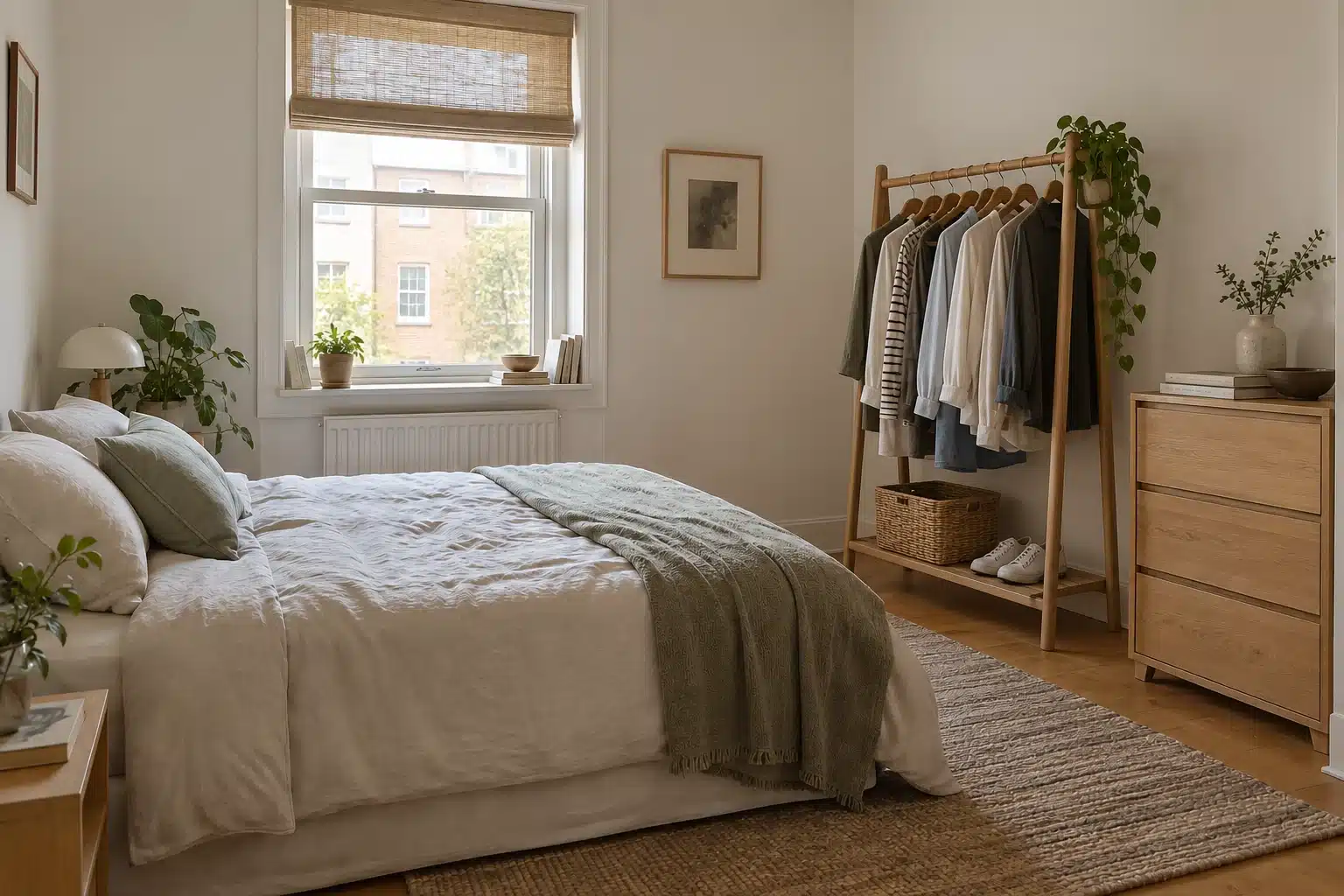
Trial the filled rail footprint with actual hangers and garments. Small bedroom storage without a closet can lose its walking route through projecting sleeves even when the empty frame looks narrow. Choose a manageable collection and a separate home for folded items.
4. Organize a dresser by use frequency
Put everyday socks, underwear and shirts in the easiest drawers to reach. Fold to the drawer’s usable height, and use dividers only if garments otherwise collapse into each other. A drawer full of empty organizers wastes space. Leave enough room to return clean items without compressing the whole stack.
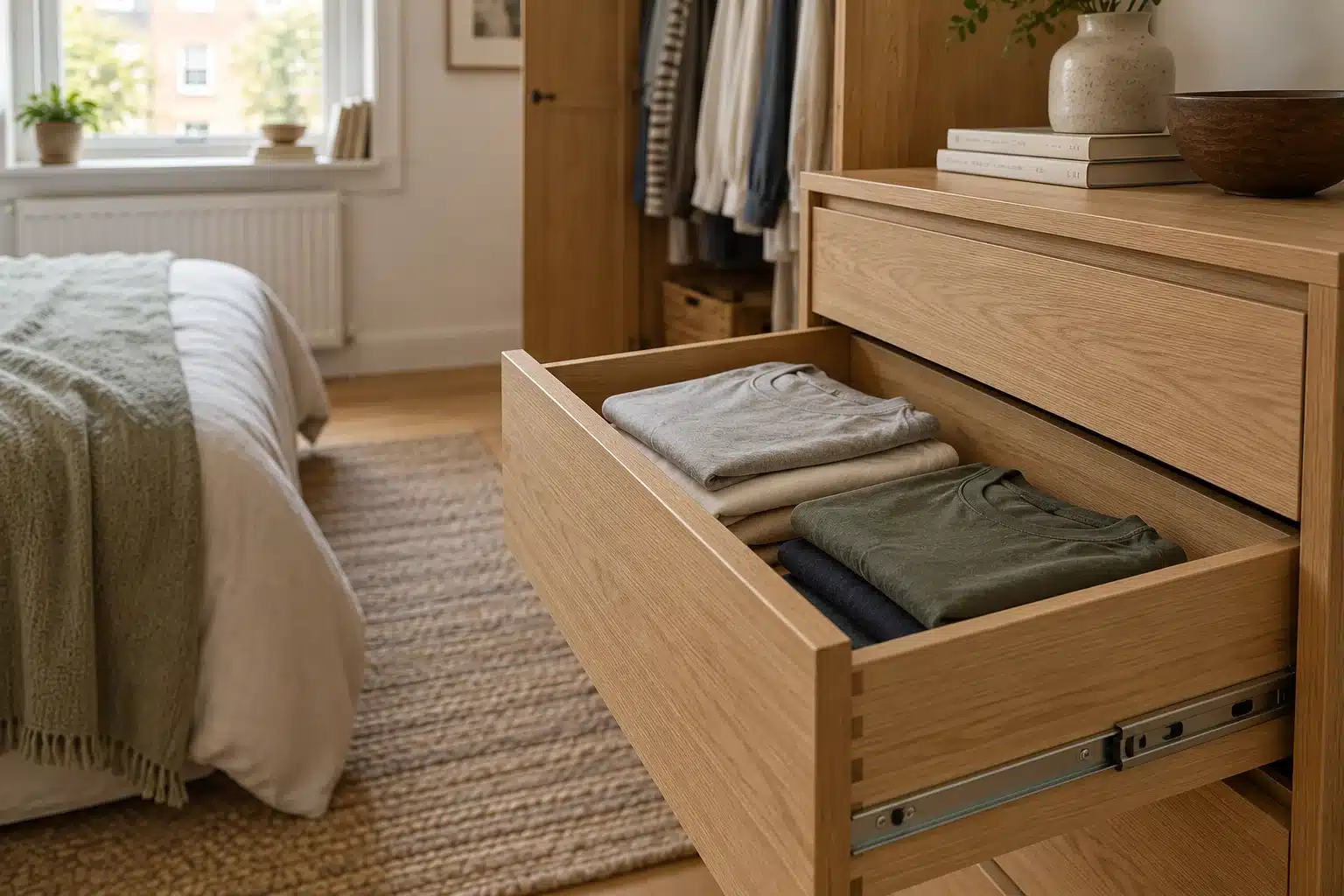
Check the drawers after all ordinary laundry returns. Small bedroom storage without a closet is harder to maintain if the dresser fits only while half the clothes are being washed. Leave practical handling room and move suitable occasional items to their assigned secondary zone.
5. Reserve under-bed space for less frequent access
Measure beneath the lowest bed-frame component, not just beside the visible leg. Check support legs and whether a container can actually slide out. Store suitable occasional textiles or other items rather than daily clothes if retrieval is awkward. Keep contents dry and follow the needs of the material; do not trap damp laundry in sealed storage.
Record which case belongs in each reachable bay. Small bedroom storage without a closet benefits from occasional storage only when you can identify, retrieve and inspect it. Keep everyday clothes in a more convenient position if low-level access is awkward.
6. Give worn-again clothes a small, defined position
A single suitable hook, short rail section or other appropriate location can stop a chair becoming an unlimited clothing pile. Keep this temporary zone distinct from clean storage and laundry. If it constantly overflows, reduce the number of items kept there or change the routine rather than adding another chair.
Set a boundary everyone can recognize, such as one suitable hook or one short section of rail. Small bedroom storage without a closet needs this temporary stage to stay distinct from clean clothing and the laundry hamper, with a clear next destination for each item.
7. Move luggage and seasonal overflow out of the daily zone
Use a less frequently accessed household location where conditions suit the contents. Keep one labeled category per container so you can retrieve an item without emptying the entire room. If the bedroom is the only available space, give occasional items the higher or less convenient locations while preserving the easiest reach for everyday clothing.
Write the next use on each occasional category label. Small bedroom storage without a closet becomes easier to review when guest bedding, travel luggage and seasonal clothes have separate purposes. Choose locations according to suitable conditions and retrievability rather than filling every high surface.
Three combinations to compare
Wardrobe only: useful when an enclosed unit can hold both hanging and folded clothes, and its doors have room to operate. This can keep the floor plan simpler than several separate pieces. Check that shelves or drawers inside are genuinely usable rather than counting the empty cabinet volume.
Rail plus dresser: useful when you own a modest hanging collection and many folded items. Mark the full garment projection and dresser drawer route together. These two pieces need not sit side by side if that blocks circulation, but they should form a clear, practical daily zone.
Dresser plus occasional storage: useful when most clothes are folded and only a few items need hanging elsewhere. Under-bed space can carry the seasonal load if access and conditions permit. Do not choose this arrangement simply to avoid dealing with long garments that have no suitable home.
A no-purchase trial before committing
- Count hanging versus folded garments.
- Choose a storage wall and mark candidate furniture footprints.
- Simulate doors and drawers in their open positions.
- Carry laundry to the zone and walk the bedroom route.
- Allocate a temporary worn-again and laundry position.
- Only then compare actual product dimensions and installation needs.
Keep the trial specific. If the rail obstructs the route, a shorter rail or different position may solve it. If hanging clothes do not fit, substituting another dresser will not. If there is nowhere to stand while a drawer is open, its closed depth understates the real space requirement.
Safety and upkeep that should not be skipped
Dressers and wardrobes can tip, particularly when drawers are opened or children climb. The CPSC’s Anchor It guidance explains why securing appropriate furniture matters. Follow the product’s specific anchoring instructions and use suitable fixings for the wall; do not invent an adhesive-only substitute for an anti-tip kit.
Keep doors, windows used for required escape, vents and heating clearances usable. Avoid stacking heavy containers on top of tall furniture just to increase capacity. Maintenance should be easy: return clean laundry to the same zone, check seasonal contents periodically, and remove organizers that make retrieval harder.
A room worksheet and a renter’s rail-and-dresser comparison
| Record for your own room | Your notes |
|---|---|
| Bed, door, window and required access positions | ________________________ |
| Candidate main clothes wall and furniture footprint | ________________________ |
| Longest hanging garment and widest hanger | ________________________ |
| Folded clothes including the normal laundry return | ________________________ |
| Wardrobe door or dresser drawer open position | ________________________ |
| Clothing rail projection with actual garments | ________________________ |
| Furniture restraints and suitable installation instructions | ________________________ |
| Laundry and worn-again clothing locations | ________________________ |
| Occasional contents and their retrieval method | ________________________ |
Use the worksheet to compare complete arrangements, keeping one unit for measurements. Do not treat the closed depth of a dresser or wardrobe as its whole working footprint. Include your standing position, the ordinary laundry route and any movement needed to retrieve under-bed cases. Keep unresolved wall or furniture installation questions in the notes so they are addressed before a product is chosen.
Imagine a renter starting with an existing dresser, a limited hanging collection and no built-in wardrobe. The initial budget is directed toward the function that is actually missing. They already have a workable home for most folded clothes, but long garments are draped over a chair. The first comparison is an appropriate clothing rail or suitable enclosed wardrobe, not a second dresser that repeats the function already available.
The renter counts the everyday hanging items, including anything temporarily being worn or washed. They measure the longest garment on its ordinary hanger and the full projection of garments on a trial rail. A clothing rail frame that looks narrow when empty can occupy more depth once sleeves and hangers extend beyond it. The trial uses that loaded outline and preserves the bed-to-door route.
Next, they assess the dresser with its ordinary drawers fully open. Folded clothes need enough handling room to return after laundry, and the user needs a practical position in front. If the rail and open drawer compete for the same patch of floor, the renter tests different locations before adding furniture. Matching pieces are optional; the clothes wall should make selection and return straightforward rather than impose a single visual arrangement.
The clothing rail appears to solve hanging access, but it is open storage. That means the renter needs an appropriate plan for dust attention and a modest collection that stays within the product guidance. They compare those limits with an enclosed wardrobe whose interior fits the garments. The wardrobe also needs door movement, suitable assembly and required restraint installation. Neither option is selected from its exterior photograph alone.
For a renter, obtain any required permission and establish suitable fixing conditions before buying furniture that requires wall restraints or attachment. Rental restrictions do not make required anti-tip hardware optional. If the chosen unit cannot be installed as instructed, compare another suitable arrangement and discuss the unresolved requirement with the owner. Keep that decision separate from the appearance of the clothing rail or storage containers.
The existing dresser is then checked after a normal laundry cycle. Folded clothes that seemed to fit during the first trial overflow when washed items return. The renter identifies a small occasional category that can move to an appropriate secondary location. They do not compress every drawer until it binds, and they do not buy dividers before confirming how much usable space the actual category requires.
Under-bed storage is trialed only for the occasional group. The case must clear the bed supports and come out without moving the dresser. It holds clean, completely dry contents with a clear label and future use. If floor-level access is awkward, an existing appropriate shelf may be better. The room does not need to exploit every low gap in order to have a complete clothes-storage plan.
Worn-again clothes receive a small separate position, while the hamper remains identifiable as laundry. The clothing rail should not silently become both clean storage and a second dirty collection zone. Agree on a simple rule for items returning there, guided by the household routine and garment care. Keep the temporary position limited so the chair does not become an alternative wardrobe when the rail fills.
Finish the comparison with the complete route: select clothing, change, collect laundry, return folded clothes and retrieve occasional belongings. Try each movement with the furniture outlines still marked. If one arrangement gains hanging space but blocks the open dresser, revise it before delivery. The better budget choice is the smallest set of suitable pieces that supplies the missing functions and can be used as intended.
After the next ordinary week, note whether the remaining problem is capacity, access or an unfinished routine. Too many garments on the clothing rail suggests reviewing allocation or available hanging capacity. Folded clothes left in a basket may indicate that the dresser has no easy return space. Frequent furniture moves point to a layout problem. Adjust the specific cause before adding another storage unit to an already crowded bedroom.
Keep a simple purchase record with the missing function, candidate dimensions, installation requirements and trial result. Include any suitable furniture already owned. A rail plus dresser can be practical, but buying two new pieces is unnecessary when one existing unit handles folded clothes well. Compare the complete working arrangement and any required setup, rather than judging value from a low price attached to furniture that cannot fit or be installed as instructed.
Questions about small bedroom storage without a closet
Is a clothing rail enough on its own?
Sometimes, for a limited hanging collection with another suitable home for folded items. Check the rated load and the amount of space clothes occupy. If folded clothing and bedding have no home, the rail only solves one part of the problem.
Are sliding wardrobes always better in a small room?
They avoid the outward sweep of hinged doors, but only part of the interior is accessible at a time. Check opening width, drawer clearance inside and the furniture’s actual depth. The better option depends on the room and the items you need to retrieve.
Should I buy a storage bed first?
Only if it fits the room and improves the way you use storage. Built-in drawers need opening space, and lift-up systems have their own operating and safety instructions. First check whether inexpensive containers under the existing bed would solve the occasional-storage problem.
How do I keep open clothes storage looking calm?
Limit the visible zone to clothes that belong there, keep spare items in their designated location and avoid filling the rail beyond a useful capacity. You do not need matching hangers or color-coordinated garments to make the arrangement work.
Related small-space guides
Plan an existing reach-in closet or find shoe storage without an entry closet. For the wider room, our cozy small-apartment guide helps keep additional storage from overwhelming the space.