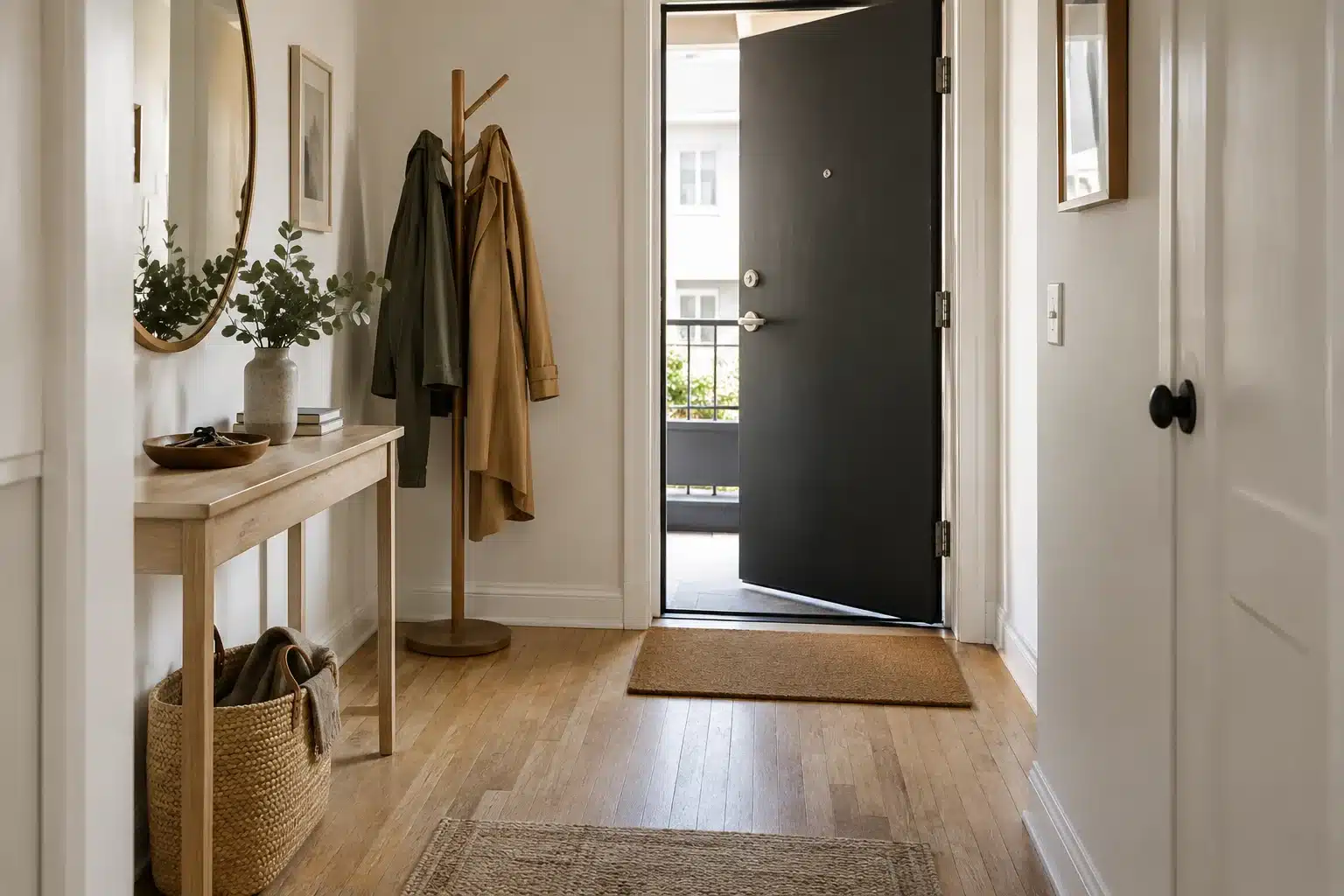
Small apartment entryway storage should make arriving and leaving easier: somewhere for keys, a usable home for everyday bags and coats, and a clear route through the door. Start with the items that pass through the entrance daily. A beautiful console that collects unopened mail and rarely used accessories is not doing the job.
This guide focuses on coats, bags and the landing zone. Footwear needs its own fit and wet-weather plan, so use our separate shoe storage guide for small apartments rather than squeezing an entire household’s shoes into every entryway idea.
In this guide
Plan small apartment entryway storage around daily arrivals
For a few ordinary days, notice what you carry in: keys, work bag, coat, parcels, mail and perhaps a pet lead. Separate everyday items from things that only occasionally pass through. The entrance needs a convenient home for the first group and a short-lived landing position for the second, not permanent storage for both.
Count realistic quantities. A single person’s current coat needs less space than a shared household’s coats and bags. Keep seasonal duplicates in another suitable location if possible. This avoids choosing a large cabinet to contain belongings that do not need to live at the door at all.
Measure the entrance with everything open
Open the front door fully, then any nearby cupboard or room door. Mark the sweep and the route used while carrying shopping. Include console handles, baskets, coat-stand feet and garments projecting from hooks. A shallow furniture listing can be misleading when the coat above it sticks far into the path.
Try a footprint before buying. Make sure the door operates freely, the lock and handles remain accessible, and you can enter without moving furniture. Do not compromise a required exit route to fit storage. In an apartment without a separate hallway, a tiny landing zone against a living-room wall may be more useful than trying to invent a full entrance room.
Compare the options for a narrow landing zone
| Option | Useful for | Check before choosing |
|---|---|---|
| Shallow console | Keys and a small bag location | Legs, handles and usable walkway |
| Suitable wall hooks | Current coats and light bags | Mounting method, load and garment projection |
| Freestanding coat stand | Flexible coat position | Base width, balance and full door sweep |
| Small cabinet | Concealed everyday items | Open doors, anchoring and access |
| Existing shelf or drawer | Minimal landing zone | Whether it is convenient enough to use daily |
Choose one or two complementary pieces for small apartment entryway storage, not one of every type. A small cabinet with a usable top may replace a console. A nearby existing drawer might remove the need for another surface altogether. The smallest workable arrangement is usually easiest to keep clear.
7 small apartment entryway storage ideas
1. Give keys a single obvious destination
Use a shallow tray, small drawer or suitable hook in a consistent position. The container only needs to hold the keys and other truly essential small items. Avoid turning it into storage for batteries, receipts and unrelated objects. Place it where it is convenient for you without leaving valuables unnecessarily exposed to an open doorway or outside view.
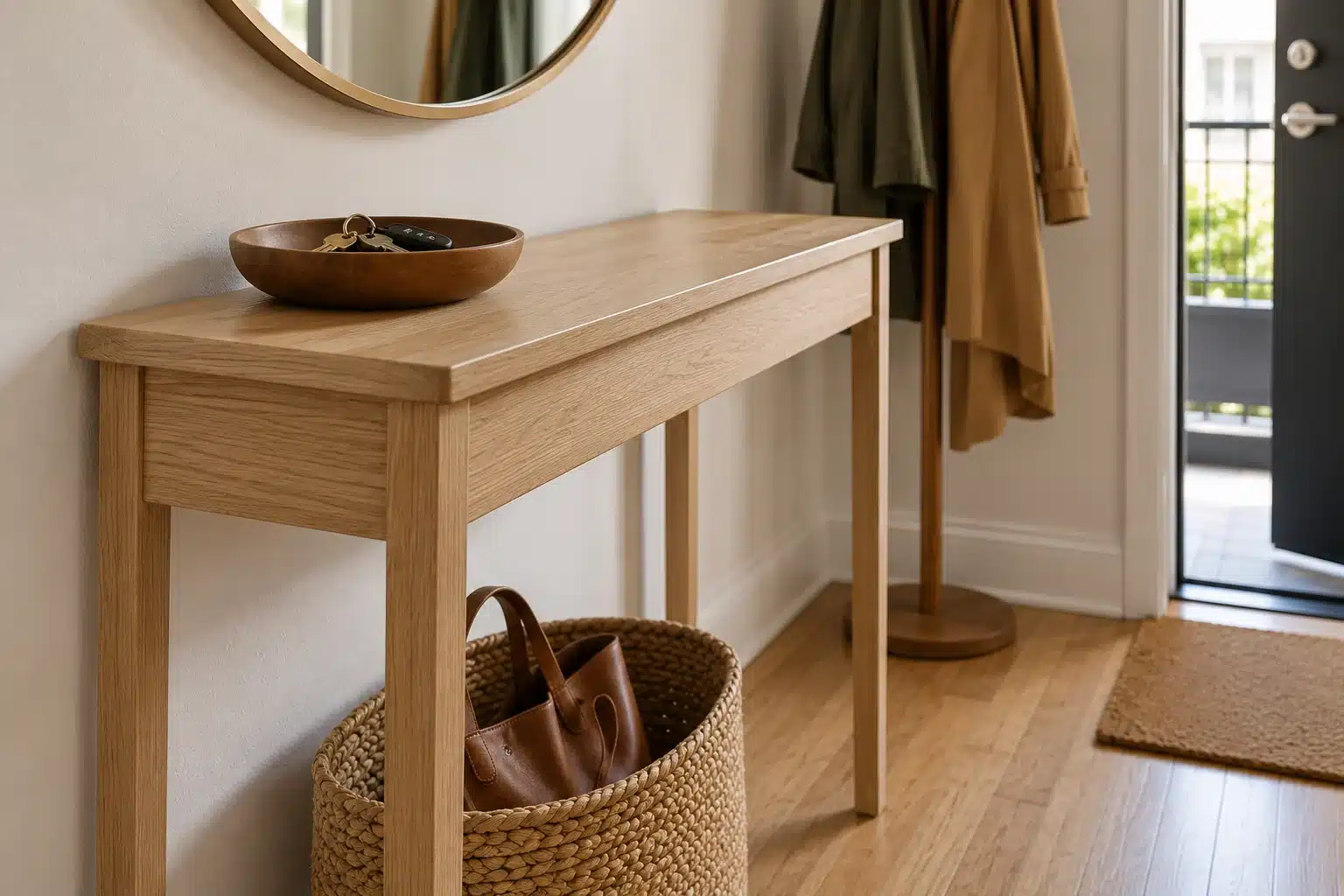
2. Choose a slim console only if it earns the space
Look for a useful surface and a sensible location below for one basket or bag. Check the real depth including projections. If the tabletop is needed for mail, define a limited paper position and a routine for removing it. A console should not become a permanent stopping point for items whose real home is elsewhere.
3. Limit coats to the current working set
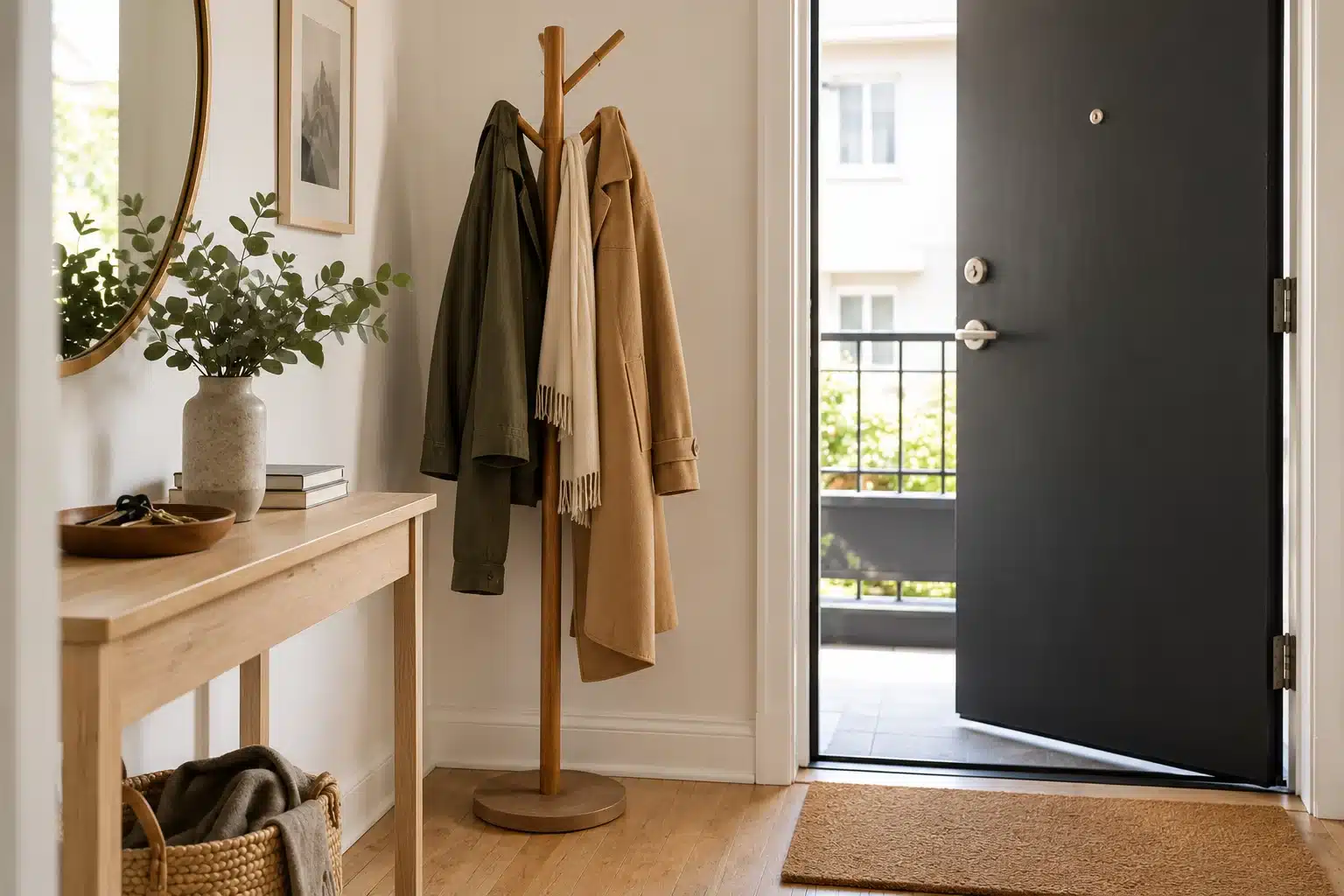
Keep the coats being worn now at the entrance and store occasional or seasonal pieces elsewhere where conditions suit them. Hang garments so they do not trail into the walking route or rest against a wet floor. A crowded row of coats can occupy more space than the bare hook rail suggests.
4. Use a coat stand when the footprint works
Check its base and balance under an ordinary load, following the product instructions. Distribute garments appropriately and avoid using one side as a heavy bag hook unless intended for that load. Freestanding does not automatically mean narrow or stable. Place it clear of the door sweep, not in the attractive empty corner the door actually occupies when open.
5. Give each everyday bag a realistic home
A basket beneath a console, an appropriate hook or a cabinet compartment can work. Measure the actual work bag or backpack while filled, not only when empty. Avoid placing a heavy bag on a light decorative hook. If the bag is used daily, choose a location that does not require moving a bench or unpacking a stack to retrieve it.
6. Make parcels temporary
Define a small parcel landing spot outside the route, then move deliveries to their final destination after opening. An entrance should not have to hold a week’s cardboard permanently. If deliveries are frequent, include their typical dimensions in the trial rather than judging the storage arrangement on a day when the floor is empty.
7. Use nearby furniture when there is no hallway
A drawer in an existing living-room cabinet and one appropriate coat position may be enough. Keep the landing zone logically close to the entrance without forcing new furniture beside the door. This works particularly well when the apparent entryway is really the narrow end of a studio’s living area.
Small apartment entryway storage: an easy arrival routine
Try the arrangement with ordinary groceries and a work bag, not just empty hands. Put keys in their chosen location, hang the current coat, place the bag in its home and move shopping onward to the kitchen. When leaving, you should be able to collect essentials without rummaging through papers or unpacking a basket.
- Return everyday keys to the same position.
- Hang only the coats currently needed.
- Place the everyday bag without blocking the route.
- Move parcels and shopping to their proper destination.
- Remove mail from the landing surface on a regular schedule.
- Recheck door clearance when seasonal coats change.
If small apartment entryway storage keeps overflowing, identify which item lacks a workable home. A bag that never fits the basket needs a different basket or location; it does not mean the whole entrance needs replacing. Mail that accumulates needs a processing routine, not necessarily a deeper console.
Common entryway mistakes
Buying seating before checking the space to use it can create a bench that no one can sit on without blocking the door. Adding a tall mirror, lamp and several decorative baskets may consume the useful surface for keys and bags. Start with function, then add only the decor that does not interfere with it.
Mount hooks and furniture according to their instructions. Ask about rental permissions when needed, and do not assume a removable adhesive works on every paint finish or can carry a heavy backpack. For cabinets that require securing, follow the manufacturer’s anchoring guidance and the CPSC’s tip-over prevention advice.
Trial small apartment entryway storage with the actual coat, filled bag and shoes you bring home. Open the door, enter with groceries and place each object in its intended home. Keep the parcel landing position empty for the first run, then repeat with a typical delivery there. This reveals whether the plan works only on an unusually quiet day.
Write one destination beside every everyday item. Use a separate note for objects that leave the entrance after arrival, such as groceries and opened parcels. If two people share the zone, check that one person can retrieve a bag without first moving the other person’s coat. Adjust the single troublesome destination before adding another piece of furniture.
A worked landing zone for a door opening into the living room
Imagine a front door opening directly beside the sofa, with no separate hallway. Two residents bring home a work bag, current coat, keys and shopping. Begin with the door fully open and mark its sweep. Trace the route from the entrance toward the kitchen while carrying a bag. The remaining space is the starting point for entryway storage. Do not assume the wall behind the open door can take a console or coats just because it looks empty with the door closed.
Try a nearby existing cabinet for small essentials before adding furniture. Assign one drawer to keys and current departure items. Put a shallow temporary tray in that drawer and check that both residents can retrieve their keys without moving papers. The top might briefly hold a bag while shopping continues to the kitchen. That does not mean the surface must become permanent bag storage. Give the bag a separate accessible home that fits its filled dimensions and the weight of its normal contents.
Next plan coat storage. Count the coats in current use and hold them in the proposed hanging position with a suitable existing support where possible. Notice the projection of sleeves and the space occupied by bags if they share that location. A bare hook line can look slim while loaded coat storage crowds the route. Keep rarely used garments in another appropriate existing location. If a suitable mounting method is unavailable, compare a purpose-designed freestanding option using its complete loaded footprint and installation instructions.
Rehearse the arrival together. One resident opens the door carrying shopping; the other retrieves a coat and bag. Put a typical parcel in the proposed landing zone and repeat. If the parcel removes the only bag destination, define another temporary delivery position or shorten the time parcels stay there. Entryway storage needs to support the day with ordinary objects present. A photo showing an empty console cannot reveal a conflict between an arriving person, an open door and a loaded coat position.
Make a measurable entryway storage shortlist
For each candidate console or cabinet, write external width and depth, handles and legs, internal storage dimensions and the opening movement. Suppose a hypothetical 25 cm deep console has a handle projecting another 3 cm and a basket below extending 5 cm beyond the frame. The loaded footprint reaches 30 cm at the basket, rather than the 25 cm in the listing. Compare the largest projection with your marked entrance route. These figures demonstrate what to add; they are not a suggested console depth for every apartment.
Compare that unit with the existing-furniture landing zone. List which extra job the new unit performs: storing a filled bag, holding a current paper tray or offering a useful drawer. If it repeats the job of a reachable existing drawer, the purchase may simply create another surface to clear. If it resolves a specific missing home, test that home with the actual item. A filled backpack needs different entryway storage from a flat tote and may not pass through a narrow cabinet door even when it fits inside.
Include retrieval effort in the shortlist. Open the drawer, lift the basket and remove the bag as you normally would. Try the action while wearing your coat and holding the keys. If two people use the landing zone, check whose belongings need moving first. Consider separate small compartments or defined sections where they simplify access. Equal-looking storage does not necessarily work equally for differently sized bags. Plan according to the objects and users rather than arranging identical baskets solely for appearance.
Treat coat storage as a loaded arrangement throughout the comparison. Check the coat stand base, the intended hanging distribution and the garment projection. Include wet outerwear handling according to its care needs rather than squeezing it against clean bags. Follow the product instructions for loads and installation. Where walls belong to a landlord, clarify an appropriate fitting before buying a mounted solution. Entryway storage that depends on an unavailable fixing does not become workable because the rest of the footprint fits.
After choosing, observe the landing zone for several ordinary arrivals. Note the item that repeatedly stops in the wrong place. Move its home or simplify its opening before adding another container. If mail accumulates, decide when it is processed and where current papers wait; a deeper console only delays that decision. If bags overflow, measure them again while filled. Keep coat storage limited to the useful current set. A precise correction to one destination can preserve the entrance without reorganizing every storage area in the apartment.
A short reset for a shared entrance
Agree what stays in the landing zone and what moves onward after arrival. Keys and a current bag may stay; groceries and opened packaging move to their appropriate destinations. Set a modest parcel position that remains clear of the route and check it after deliveries. Before leaving, confirm the everyday essentials are easy to retrieve without opening someone else’s container. This shared routine gives entryway storage a practical boundary while allowing the entrance to remain part of the living space rather than expanding into a general-purpose cupboard.
Separate current papers from the everyday bag and coat homes
If the landing zone collects mail, make a small current-paper destination rather than treating the whole console top as a paper area. Decide which papers need an action and which move to their final location. Use a container that allows its contents to be seen and reviewed. Keep keys and the everyday bag out of that paper group so finding departure essentials does not require sorting correspondence.
A useful entryway storage review follows one arrival rather than emptying the whole entrance. Watch where the bag lands, where the coat goes and what happens to shopping. Ask whether the bag’s assigned home fits it while filled and whether coat storage is reachable without crossing the door sweep. When one item fails the sequence, change that destination. Several new baskets will not fix a door conflict or a bag that cannot pass through a cabinet opening.
For a shared landing zone, keep the allocation legible without making every position identical. One resident may need a larger bag section while the other needs space for a current sports kit. Discuss the ordinary loaded objects and who retrieves them at the same time. Mark the destinations in a way the household can remember. Recheck the setup when those objects change, such as when a new work bag is larger than the previous one.
Questions about small apartment entryway storage
What if there is no entryway at all?
Create a compact landing zone using existing furniture near the entrance. One drawer for small essentials and one suitable coat position may be enough. Do not add a console simply because a conventional entryway photograph includes one.
How shallow should an entry console be?
There is no universal depth. Measure the remaining walkway and door movement with the console’s handles, legs and contents included. A unit is too deep for your entrance if it makes normal arrival or door operation awkward.
Are wall hooks always better than a coat stand?
Hooks can save floor space, but they need appropriate mounting and still have projecting garments. A stand avoids wall installation only if the product is designed for safe freestanding use and its base fits outside the route. Compare both in use, not empty.
Should all shoes stay at the front door?
Only the working footwear set needs immediate access. Our separate shoe guide helps compare dry backups, wet footwear and different storage positions. Keeping every pair in a tiny entrance can undermine an otherwise useful landing zone.
Related storage planning
See small-apartment shoe storage and cozy apartment ideas without clutter. Browse IKEA’s hallway planning examples for additional configurations, then verify the footprint and installation instructions for the actual products.