By Owen Bennett · Little Room Lab editorial team
Small kitchen ideas work best when they give you somewhere useful to prepare dinner, not simply somewhere else to put things. When a kettle, drying rack, and chopping board compete for the same patch of countertop, the first question is practical: what needs this surface now, and what could live elsewhere?
These 17 small kitchen ideas address kitchens with little or no usable counter space. Some reclaim the surface you already have; others add a temporary workstation or change the order of preparation. You do not need to install every solution. Choose the one that removes your biggest daily interruption, then check the fit before buying.
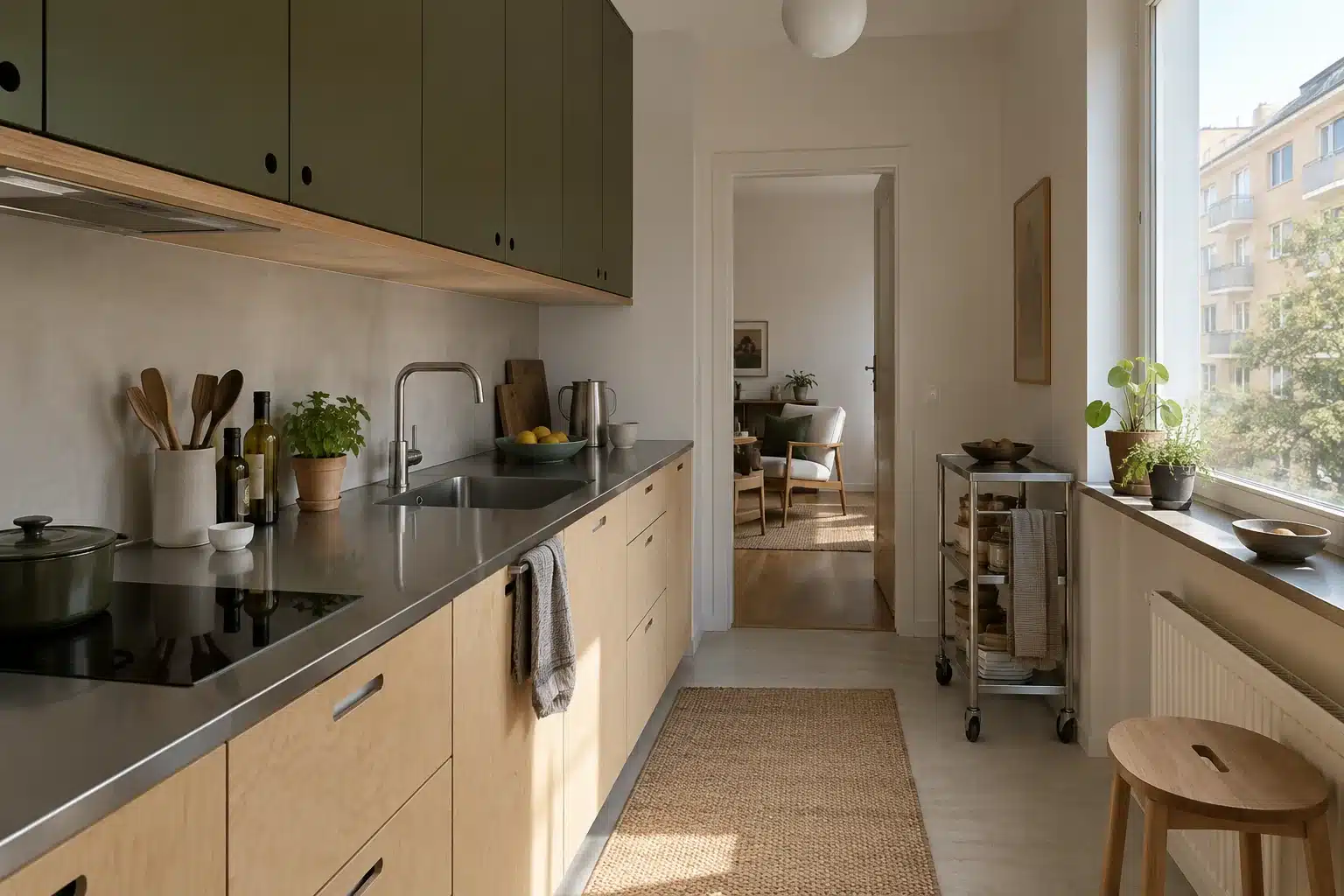
In this guide
Choose small kitchen ideas that solve your actual bottleneck
Choose small kitchen ideas around the interruption you notice: dishes occupying the board space, a blender you rarely use, or nowhere to place prepared ingredients. These are different problems. Moving clutter will help the first two; a second working surface may help the third.
| Main constraint | Start with | Check first | Trade-off |
|---|---|---|---|
| The existing counter is crowded | Protected prep zone and appliance storage | Reachable alternative homes for everyday equipment | Some items come out only when needed |
| Almost no continuous worktop | Compatible sink board or nearby table | Stable support, cleaning, and board storage | Sink access or dining use changes during prep |
| Room beside the kitchen | Purpose-built prep cart | Working position, parked position, and door movement | Furniture needs a permanent home |
| Loose tools occupy the counter | Drawer zone or suitable wall rail | Drawer access or mounting permission | Capacity stays limited to selected tools |
| Several ingredients spread everywhere | One staging tray and sequential preparation | A clean place for the filled tray | You prepare in stages rather than all at once |
Measure small kitchen ideas before adding furniture
Before choosing small kitchen ideas that add a surface, record the room, usable countertop, and any potential parking space. Include baseboards, handles, radiators, and appliance vents. A trolley fitting a gap in a small kitchen is not enough: it must also come out without trapping you or stopping a door.
Open the refrigerator, oven, dishwasher, and cabinet doors in their normal positions. Check where you stand to load, unload, or lift a pan. IKEA’s kitchen measuring guidance includes obstacles and the space needed to open windows and doors. Use your appliance manuals for required clearances; there is no single aisle measurement that guarantees every kitchen will work.
Read your lease before drilling or altering cabinetry. Ask for written permission when necessary. Removable products still have surface and installation requirements. Tall storage may require restraints: the CPSC’s Anchor It! guidance emphasizes securing furniture according to its manufacturer’s instructions. A rental restriction is a reason to choose another solution or seek permission, not omit required anchoring.
Small kitchen ideas: a measuring worksheet
Use one unit throughout. These blanks record your kitchen, not universal minimums. Sketch the proposed item in both its working and stored positions.
| What to record | Your measurement or observation |
|---|---|
| Clear worktop length and depth | ________________________ |
| Board footprint and comfortable working position | ________________________ |
| Sink opening, supports, and faucet movement | ________________________ |
| Cart footprint, handles, and parking place | ________________________ |
| Door and drawer movement with the item in place | ________________________ |
| Baseboards, heating, vents, and other obstacles | ________________________ |
| Shelf depth, door hardware, and available height | ________________________ |
| Lease permission and product installation requirements | ________________________ |
17 small kitchen ideas for little or no counter space
1. Give one worktop zone a single job
In a small kitchen, clear a section large enough for your actual board and a bowl. Move mail, charging cables, decorative jars, and duplicate utensils elsewhere. Keep the board accessible rather than buried behind appliances.
This is a boundary, not a request to own nothing. Keep the coffee setup if you use it daily, but separate it from preparation. The test is whether you can start chopping without first relocating several objects.
2. Store occasional appliances within comfortable reach
Put an infrequently used blender or food processor in a suitable lower cabinet or accessible shelf. Store its attachments beside it so retrieving the appliance is one action, not a hunt.
Do not trade clutter for awkward overhead lifting. Store appliances unplugged and operate them only on suitable surfaces with the clearances and electrical connection their manuals require. Refrigerator tops are not a default appliance station.
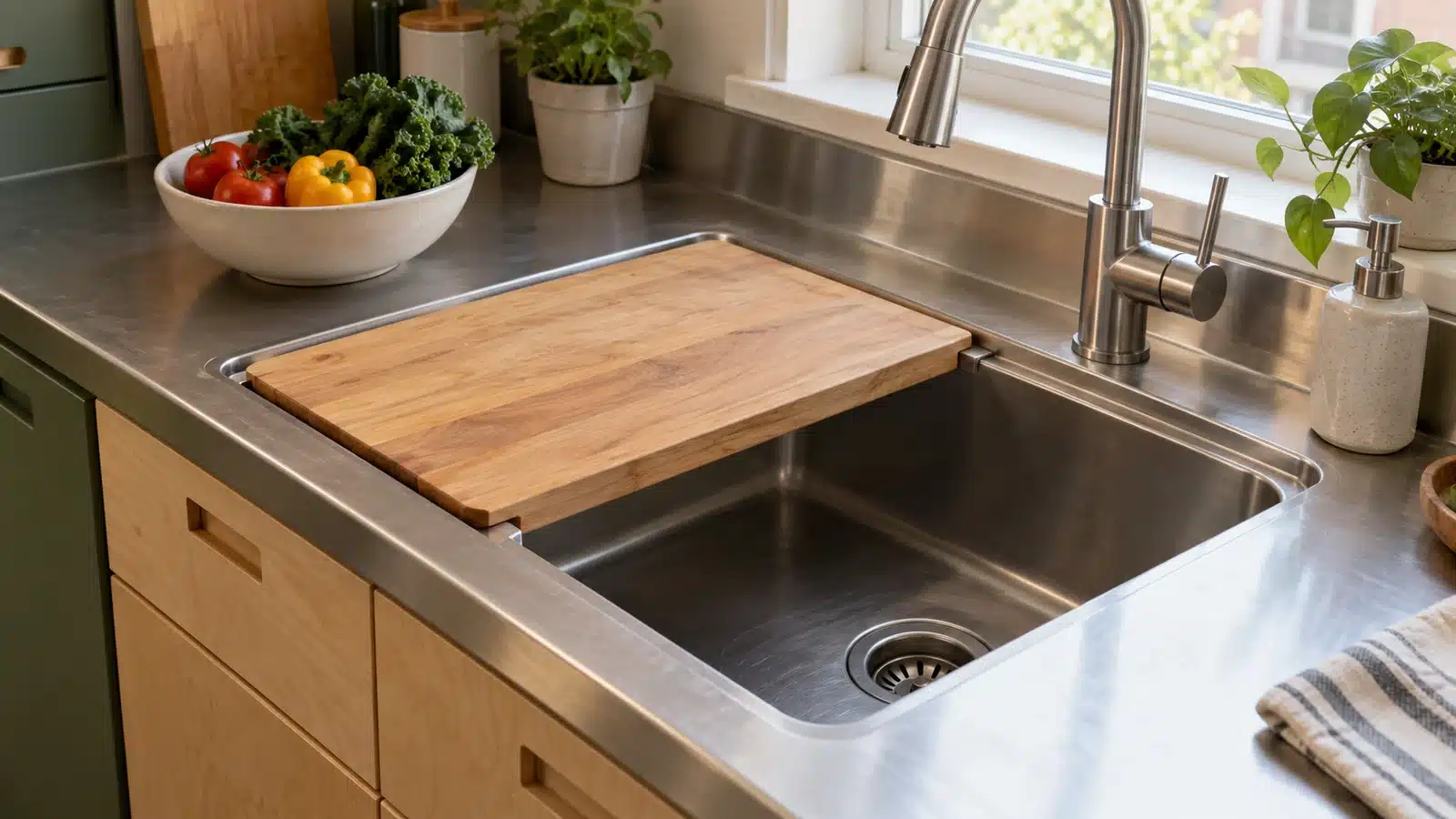
3. Use a properly fitted over-sink board
A board designed for your sink can provide temporary preparation space when its specified supports fit securely. Compare the support span, rim shape, and faucet position; matching the basin’s width alone does not establish compatibility.
Keep the board removable for washing and handwashing. Follow its care instructions, and stop if it rocks or slips. Do not balance a loose board over an opening and assume it can withstand chopping pressure.
4. Choose a prep cart, not just a storage trolley
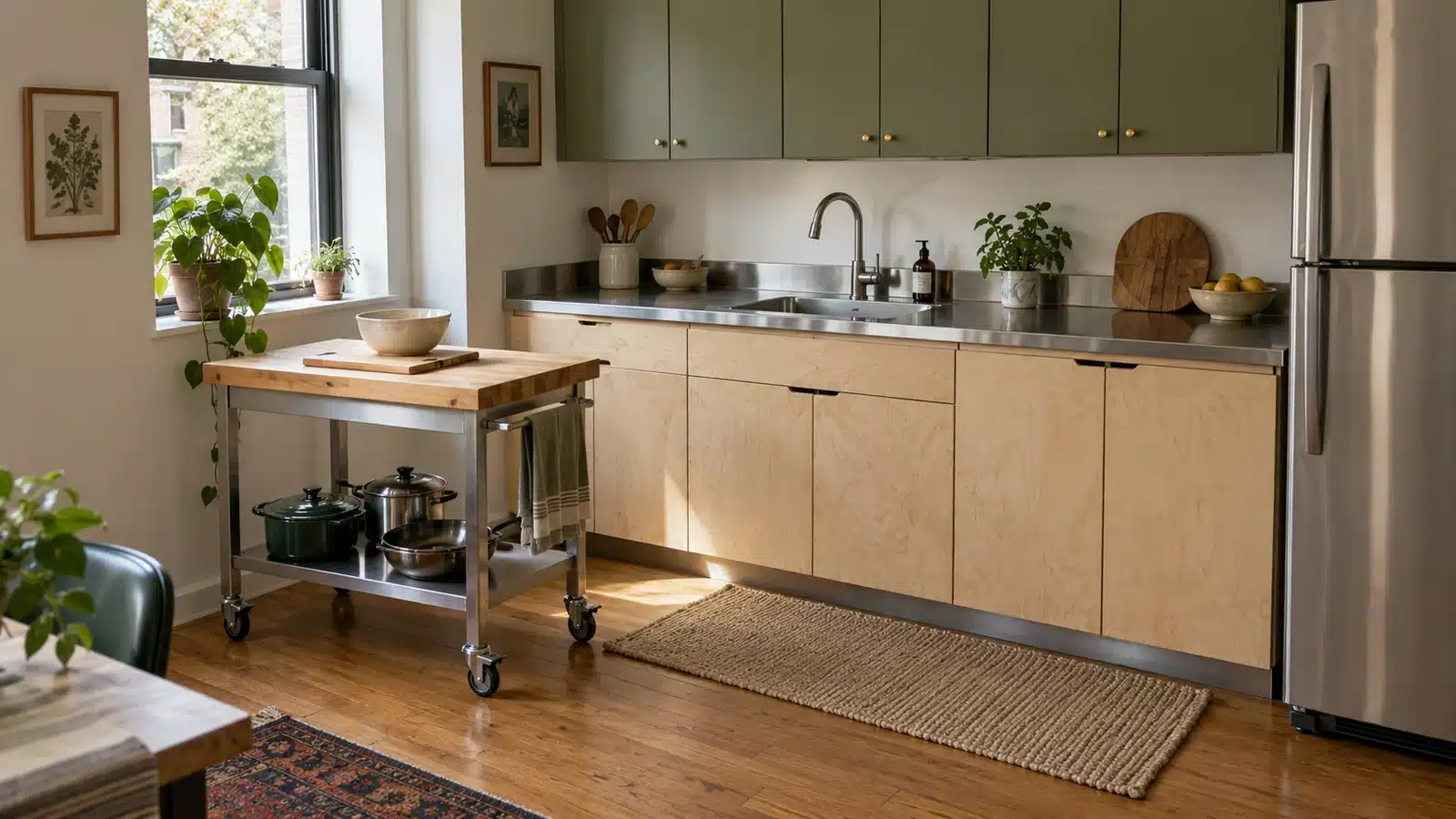
A purpose-built kitchen cart can give a small kitchen a working surface plus lower storage. Check that the manufacturer permits the intended task and that the surface, supports, and any wheel locks suit it. A lightweight trolley for bottles is not automatically a chopping station.
Plan where the cart stays between meals. Position it without obstructing doors or the route out, and keep its top clear enough to use. Reject a cart that works only when another essential item is moved.
5. Let a nearby dining table handle a preparation stage
A stable dining table can hold mixing bowls or support a cutting board, especially when the kitchen has no room for extra furniture. Use a suitable board and protect the finish from moisture, knives, and hot cookware.
Check that the working height feels manageable. With a drop-leaf table, follow the instructions for supporting and securing the leaf. Clear the table afterward so the dining space does not become permanent kitchen overflow.
6. Consider an approved folding wall table
Where there is a suitable wall and permission, a purpose-built folding table can provide an occasional work surface. Check its open footprint, bracket operation, and intended load and use before ordering.
Installation depends on the wall construction and the specific fixing instructions, not a generic anchor recommendation. If correct installation is not possible in your rental, choose a freestanding alternative. Keep the opening and folding path unobstructed.
7. Investigate a purpose-built pull-out worktop
Some kitchen systems offer pull-out preparation surfaces. For an existing kitchen, ask its manufacturer or an appropriate installer about compatibility before making alterations. Include the extension in your door and walkway test.
This is different from laying a board across an ordinary open drawer. Drawer fronts and runners are not necessarily designed for preparation loads. Avoid that shortcut; use a surface explicitly designed for the job.
8. Move drying into a suitable sink rack
A compatible in-sink or over-sink drying rack can release the small kitchen area occupied by a counter drainer. Check faucet movement, cabinet height, support points, and the space needed to wash your largest pan.
Choose an arrangement you can clean easily. A towering rack that blocks washing only shifts the problem. Put dry dishes away regularly so yesterday’s plates do not dictate where tonight’s preparation happens.
9. Give everyday utensils a shallow drawer zone
Replace a crowded countertop utensil pot with a small drawer section for the tools you actually use: perhaps a spatula, tongs, and serving spoon. Keep knife storage suitable for protecting blades and fingers.
Separate occasional tools rather than adding them to the same compartment. Check that the organizer fits below the drawer opening and allows it to close. The aim is quick retrieval without consuming the worktop.
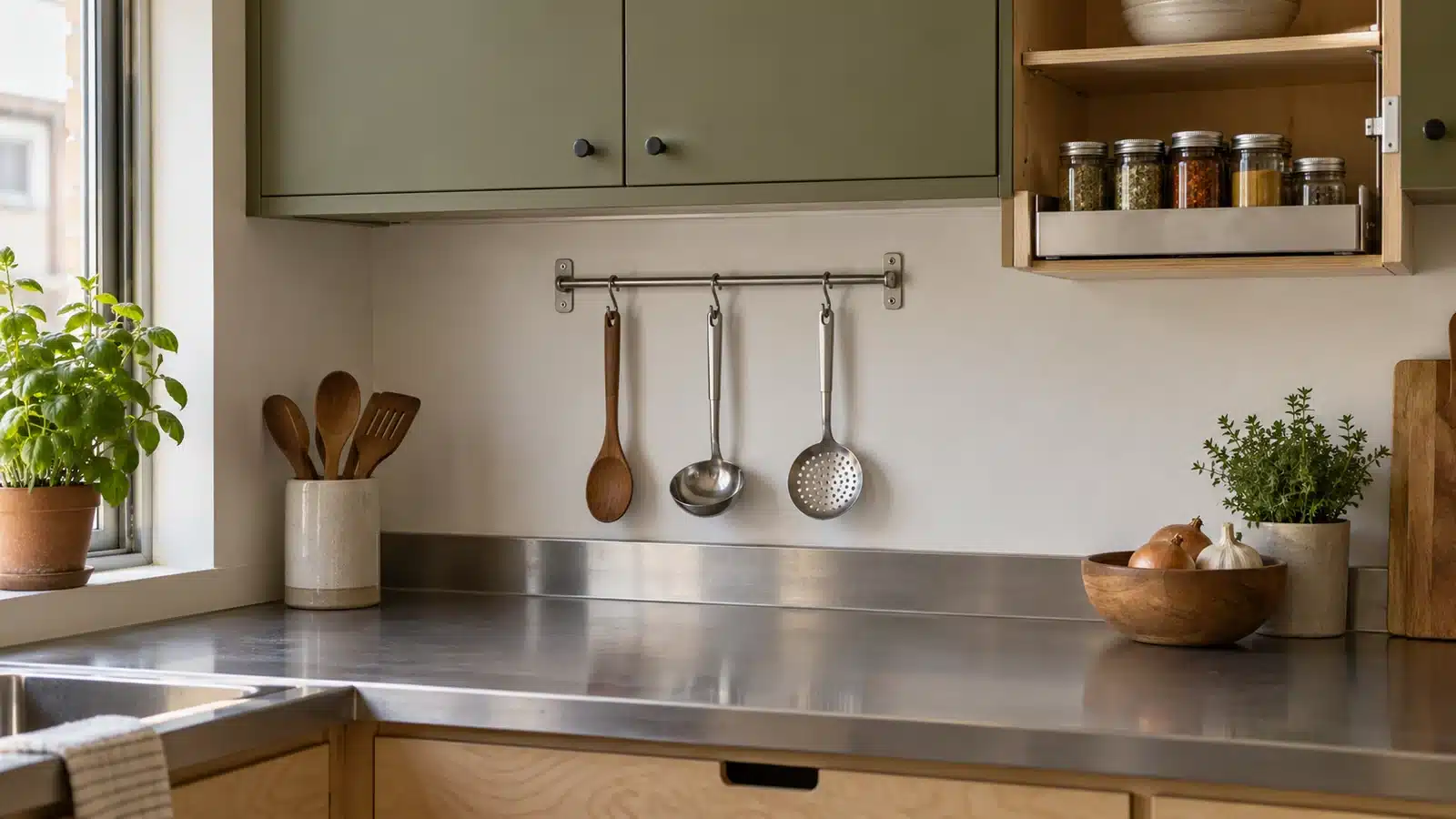
10. Use a wall rail for selected lightweight tools
If mounting is permitted, a suitable rail can hold a few utensils away from the preparation surface. Place it where tools are reachable without leaning over burners and do not hang combustible items near the cooking area.
Follow the exact mounting system’s instructions. Command’s official FAQs distinguish product-specific weight limits and compatible surfaces; additional strips do not automatically increase capacity. Do not improvise an adhesive knife rack.
11. Keep spices in a removable cabinet tray
For small kitchen storage, group the seasonings you use most in a shallow tray that fits an accessible cabinet shelf. Bring it out for seasoning, then return it, rather than lining every bottle along the backsplash.
Keep taller bottles where they are easy to lift without catching the shelf above. A small tray limits sprawl and lets you clean underneath. Leave occasional baking spices in a separate group.
12. Divide an existing shelf before adding another cabinet
A compatible freestanding shelf riser can separate everyday bowls from plates so both are easy to retrieve. Measure usable height and depth, and follow the riser’s load instructions.
Use it to eliminate an awkward stack, not simply fit more objects. If a bowl still requires dismantling the arrangement, change the allocation. Avoid making a top-heavy stack of containers on the new level.
13. Store flat boards inside a suitable cabinet door
A compatible over-door holder can contain cutting boards or lightweight trays without leaving them propped against the backsplash. Check the hook thickness, hinge movement, and space behind the closed door.
Choose a holder intended for those items and for the door construction. Dry boards before storing them, and keep food-contact equipment separate from cleaning products. Stop using the holder if it prevents normal closing.
14. Give pan lids and baking sheets vertical slots
Use an appropriate divider in a lower cabinet to store flat cookware upright. This releases worktop corners often occupied by leaning sheets and lets you remove one lid without unstacking everything.
Check the actual tallest item against the cabinet opening. Use stable dividers suited to the cookware, with heavy pots separately supported. A clearly divided small collection is more useful than tightly wedged duplicates.
15. Make a portable baking kit
For an occasional baking session in a small kitchen, keep your scale, measuring tools, and baking equipment together in a manageable container. Retrieve the kit for a baking session instead of permanently displaying each piece.
Choose a container you can comfortably carry and put back. Keep heavy equipment separate and ingredients in appropriate closed packaging. This is task-based storage: it frees the everyday counter without hiding frequently used cooking tools.
16. Stage ingredients on one tray, in sequence
Place small bowls of prepared ingredients on a rimmed tray rather than spreading them across the counter. Give the filled tray a stable nearby surface, then use the board for the next task.
Prepare ready-to-eat ingredients separately from raw meat and poultry. USDA cutting-board guidance recommends separate boards for those uses and cleaning after use. Avoid balancing filled trays in improvised vertical stacks.
17. Use a narrow pantry cart for storage only
A purpose-built narrow cart may organize dry goods in an otherwise useful gap, but verify the appliance’s ventilation requirements, door movement, and the cart’s retrieval path first.
Keep it within its stated storage limits and avoid top-heavy loading. Do not assume its narrow top is a preparation surface. If the gap is required for cooling or maintenance access, leave it empty and improve an existing cabinet instead.
Troubleshoot small kitchen ideas during meal preparation
A new cart will not solve every kind of crowding in a small kitchen. To test your small kitchen ideas, write down the first point in a familiar meal at which you have to stop and relocate something. Name the object and its destination. “The kitchen is too small” is difficult to act on; “the clean colander occupies the board space” gives you a specific change to test.
In a small kitchen, separate a storage problem from a timing problem. If washed dishes remain on the counter because their cabinet is inaccessible, fix the return location. If several ingredient bowls need the same surface at once, decide which preparation stage can finish and move before another begins. You may need a better sequence rather than another permanent piece of furniture.
| What stops the meal? | What to check | One experiment |
|---|---|---|
| Clean dishes occupy preparation space | Is their cupboard easy to reach and open? | Give frequently used dishes a simpler return location |
| Prepared ingredients spread across the board | Where can a filled tray sit stably? | Finish one preparation stage and move it to that landing place |
| The cart blocks an appliance door | Does it have a usable parked position? | Remove the cart from the plan if both positions cannot work |
| The same appliance is repeatedly lifted out | Is it genuinely occasional equipment? | Give that daily appliance an accessible home; relocate a less-used item |
Repeat the meal with only that change. Check preparation, cooking, washing and putting away separately. An arrangement that helps chopping but makes the refrigerator awkward to open is not a finished solution. Keep the test modest enough that returning to the previous setup is straightforward.
Finally, choose a stopping point. Keep the change when the named interruption disappears without creating another one. If it fails, record why before buying a different organizer. This short record becomes a useful shopping filter: you can compare an actual task and operating position, not just an attractive photograph.
Try these small kitchen ideas during a real meal
Keep a short trial note with three entries: the object that interrupted preparation, the new location you tried, and whether that location stayed usable while washing up. If the change helps chopping but blocks unloading the dishwasher, revise it before buying matching accessories.
Start with one arrangement and cook a familiar dinner. Can you retrieve the board, wash ingredients, open the refrigerator, and put dishes away without relocating the new storage? Notice which step remains awkward. Change that step before buying another organizer.
Afterward, restore the preparation zone. Wash boards with hot, soapy water, rinse, and dry them as USDA advises; follow care instructions for the material. Keep the sink available rather than treating every fixture as permanent storage.
Leave the stove for cooking. The U.S. Fire Administration’s cooking guidance says to keep combustible items away from the stovetop and plug cooking appliances directly into a wall outlet, not an extension cord. This guide does not recommend wooden burner covers as extra worktops.
Small kitchen ideas: common questions
What should I change first when there is no counter space?
Clear one preparation zone and relocate items that do not need to remain there. If that still leaves nowhere to work, compare a compatible sink board with a stable nearby table before considering new furniture.
Is a kitchen cart worth it in a narrow galley?
Only if its working and parking positions allow normal door movement and passage. A storage cart and a prep cart have different jobs. If either position obstructs the kitchen, improve cabinet storage instead.
Can no-drill organizers damage a rental?
They can be unsuitable for a surface or door, even without screws. Check the lease, product instructions, condition of the finish, and removal method. No-drill does not mean universally compatible or guaranteed damage-free.
How do I avoid making a tiny kitchen look cluttered?
Give recurring tasks separate homes, limit what lives on the worktop, and keep frequently used items easy to return. A visible rail or open cart can work, but it should hold an edited collection rather than every kitchen accessory.
Make one preparation step easier
The best small kitchen ideas make cooking less interrupted. Start with the board, the dishes, or the appliance that causes the most shuffling. One dependable surface and accessible storage are worth more than several clever additions that compete for the same room.