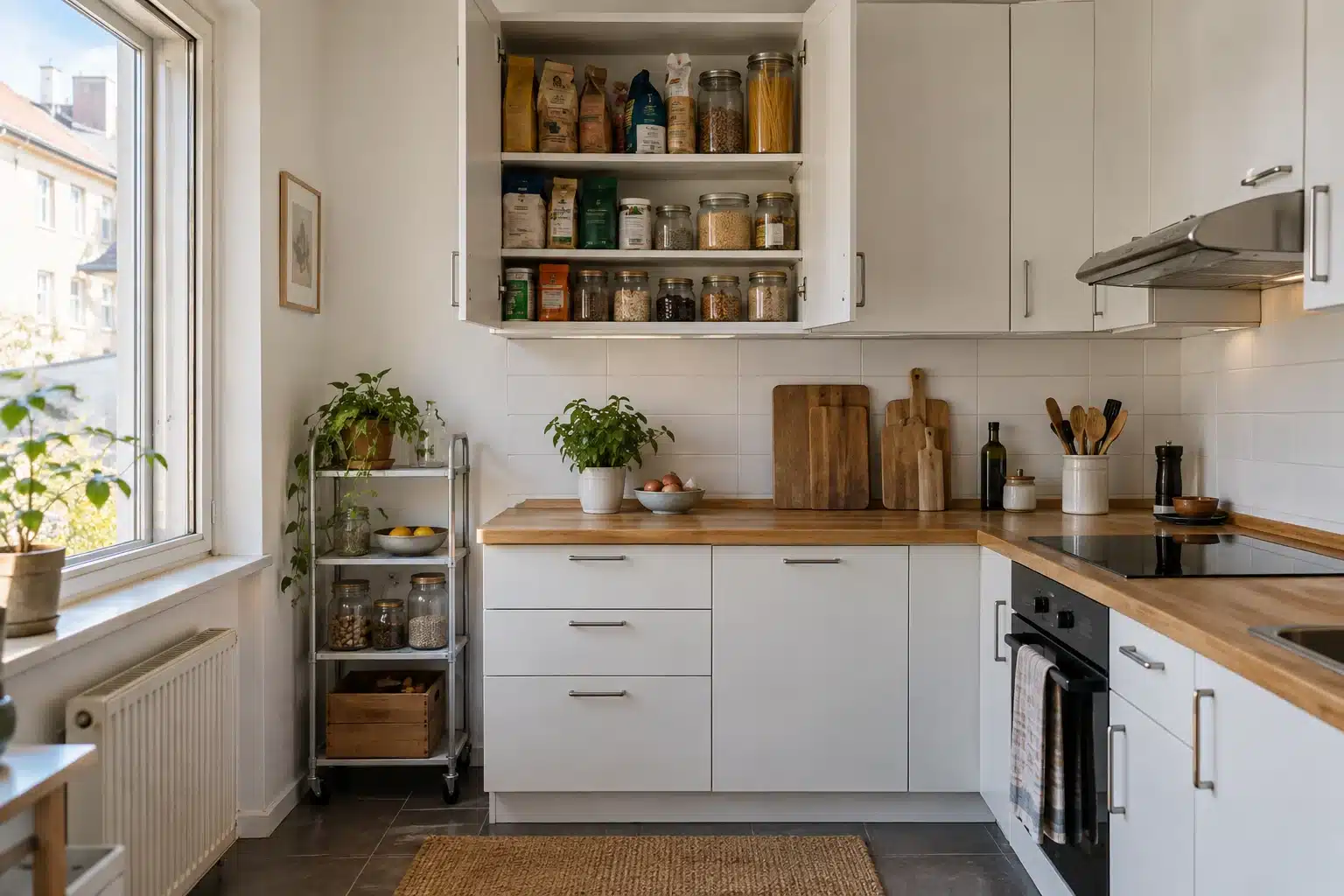
A kitchen without a pantry needs a clear home for food, not a cupboard full of matching containers. Start by grouping shelf-stable groceries in one cabinet or drawer, keep preparation space free, and add another piece of furniture only if the weekly shop genuinely will not fit. The right arrangement lets you see what you own and put groceries away without moving three other things first.
This guide deals with dry-food storage in a small kitchen. For boards, appliances and somewhere to chop, use our separate guide to kitchens with little or no counter space. Solving the food zone first usually makes that worktop problem easier.
In this guide
Start with a one-shelf food audit
For a kitchen without a pantry, start on a clear table and empty only the area holding shelf-stable food. Group breakfast, meal ingredients, snacks and unopened backups. Check package dates and condition; follow the product’s storage instructions rather than assuming that every pantry food can be stored in the same way. Write down which items you reach for most and which are rarely used.
Next, measure the actual cabinet opening, usable depth and shelf spacing. Hinges and face frames can make an organizer fit inside a cabinet but impossible to slide through its doorway. Measure the tallest package too. If a cereal box only fits on its side, account for the space it occupies after opening, not just the dimensions of a new box.
- Daily foods: give these the easiest reach.
- Meal ingredients: group by how you cook, such as pasta with sauce.
- Unopened duplicates: keep one small, visible backup area.
- Overflow: identify why it exists before buying furniture to contain it.
Choose storage for a kitchen without a pantry
| Option | Best use | Check before choosing |
|---|---|---|
| One upper cabinet | Light everyday dry foods | Reach, shelf load and package height |
| Deep drawer | Packets, cans and short containers | Closing height, runners and load rating |
| Lower cabinet | Heavier foods in accessible trays | Whether you can see and retrieve the back row |
| Small freestanding cabinet | A larger weekly food shop | Footprint, door swing and required anchoring |
| Rolling trolley | A limited, movable overflow zone | Stable parking position, wheels and walking space |
Choose the smallest storage option that holds a normal grocery cycle in your kitchen without a pantry. An attractive trolley that blocks the oven is not additional usable storage. A tall unit may provide more capacity, but it also needs a suitable location and installation. Follow the manufacturer’s instructions for anchoring rather than treating freestanding furniture as automatically safe in a rental.
Worked example: one cabinet before a new pantry unit
Imagine a rental kitchen with one food cabinet, a deep dish drawer and no spare floor corner. The cabinet has a clear opening 36 cm wide, usable depth 29 cm and shelf height 27 cm. These are example measurements, not a description of a typical kitchen. A basket advertised as 35 cm wide appears promising, but its side handles extend to 38 cm. It fails the opening check before you consider how many packets it holds. Compare full outside dimensions rather than the product name.
Now measure the groceries. The tallest cereal box is 31 cm high, several jars are shorter than 15 cm and the opened rice packet falls sideways. The cereal needs another suitable shelf position or different storage orientation; a riser cannot create height. A shallow existing tray may keep the rice packet upright while placing small jars in a visible front row. Pantry substitutes work best when you match each awkward package to a specific problem instead of selecting one organizer for the entire collection.
Try reallocating the dish drawer before buying furniture. Suppose the drawer closes over packages 18 cm high and its documentation permits the planned load. Short packets may fit there while lighter breakfast foods remain in the cabinet. Retain the everyday plates where they are easy to retrieve; move only occasional serving pieces if another appropriate home exists. A kitchen without a pantry may need an allocation change rather than an additional storage footprint.
Draw the resulting dry food storage from above. Label daily ingredients, breakfast and backups, then mark where an open door or hinge reduces access. Compare the drawn plan with the actual containers during a grocery put-away. If you cannot lift the tray without tilting tall jars, use a narrower tray or a different location. A workable combination of pantry substitutes can be visually ordinary while being much easier to maintain.
| Fit question | Example observation | Decision |
|---|---|---|
| Clear opening | 36 cm; handled basket is 38 cm | Reject that basket |
| Tallest package | 31 cm; shelf height is 27 cm | Change location or suitable orientation |
| Short-packet drawer | 18 cm closing height | Test actual packets and permitted load |
| Retrieval | Tray catches a hinge | Reduce width or reposition |
7 storage fixes for a kitchen without a pantry
A no-purchase trial for dry food storage
Begin with containers already in the household: a sound shallow tray, a washable box appropriate to the contents, or the original grocery packages. Avoid spending money on pantry substitutes until the trial shows where something spills, falls over or disappears. A cardboard planning marker can identify a proposed footprint, but it is not permanent storage for damp locations, heavy jars or foods needing another environment. Remove planning materials when the measurement task is finished.
Choose a small dry food storage zone you can reset completely in one session. Return the foods used most often first. Put heavier containers where you can handle them comfortably and give open packets a supported position that preserves labels. Keep one narrow backup section visible. Write the contents on an ordinary note if looking into that section is difficult. The note supplements a suitable arrangement; it does not justify stacking inaccessible stock behind appliances.
Run a meal trial and a shopping-list trial. For the meal, retrieve the ingredients for a familiar dish and notice any item that requires moving several unrelated packages. For the list, inspect the food zone and identify what needs replacing. Dry food storage succeeds at both tasks: cooking and checking stock. If the arrangement improves visibility but leaves no space to put away an ordinary shop, adjust the allocation or buying quantities rather than adding layers blindly.
Buy only for the failure that remains. A small divider may support packets; a shallow tray may make a rear group removable. A freestanding cabinet is a different purchase because it needs a usable footprint, opening space and correct installation. Compare pantry substitutes by complete cost, including any required installation, rather than by container count. Keep the trial arrangement available until the new item has passed the same retrieval and grocery-cycle checks.
1. Give food one main address
Move dry groceries into one deliberate zone instead of distributing them wherever a gap appears. Start with the cabinet nearest your usual preparation spot, provided it is appropriate for the food’s storage needs. Move infrequently used serving pieces elsewhere if that releases a better food location. Keep cleaning products in a separate area, not alongside ingredients.
2. Use shallow trays for meal ingredients
A low tray can bring sauce jars or small packets forward together. Choose one that clears the hinge and leaves finger space at the sides. Keep heavier jars within comfortable reach. An oversized deep basket often hides more than it organizes; a tray is useful when you can identify its contents without unloading it.
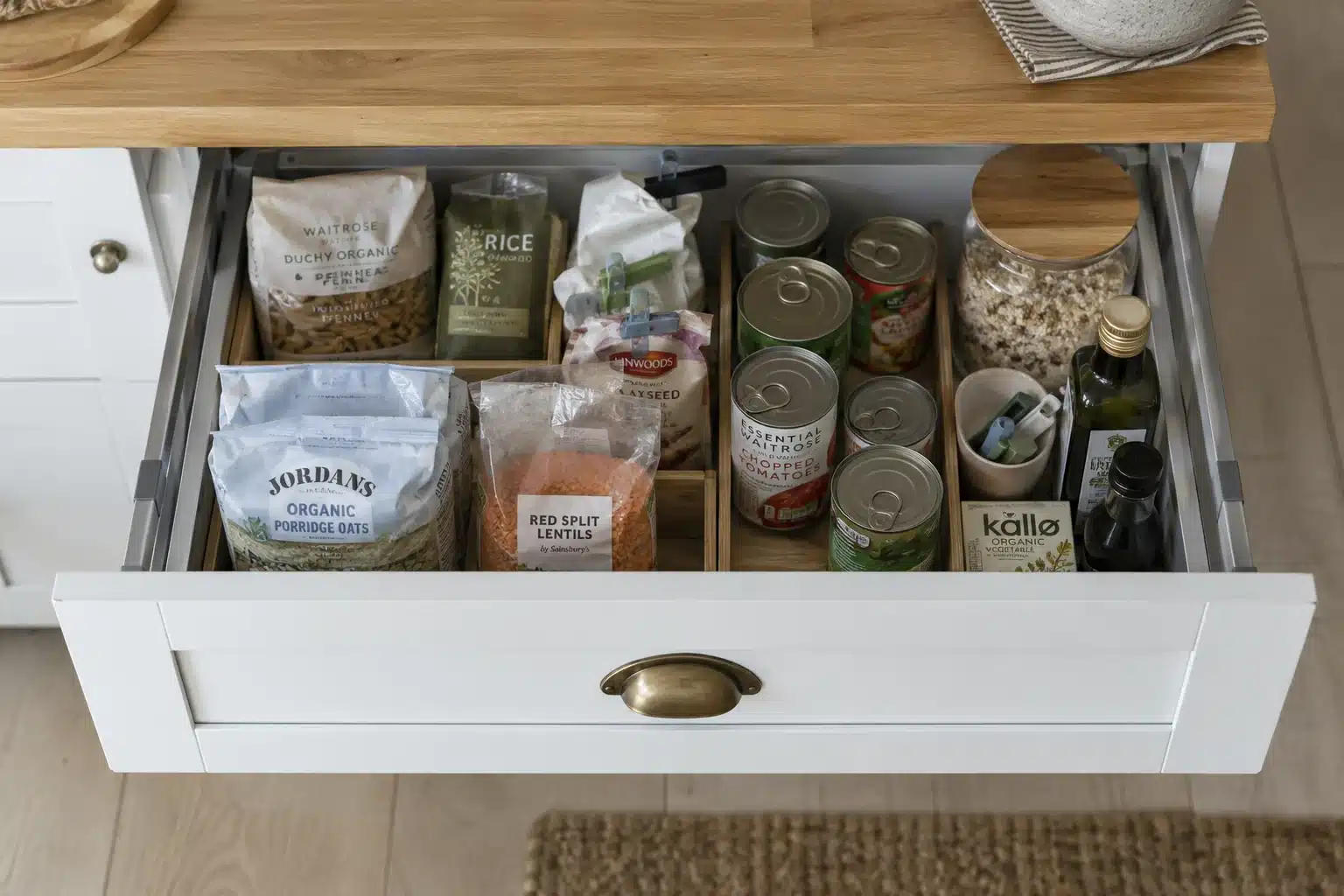
3. Make a drawer work vertically
Store suitable packets upright between low dividers so the top edges are easy to scan. Test the drawer with the tallest package before filling it. Cans and bottles add substantial weight, so follow the drawer’s load guidance. Do not force a drawer shut over a lid or handle that projects above its sides.
4. Add a shelf riser only where height is wasted
A riser can separate short cans or small jars on a tall shelf. It is less helpful when cereal boxes already use the full height. Check that the top row can be retrieved without knocking the lower row over, and use the organizer only within its stated capacity. The goal is visible storage, not the maximum number of layers.
5. Limit the backup zone
Use one defined section for unopened duplicates. Put the next item to use at the front, keeping package labels and dates visible. When this section is full, pause additional bulk purchases rather than allowing backups to colonize another cupboard. This is a capacity rule, not a requirement to throw useful food away.
6. Decant selectively
A sealed container can help with an awkward opened bag, but there is no need to repackage every grocery. Keep storage instructions, allergen information and dates with the food. Wash and dry containers appropriately before refilling, and avoid continually topping new stock onto old. Original packets in a simple bin are a perfectly workable option.
7. Park overflow furniture outside the working route
If you need a trolley or cabinet, mark its footprint on the floor first. Open the fridge, oven and nearby doors, then carry a shopping bag through the route. Allow for handles and open furniture doors, not just the closed-unit width. Choose a different location if you must move the unit every time you cook.
Reset a kitchen without a pantry after the weekly shop
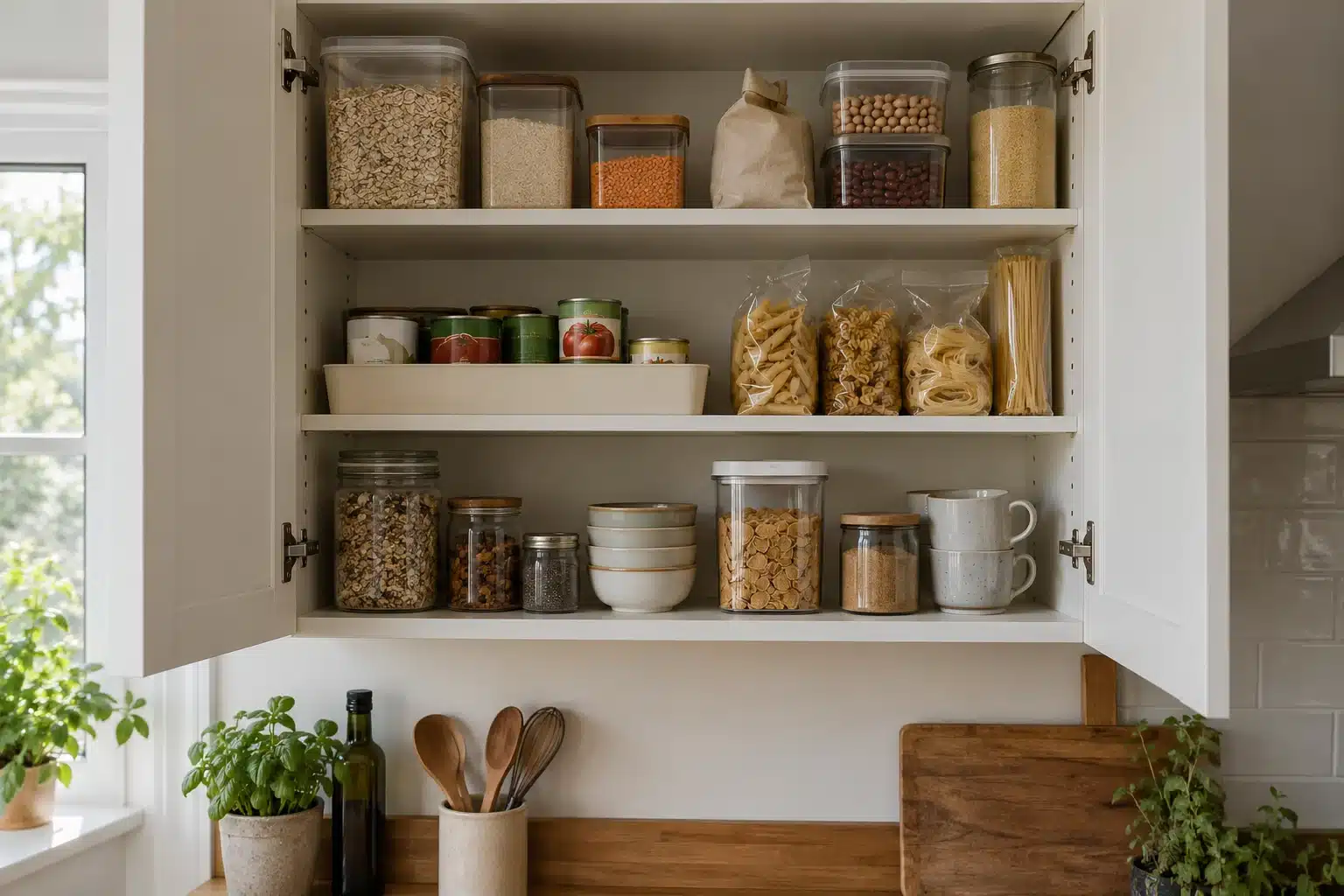
Test your kitchen without a pantry through one complete shopping cycle. Put breakfast foods in the easiest shelf or drawer section; place cooking staples beside each other; store lighter backups above or behind daily items where they remain visible. Leave a little spare room for the groceries you buy occasionally. A layout that only fits on the day it is photographed is not a useful household system.
- Clear and wipe one chosen cabinet or drawer.
- Return daily foods first, using their existing packaging.
- Add one tray or divider only where items fall over or disappear.
- Put unopened duplicates in the defined backup zone.
- Check the zone before making the next shopping list.
- Adjust the difficult shelf after a week of ordinary use.
Check capacity just after shopping and visibility just before the next shop. On the first day, confirm that every package fits without blocking the door. On the last day, confirm that you can see what remains without emptying a basket. These two checks distinguish insufficient space from an organizer that hides stock.
When a kitchen without a pantry remains difficult to use, describe the failure precisely: the drawer is too shallow for cereal, the lower cabinet hides tins, or the bulk purchase exceeds the available space. That tells you whether to change the location, organizer or shopping quantity. Buying an entire matching set does not answer those questions.
Common mistakes to avoid
Do not use the oven as food or equipment storage unless you are following a safe, manufacturer-approved arrangement; it is too easy for someone to preheat it without checking. Keep appliance ventilation and service access clear. Avoid storing heavy groceries high enough that lifting them down becomes awkward. A cupboard above a hot appliance is not automatically a suitable home for every ingredient.
Door-mounted organizers also need a fit check. Their contents must clear the shelves when the door closes, and the mounting method must be appropriate for the cabinet material and load. In a rental, removable does not necessarily mean damage-free. Ask about installation permission where needed instead of improvising a weak fixing.
Troubleshoot pantry substitutes by the symptom
If packages disappear at the back, reduce the number of rows or make one suitable group removable. Clear containers alone will not help when the rear row is hidden behind taller bottles. Position labels toward the view you actually have when the door opens. For a deep drawer, the view is usually from above; for a high cabinet, seeing through a low transparent front may be more relevant. Choose the arrangement for that view.
If the food zone repeatedly overflows, record what arrived during the most recent shop. Was it the normal quantity, a special occasion or several bulk duplicates? Pantry substitutes should hold the routine quantity with workable access. Occasional excess may need a deliberate temporary suitable location, while repeated excess calls for a capacity or shopping change. Avoid turning a hallway walking route into permanent dry food storage because one large purchase did not fit.
If an opened packet spills, keep its storage instructions with it and use a compatible closed container only when that resolves the problem. Measure the container after including its lid and the space needed to remove it. Repackaging is less useful when a wide square container consumes more space than the bag or leaves you unable to identify an allergen or date. A packet clip and a supportive tray can sometimes be the simpler option.
If putting groceries away takes too long, check whether each category has a visible receiving location. Food that needs immediate appropriate refrigeration or freezing follows its own instructions; this guide concerns shelf-stable groceries. Keep dry food storage separate from the washing-up and cleaning-products zones. Reassess the plan after a normal cycle, retain the changes that work, and stop buying pantry substitutes once the daily food zone is reliable.
| Repeated symptom | Check | Small next trial |
|---|---|---|
| Rear packages vanish | Rows and viewing angle | One removable shallow group |
| Every shop overflows | Normal quantity versus duplicates | Limit a visible backup section |
| Tall packet will not fit | Full opened-package dimensions | Assign a suitable taller location |
| Put-away is slow | Category receiving locations | Return daily foods before backups |
Record the receiving location before the next shop
Make a short dry food storage record with one row for each routine category: breakfast, main meal ingredients, snacks and appropriate unopened duplicates. For each row, write its actual location, the tallest current package, and the product you most often cannot see. These notes identify the receiving location for a new purchase. Keep the record near the shopping list instead of making a separate inventory that nobody checks.
In the backup zone, record only items that are genuinely difficult to see or easy to duplicate. Update the note when the replacement moves into daily use. Pantry substitutes should simplify checking, so abandon a detailed tally if it takes more effort than looking at a clear shelf. The useful result is knowing where the next packet goes and whether another is already waiting.
When package sizes change, repeat the height and opening checks for the affected group rather than replacing every container. A different cereal box can change one shelf decision without invalidating the whole kitchen. Keep dry food storage adaptable: move a suitable small group, adjust a permitted shelf or use another appropriate receiving location. The backup zone stays bounded while the daily group reflects what you actually buy.
Questions about a kitchen without a pantry
Where should food go if every cabinet already has dishes?
Compare use frequency before adding furniture. Everyday plates should remain easy to reach, but a rarely used serving platter may be a better candidate for another room. Reallocate one small zone to food first; if that still cannot hold your normal groceries, measure a compact freestanding alternative outside the kitchen’s working route.
Are open shelves a good pantry substitute?
They can be, if the shelf, location and foods are suitable. Open storage shows stock clearly but also exposes packaging to light, dust and the room’s conditions. Follow product storage guidance, use secure shelves, and keep heavier items lower. You do not need an open shelf just because it looks attractive in a photo.
Should all food go in clear containers?
No. Use containers when they solve a specific problem such as an opened bag that spills. Keep the food’s original information available. Trays for packets and jars are often simpler to maintain, especially when you buy different package sizes each week.
What should I organize first?
Start with daily food, not decorative accessories. One reliable breakfast-and-meal zone helps you judge the remaining capacity. Improve the awkward shelf next, rather than emptying the entire kitchen at once.
Related planning and safety resources
Continue with small-kitchen preparation space and a calmer small-apartment arrangement. For tall storage furniture, consult the CPSC’s furniture anchoring guidance and the unit’s installation instructions.