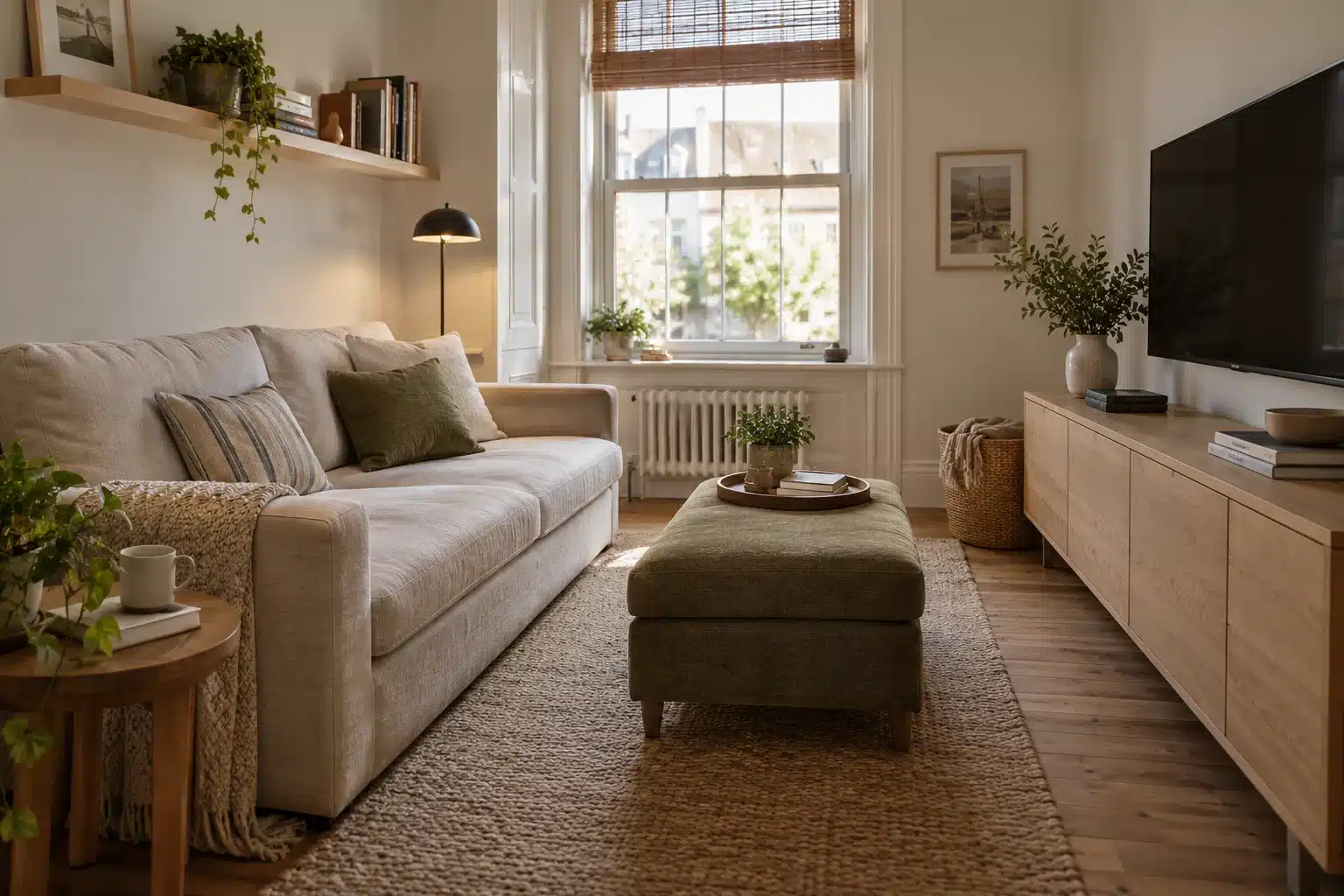
Small living room storage should help you use the seating area: a blanket within reach, a home for remotes and enough space to open a cabinet without shifting the sofa. Start with the objects that belong in the room. Then choose a limited amount of furniture that stores them while leaving the seats and walking route comfortable.
For the wider look and arrangement, see our cozy small-apartment guide. Coats, bags and arriving mail need a separate landing-zone plan; our small-apartment entryway storage guide keeps those everyday items from taking over the sofa.
In this guide
Start small living room storage with the objects you use
Put the room’s loose belongings on one clear surface. Group entertainment items, reading, blankets, hobbies and small daily essentials. Count what is regularly used and what merely ended up there. Paper archives, duplicate bedding and unused appliances may need another storage zone rather than a larger living-room cabinet.
Measure awkward pieces first: the widest board-game box, a folded blanket, a games console and any album or record sleeves. Check internal furniture dimensions against these objects. A cabinet’s advertised width includes its sides and may conceal several smaller compartments. A narrow door can also make a large internal shelf difficult to use.
Give each group a preferred position in your small living room storage plan. Remotes should be easy to retrieve from the sofa; craft tools may suit a removable tray that goes to a table. Keep items needed together in the same accessible area where practical. This makes the storage plan about retrieving and returning belongings, instead of simply hiding everything behind doors.
Measure small living room storage in its open and closed states
Record furniture width, depth and height including handles, feet and a projecting top. Then measure open doors, drawer extension or an ottoman lid’s movement. Include the position where you stand or kneel to reach inside. A shallow cabinet can demand considerable room if its door swings across a neighboring chair.
Imagine a cabinet 35 cm deep, roughly 14 inches, with a door projecting another 40 cm when open. Its temporary depth reaches 75 cm, approximately 30 inches, before allowing for you. These are hypothetical dimensions to illustrate the method. Compare the actual product’s opening movement with the gap to the sofa and the route beyond it.
Mark the footprint before buying and use a cardboard shape or paper plan for the door swing. Try walking past the sofa, sitting down and getting up. If the cabinet blocks a required exit or prevents a door operating, it does not fit the available location. Do not judge the room only from an empty, closed-furniture photograph.
Compare the main small living room storage options
| Option | Best-matched contents | Useful benefit | Limit to check |
|---|---|---|---|
| Closed media unit | Entertainment supplies and suitable electronics | Combines an existing media function with storage | Ventilation, cable space and TV suitability |
| Storage ottoman | Light blankets or soft accessories | May replace another occasional surface | Lid movement, load and access from the sofa |
| Shallow cabinet | Books and small household supplies that fit | Uses less wall-to-room depth | Internal depth, door swing and anchoring |
| Open shelf with limited bins | Frequently handled objects | Easy visual access | Dust, bin retrieval and furniture support |
| Existing side-table drawer | Remotes and a small working set | Adds no new floor footprint | Capacity and convenient reach |
Start with existing furniture that already performs another useful task. A drawer in a side table may solve the remote problem without an extra basket and cabinet. For larger groups, compare capacity with usable access. A deep unit filled in two rows is not necessarily better if everything in front must be removed to reach the back.
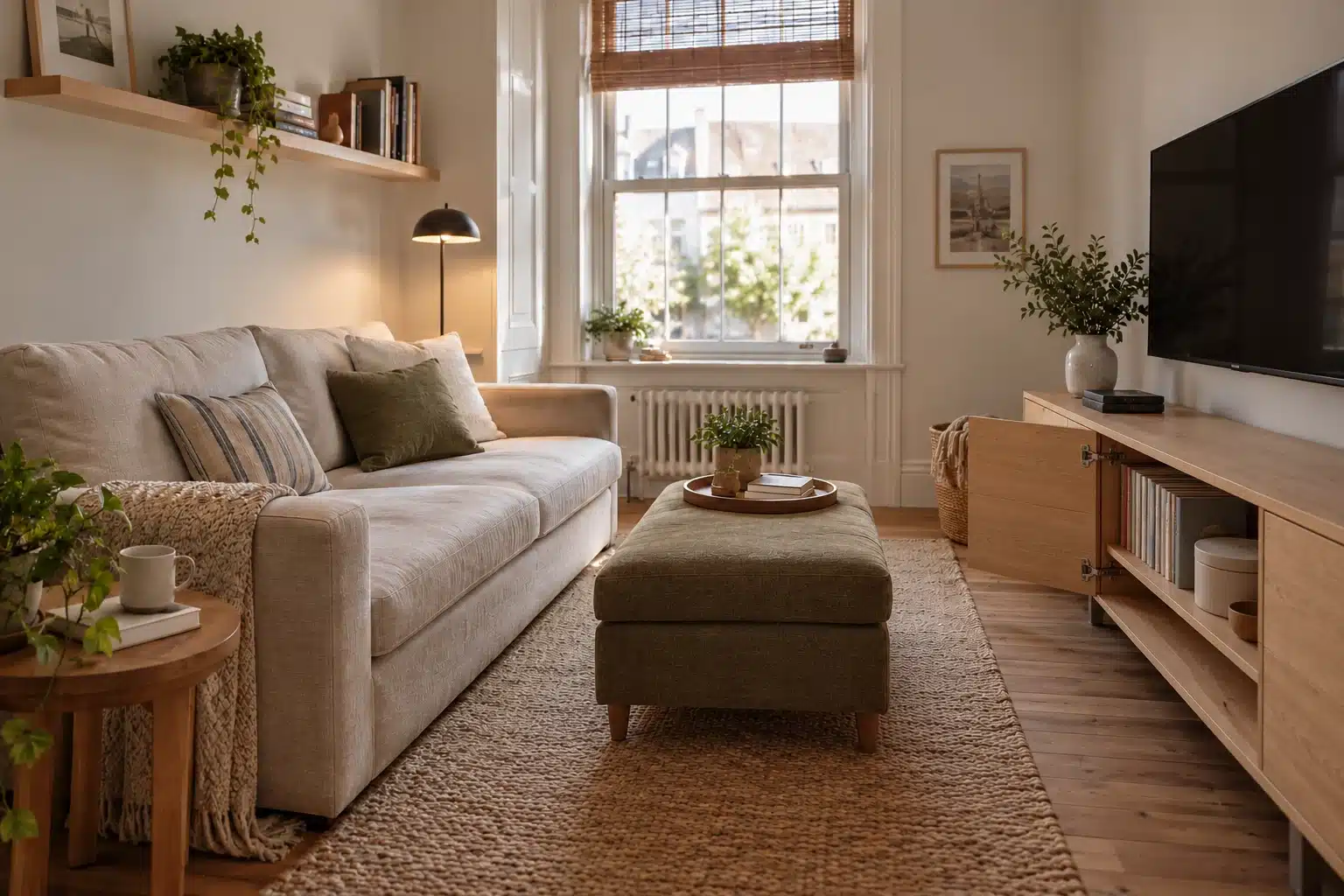
Make a media cabinet work for more than the screen
Allocate the easiest compartment to the entertainment items you regularly handle. Group controllers and their compatible leads, and keep the labels visible on game cases or discs you still use. A shallow removable box can help small accessories, provided it leaves enough room to grip and lift it without catching a hinge.
Powered equipment needs the ventilation and clearance stated by its manufacturer. A closed cabinet door can make a neat view while restricting an operating device. Check vents, cable bends, power access and the usable depth after connectors are attached. If the intended electronics cannot operate correctly there, use a suitable open position rather than forcing the closed-storage idea.
If a television sits on the unit, use furniture designed to support it and follow the relevant attachment instructions. The CPSC’s Anchor It advice calls for appropriate TV furniture and securing TVs and furniture according to instructions. A low unit or heavy television is not a reason to skip required protection.
Use a storage ottoman for contents you can lift easily
For small living room storage, an ottoman can hold a blanket or a few soft accessories without introducing a separate chest. Before choosing it, identify which existing piece it replaces or what daily function earns its footprint. Adding an ottoman beside an already crowded coffee table may increase furniture even though it adds storage.
Check internal dimensions and the lid in its fully supported position. Some lids lift off and need a place to rest; others have hinges or mechanisms with their own instructions. Keep hands clear and follow any limits for seating or surface loads. Do not infer suitability for sitting from an upholstered appearance alone.
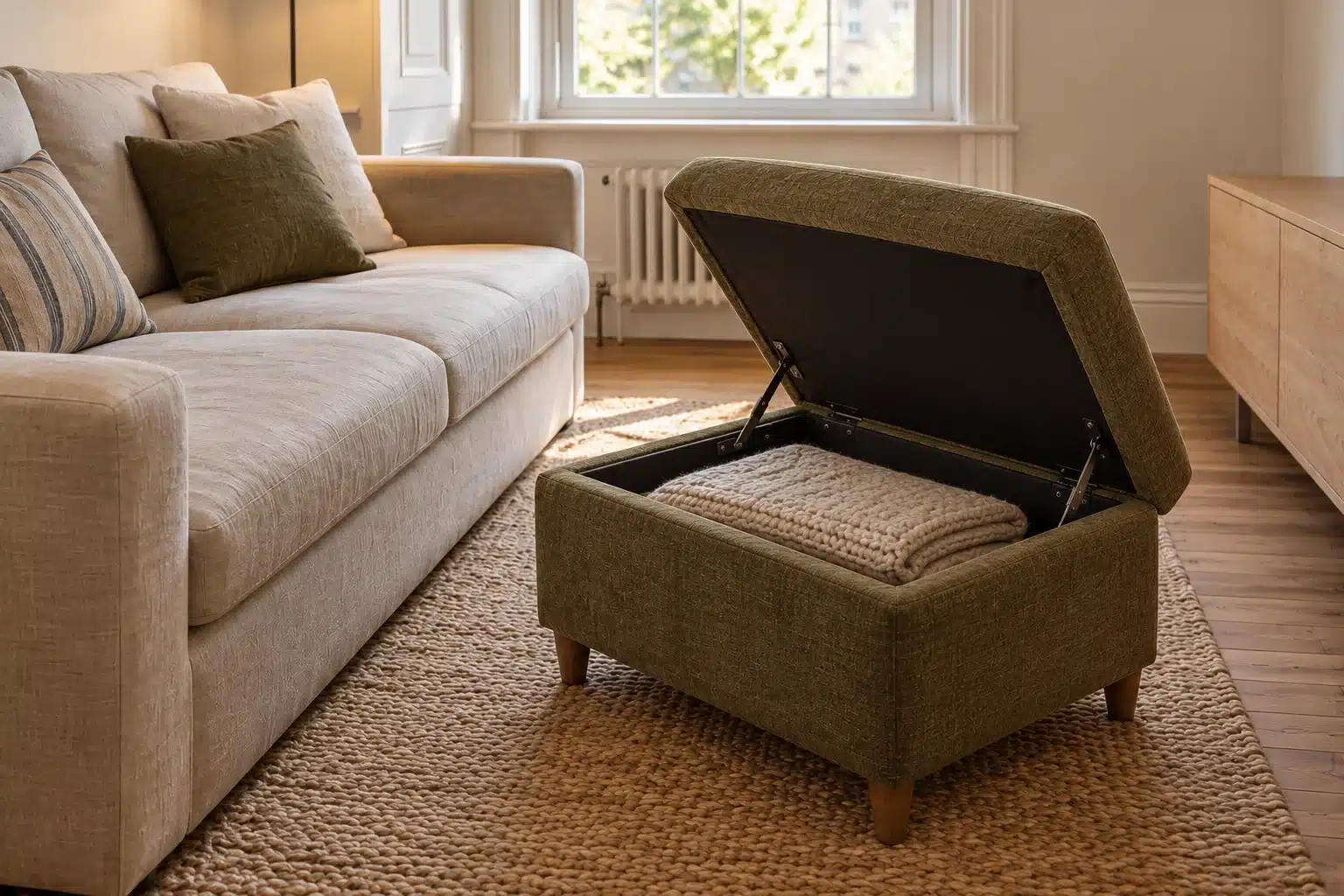
Consider the retrieval sequence. If a decorative tray and three books must move every time you want the blanket, the storage may be too inconvenient for daily use. Keep the top simple or put the blanket in a different accessible location. Reserve less convenient ottoman storage for items you retrieve occasionally, where the opening process is less disruptive.
Choose shallow cabinets and shelves around real contents
A shallow wall-side cabinet may suit paperbacks, notebooks or a small hobby kit. Measure the deepest item and the usable shelf depth behind the closed door. Do not buy solely because the furniture looks slim. The back panel, hinges or inset doors may make the internal space too shallow for your collection.
Choose small living room storage shelf positions that let you see and retrieve the working set. One row of books or labeled containers is easier to handle than several hidden layers. Allow finger space around a basket and enough opening height to remove it. Use shelf and furniture load instructions when placing books or other concentrated weight.
Wall-mounted storage needs suitable installation and rental permission where applicable. Tall or freestanding furniture may still require anchoring. If a fixing cannot be installed in the intended location, consider a suitable different product or place rather than treating the cabinet’s small footprint as proof that the arrangement works.
Small living room storage: three routines to keep it working
For a reading household, use one reachable area for current books and a separate shelf for the rest. Set a limit based on what that shelf holds comfortably. A stack of unread books on every surface is a signal to review the working collection, not necessarily to buy another bookcase.
For a shared living room with games or crafts, use one removable container per activity. Keep the regularly used tools together and return the container after the session. Choose a size its user can handle; a huge box packed with everything can be difficult to lift and impossible to search.
For blankets and small essentials, use a nearby soft-storage position and a defined remote drawer or tray. Reset those two locations when you finish in the room. Keep entryway items moving to their own homes using the entryway plan. If belongings repeatedly land elsewhere, move their storage closer to the activity or simplify the opening process.
Make a small living room storage shortlist with three columns: contents, opening action and nearby activity. A remote drawer needs access from the sofa; a craft box needs a route to the table. Write down every object you must move before retrieving the contents. That extra handling can distinguish two cabinets with otherwise similar capacity.
Test one busy evening before deciding. Put a blanket on a seat, take out a game and open the media drawer. Then return everything while another person uses the sofa. If a door or lid needs the occupied seat to move, reassign those contents or choose another position. Buy additional storage only for the specific group still lacking a workable home.
A worked choice between a media cabinet and a storage ottoman
Imagine a household with two regularly used blankets, six board games, remotes and a games console. The sofa and reading chair already fit comfortably, but a pile of games uses the coffee table. List the game-box dimensions and the console dimensions with connected leads. Compare these with the internal compartments of a proposed media cabinet. Then measure the blankets when folded without excessive compression. This determines whether the storage problem is one mixed furniture problem or two smaller groups needing different homes.
Suppose a media cabinet has two compartments, each 42 cm wide, 32 cm deep and 28 cm high. A game box 45 cm wide will not fit flat in that compartment even though the cabinet’s overall width is much larger. Turning it may create a possible arrangement, but check whether it can come through the door and be grasped comfortably. Place the other games behind a paper outline of the opening. If retrieving one requires unpacking the whole shelf, give current games a more accessible position.
Next compare a storage ottoman that could replace the coffee table. Use its internal dimensions rather than the upholstered exterior and check the way its lid opens. Put an existing blanket in a similarly sized container to estimate whether both fit. Decide where drinks and books would go when the lid is open. If opening the storage ottoman means placing the entire tabletop arrangement on the sofa, it may be better as occasional storage than the nightly blanket home. The extra capacity must be useful in the role you actually need.
Choose the media cabinet if it can hold the entertainment collection appropriately and replaces an existing screen stand or cabinet. Choose the storage ottoman if it also serves a wanted footrest or surface and its contents suit the opening routine. Neither piece automatically resolves both groups. A small living room storage plan might instead use the existing media unit for games and one suitable basket for the evening blanket. Compare the resulting furniture count and handling, not merely the total advertised storage volume.
A shallow cabinet trial for books, games and hobby supplies
A shallow cabinet can work well for an accessible row of smaller objects, but begin with the deepest item you intend to keep there. Measure a game box, album or craft case in the position used for retrieval. Include room for fingers and any label you need to see. A cabinet with an internal depth only equal to the object’s depth may close while still being awkward to use. Trial a shelf outline with the real objects before deciding that a slim exterior solves the room.
Separate current-use belongings from archives. A shallow cabinet near the sofa could hold the current book, a notebook and a small game collection; older paperwork might belong in a different existing storage zone. Do not put rarely needed boxes in front of the daily items because both happen to share a category name. Assign the front of the media cabinet to accessories regularly handled during use. Keep powered equipment arranged according to its instructions rather than letting paper or containers occupy the spaces needed around it.
For a craft activity, assemble one session kit rather than storing every supply in the seating area. Put the materials you normally use together in a container you can carry to the table. Check the loaded weight and the grip. Return that container to its proposed shallow cabinet compartment while another person sits nearby. If the container must tip sharply or the cabinet door meets a knee, change its location. This trial makes the storage plan about returning belongings after use, which is often where clutter accumulates.
If a storage ottoman becomes a miscellaneous box, empty and sort just that piece. Keep the soft contents it opens conveniently for and assign cables, paperwork or heavy objects elsewhere. If the top repeatedly collects objects that prevent opening, decide whether that top is doing a more important job than the internal compartment. It can be reasonable to keep the surface clear for regular access, or to reserve the inside for less frequent use. Trying to make one piece perform every function can create repeated handling rather than convenience.
When the media cabinet stays full but the room still gathers piles, watch the next ordinary evening. Note which object lacks a destination and how far its supposed home is from use. A remote may need a small reachable drawer rather than a cabinet across the room. A blanket may need a simpler opening than the storage ottoman offers. Fix that one mismatch first. Small living room storage works best when returning belongings takes a familiar action, without requiring the household to reset several other surfaces.
Use an internal capacity check rather than a furniture-size guess
For a final shortlist, draw the internal shelf rectangle at scale and place outlines of the largest stored objects inside it. Include dividers and hinges that reduce the opening. Compare the paper arrangement with a trial on an existing shelf. The useful capacity is the collection you can retrieve and return, not every centimeter that can theoretically be filled. A shallow cabinet with one accessible row may serve the current books better than a deeper unit requiring two rows.
Next write the daily opening action beside the shelf drawing. A media cabinet door needs space beside the sofa, while a storage ottoman needs an accessible top and room for its lid. Trial those actions with someone using the seating. Notice whether the container has a safe, convenient temporary position when removed. If not, reduce the working collection or relocate that activity kit. This is more specific than assuming any closed storage will make the room easier to maintain.
Keep the final purchase list tied to the unresolved contents. Note which existing piece leaves if the new unit replaces it, and where its current belongings will move. A cabinet added without that transition can increase the furniture count and leave two partially useful units. Take the measurements and opening notes with you when comparing products so an appealing finish does not displace the checks that made the shortlist practical.
Questions about living-room storage
Are closed cabinets better than open shelves?
Closed storage can make mixed contents less visually busy, while open storage makes frequent retrieval simple. Compare the actual objects, door movement and maintenance. A cabinet full of inaccessible items is less useful than a small well-arranged shelf.
Can I put storage behind the sofa?
Only if you can reach it and the whole arrangement fits. Include the sofa, cabinet doors and working access on your plan. A narrow strip behind a sofa may be more useful as circulation than as a place for furniture.
Should every piece of furniture have storage?
No. Storage furniture earns its place when it holds relevant contents and remains comfortable to use. A clear, supportive seat can be more valuable than a complicated multifunctional piece that is awkward in its main role.
How do I stop the room looking crowded?
Keep the furniture count limited, use one deliberate home per group of belongings and protect the route. See the cozy apartment guide for the wider visual arrangement. Capacity and visual calm improve when unnecessary overflow leaves the room.