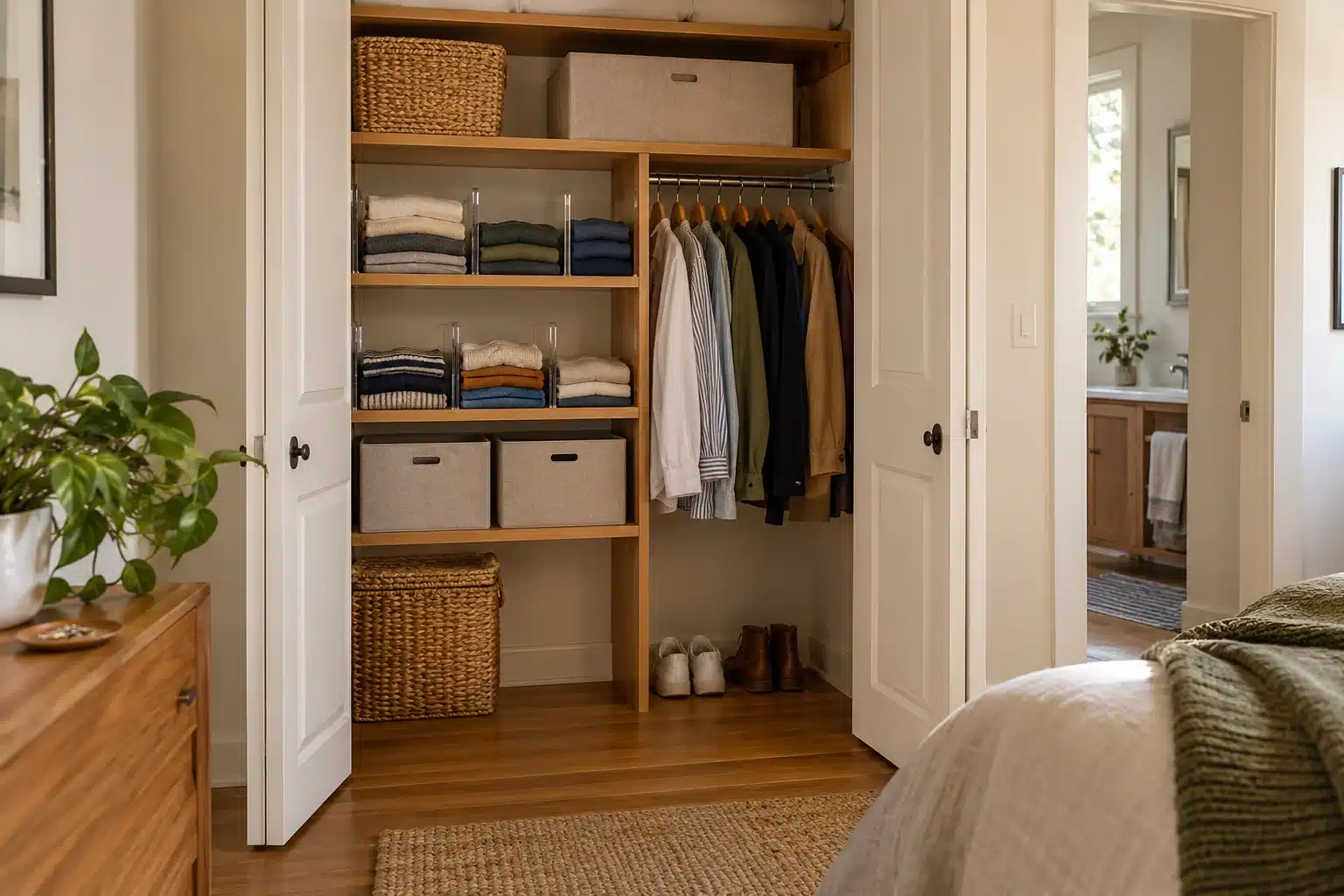
Closet shelf organization for folded clothes improves when the shelves match the way you retrieve and return garments. Begin with the items you wear most, fold a few to a repeatable footprint, and measure them. Then decide which shelves need short stacks, open bins or dividers. You do not need identical containers across every level.
This guide keeps existing shelves useful rather than redesigning the whole closet. Use our small closet layout guide for hanging and overall zones. If the room has no built-in closet, start with a separate bedroom clothes zone.
In this guide
1. Audit closet shelf organization for folded clothes and shelf openings
Empty one shelf and sort its contents by use: current everyday clothes, occasional garments and seasonal extras. Keep laundry and repairs separate while you work. Count the categories that need to return, then identify whether the shelf is failing because stacks fall sideways, small items disappear or the back row is inaccessible. Those are different problems with different solutions.
Measure clear width, depth and the gap to the shelf above. Check the front opening with closet doors in their normal positions; sliding doors may expose only part of a wide shelf at once. Note hinges, rails and hanging clothes that intrude into the opening. A bin can fit on the shelf but still be impossible to remove straight through the door.
Inspect shelf supports and consult their capacity guidance before adding loaded containers. An organizer does not strengthen a shelf. A bowed board, loose bracket or missing support deserves attention before restocking. Use the instructions for the actual system rather than transferring a load rating from a shelf with a similar appearance.
Write the failure beside the shelf measurement. Closet shelf organization for folded clothes needs a different response for hidden garments, leaning stacks or a crowded return step. Choose one current problem shelf and keep the remaining shelves usable while you trial a change, rather than emptying the whole wardrobe into the bedroom.
2. Choose a fold that fits the available depth
Fold three examples from each main garment group, including the largest size or bulkiest fabric. Measure their width, depth and thickness without pressing them flat artificially. A T-shirt, hoodie and pair of jeans rarely produce the same stack. You can use a shared width while allowing different depth or height where the clothes need it.
For a shelf 14 inches deep, imagine a folded shirt footprint 10 inches wide and 11 inches deep. The spare depth can provide finger access or room for a bin wall; it is not a reason to hide another daily stack behind the first. These are example dimensions. Your clothes and shelf determine the fold, so adapt the method instead of forcing thick garments into a miniature shape.
File folding works best in a suitably sized bin or drawer where the garments remain upright as items are removed. On a bare shelf, narrow folded parcels may topple. Conventional flat stacks can be easier for bulky knits. Follow garment care guidance when deciding between folding and hanging, and preserve a shape that avoids unnecessary strain on delicate fabrics.
Keep one sample fold from each garment group while comparing organizers. Closet shelf organization for folded clothes should use the filled garment footprint, not a tightly pressed demonstration. Return the sample to its ordinary shape and check that your preferred method still fits after the clothes are washed and folded again.
3. Compare closet shelf organization for folded clothes
| Method | Good use | Fit check |
|---|---|---|
| Short open stack | Bulky or easily recognized garments | Bottom item removable without collapse |
| Shelf divider | Separating neighboring stacks | Shelf thickness, depth and divider height |
| Open handled bin | Small garments or file-folded shirts | Door opening; hand space; filled weight |
| Shallow tray | A few accessories or lightweight folded items | Useful depth and graspable front edge |
| Lidded container | Infrequent clean seasonal clothing | Lid-opening and full removal space |
Open stacks let you see colors and categories at a glance but need enough separation to survive daily use. A divider is useful when stacks lean into each other; it does not fix a stack that is too tall to handle. Bins contain smaller parcels and can act as removable drawers, but each bin wall uses space and each loaded bin must be manageable.
Integrated wardrobe components are not universal. The IKEA KOMPLEMENT shelf specification says that this version fits its designated PAX frame and refers readers to exact product dimensions. Check compatibility as well as nominal width when buying replacement shelves or system dividers. Matching the label “20 inches” alone is insufficient.
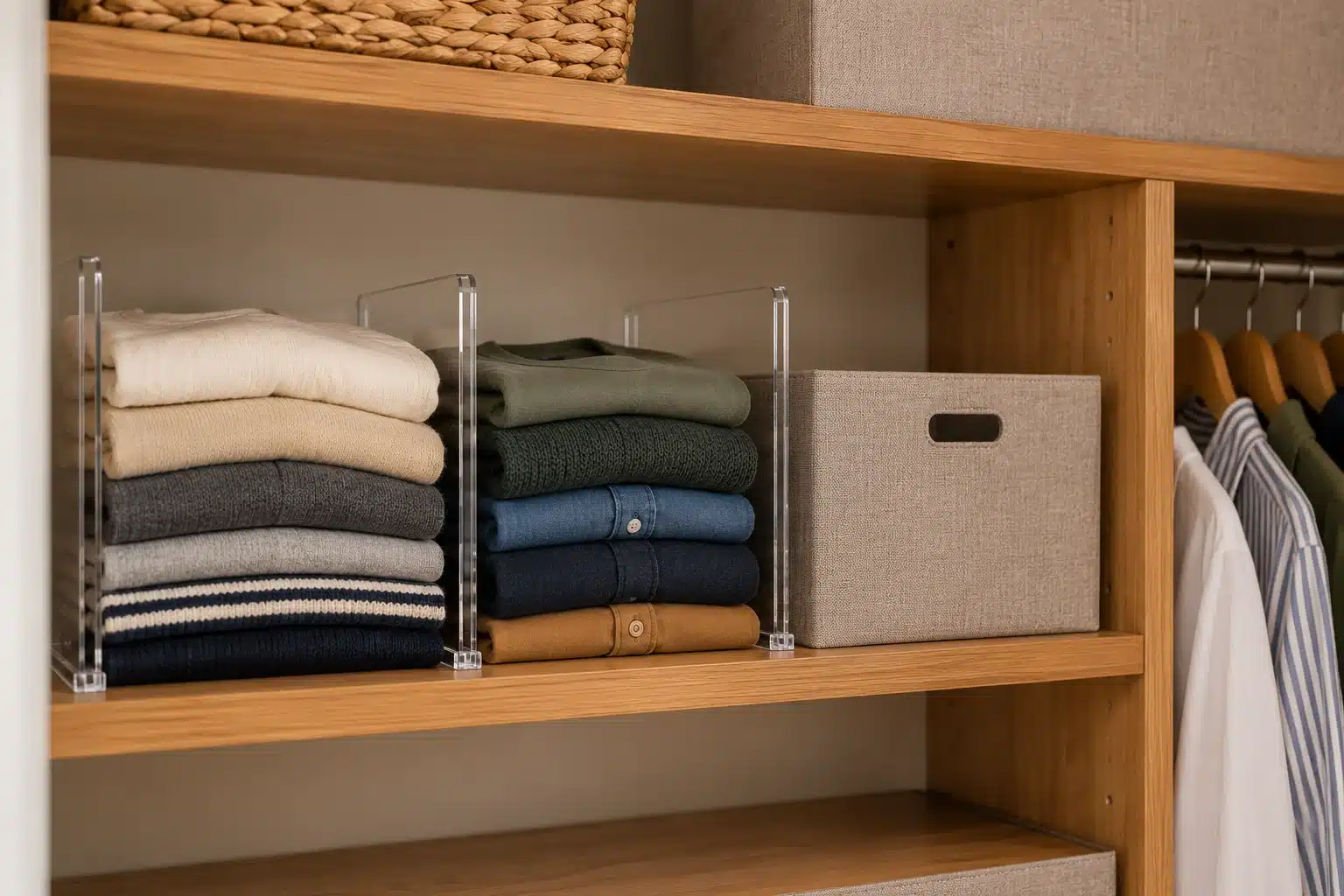
Trial the simplest method first. Closet shelf organization for folded clothes may need only two shorter stacks, rather than a new collection of bins. Add a divider when adjacent groups merge; choose a removable bin when it brings small items forward. Check how each option behaves after one garment is removed.
4. Arrange shelves by comfortable reach
Use the easiest reachable shelf for daily folded clothes. Put frequently used T-shirts, sleepwear or jeans where you can identify and retrieve them without lifting a heavy container overhead. Position small accessories in an open bin or shallow compartment nearby. This working zone should remain useful when you are tired or putting clothes away quickly.
Reserve higher shelves for light occasional items you can safely retrieve using an appropriate method. Do not place a heavy packed bin high merely because it looks neat in an illustration. Lower shelves can suit bulky garments or manageable baskets, but consider bending and the closet doorway. A low position is not automatically comfortable for every user.
In a shared closet, divide a useful shelf horizontally or give each person a reachable level. Labels can name the person or garment category. Avoid making one person’s entire daily wardrobe accessible only behind the other’s stacks. Agree on the boundary before buying dividers, and leave an obvious return location for laundry.
Test both the morning selection and the laundry return at the proposed height. Closet shelf organization for folded clothes should be comfortable in both directions. If you can pull a shirt down but cannot see where to return it, use an easier level for daily clothes and reserve that position for suitable occasional items.
5. Use a measured example to size stacks and bins
Suppose a shelf has 30 inches of clear width, 14 inches of usable depth and 12 inches between levels. Three shirts folded 10 inches wide do not make three effortless lanes: the arithmetic leaves no space for dividers, hands or slight differences between garments. Two relaxed stacks with a small accessory bin may function better. Capacity should reflect retrieval, not just geometric packing.
For a bin, compare external and internal dimensions. A hypothetical bin 12 inches wide outside may offer less than 11 inches inside after walls and a handle are accounted for. Place a few folded garments inside a comparable existing container. Check that you can grasp the handle and lift the bin past the shelf above when filled.
Now consider a 24-inch-deep shelf. Two rows of daily stacks can hide the entire rear group. Use the front for current clothes and an explicitly occasional rear zone only if you can retrieve it. Alternatively, choose a suitably deep removable bin that brings its contents forward. Do not add more bins until you have confirmed how their loaded depth passes the door.
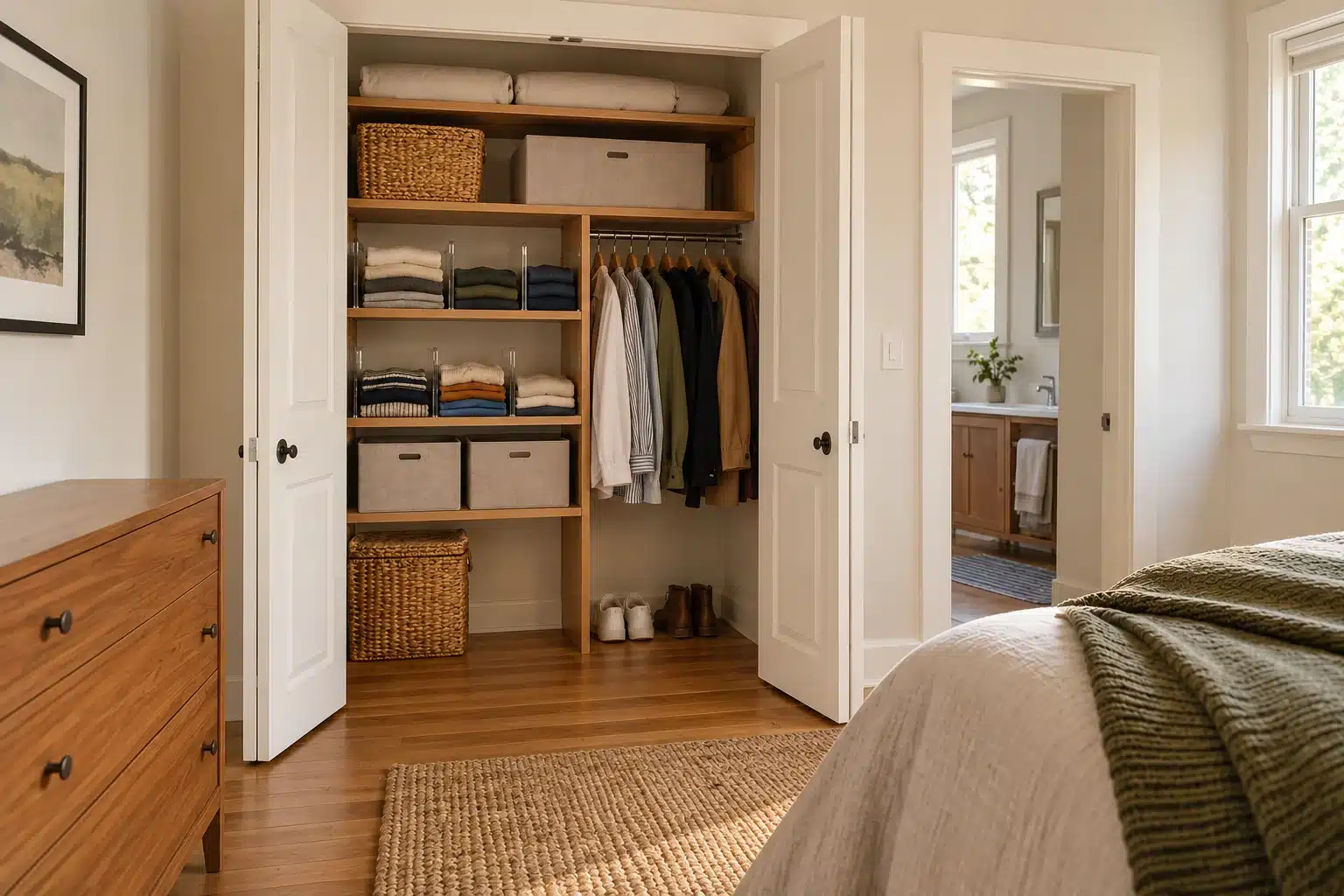
Calculate usable lanes after allowing for bin walls, dividers and handling. Closet shelf organization for folded clothes is not a tight packing puzzle. Mark the candidate stack widths on the bare shelf, place real garments there and remove a bottom item before deciding how many lanes the shelf can support in daily use.
6. Make the laundry return easy to maintain
Organize around the return step as well as the morning selection. If putting away one shirt requires removing a lid, lifting a tall stack and rebuilding two rows, the shelf will drift into disorder. Leave enough working room to return a garment directly. Keep categories broad enough that every ordinary item has an obvious home.
Use a stack size you can manage with the clothes you own. There is no universal number of garments per stack: five thin shirts occupy a different height from five sweaters. Pull a bottom item during the trial. If the stack collapses, reduce its height, move it to a bin or revise the fold. A divider may contain sideways movement but does not change the bottom-item problem.
Rotate seasonal clothing deliberately. Move the current season into the easy zone and label the occasional container with its contents. Check the label before putting away fresh laundry so old and new groups do not merge. Keep only clean, dry clothes in storage, and inspect them when rotating rather than leaving a sealed container indefinitely.
Leave a clear return position for each ordinary clothing category. Closet shelf organization for folded clothes becomes harder to maintain when fresh laundry has no obvious destination. If a shelf is only tidy while half the clothes are being washed, test it again after the whole usual wardrobe returns.
7. Check organizers and avoid common limits
- Measure divider attachment thickness and confirm the shelf material is suitable.
- Check the divider’s front projection and height against doors and the shelf above.
- Compare bin internal dimensions with the actual garment footprint.
- Include handles and loaded bulging in the external fit.
- Confirm care instructions for fabric and rigid containers.
- Check shelf capacity, support condition and system compatibility.
Wire shelves need accessories designed to work with their construction. A clip for a solid board may not attach securely to wire. Likewise, hanging fabric shelves add weight to their supporting rail and may narrow the hanging zone. Consult that product and rail guidance if introducing them; this article does not assume an existing rod can carry any added organizer.
Do not buy a full collection simply to match colors. An open tray for socks and a short uncovered stack for knitwear can be more useful than identical deep boxes. If visibility is important, use clear labels or accessible open fronts. If dust protection is the priority for occasional clothes, a removable lidded container may suit that specific zone.
Organization cannot create unlimited wardrobe capacity. If the shelf fails whenever laundry returns, compare the amount of clothing with the space assigned to it. Reallocate an occasional category or reduce excess duplicates where appropriate. Keep the easiest shelf for the garments you actually use rather than letting untouched clothes control the layout.
Keep the organizer instructions with your measurements. Closet shelf organization for folded clothes must account for shelf construction and attachment compatibility as well as appearance. Trial one shelf before buying a full set; a divider that catches the door or prevents bin removal will repeat that problem on every matching shelf.
A shelf worksheet and a shared-wardrobe trial
| Record for your own room | Your notes |
|---|---|
| Clear shelf width, depth and vertical opening | ________________________ |
| Shelf material, support condition and instructions | ________________________ |
| Visible door opening at the intended position | ________________________ |
| Largest folded garment in each everyday category | ________________________ |
| Space for fingers, dividers and bin walls | ________________________ |
| Loaded bin removal and comfortable lifting position | ________________________ |
| Daily versus occasional clothing allocation | ________________________ |
| What returns after the usual laundry cycle | ________________________ |
| One failure to resolve before buying organizers | ________________________ |
Use the worksheet on one shelf at a time. Include clothing temporarily in the laundry so the plan represents the full ordinary wardrobe. Record a folded garment’s relaxed shape rather than pressing it down to make the arithmetic work. Shelf dividers and bins should be compared with that shape and the real doorway, including the space needed for your hands when retrieving or returning folded clothes.
Imagine a shared wardrobe where two people each use T-shirts, jeans and sleepwear but have different clothing amounts. They start by clearing one reachable shelf, counting the current categories and separating occasional extras. The goal is to return folded clothes without rebuilding another person’s stacks. They mark a boundary based on the actual wardrobe and reach, rather than splitting the shelf into equal halves solely for appearance.
The first trial uses short open stacks without new accessories. Each person removes a bottom item, then returns one freshly folded garment. One stack stays stable, while the neighboring shirts lean into sleepwear. That second problem may justify suitable shelf dividers. It does not justify putting every category in a lidded bin, because the successful open stack is already visible and easy to maintain.
Next, they measure the shelf construction and opening before trying one divider. Its attachment must match the shelf, its height must clear the level above and its front edge must not obstruct the door. Shelf dividers separate adjacent groups; they are not added structural supports. If the shelf itself bows or its bracket is loose, the supporting system needs attention before either person returns loaded organizers.
Small garments need a different trial. Socks disappear within a broad mixed stack, so the household compares a shallow existing tray with an open bin. They check internal dimensions, filled weight and finger access at the front. The bin wins only if it comes out easily through the door and the contents stay identifiable. The tray may be sufficient when it solves the problem with less occupied shelf depth.
Now repeat the trial after ordinary laundry returns. Folded clothes that were absent during planning can reveal overcapacity. If the daily lanes become packed, move an appropriate occasional category to its designated position or review duplicate garments. Do not keep buying narrower shelf dividers to make increasingly tall stacks appear separate. The useful capacity is the amount that remains manageable through selection and return.
For a deep shelf, agree which category can occupy the rear and how it is retrieved. The rear zone should not hide another set of daily folded clothes behind the front row. A removable container may bring occasional contents forward if its size and weight suit the doorway and user. Label that container by purpose, and test full removal rather than assuming that deep storage is available just because the board extends backward.
Keep the successful method modest: one clear boundary, suitable shelf dividers where they solve leaning, and a specific small-item tray if needed. Review it after a normal laundry cycle. If return remains awkward, note whether the cause is stack height, inaccessible depth or an overfilled category. Change that feature before buying a coordinated organizer collection. The goal is a shelf each person can read and maintain with their actual clothes.
Questions about closet shelf organization for folded clothes
Should I fold every garment the same way?
No. Aim for repeatable shapes within a category and adapt to fabric bulk. A hoodie and a lightweight shirt need different room. The fold should suit both the garment’s care needs and the shelf opening.
Are shelf dividers worth adding?
They help when neighboring stacks merge or lean sideways. Measure compatibility first and trial one problem shelf. If the issue is inaccessible depth or unstable tall stacks, a different layout may matter more.
Can I keep two rows of clothes?
Use a rear row only for a deliberate occasional category that remains retrievable. Daily clothes hidden behind other daily clothes are difficult to scan and return. A removable bin may improve access if its loaded size and weight are manageable.
How do I keep small items from disappearing?
Use one shallow open compartment for a specific category, such as socks. Make it visible and easy to remove. Avoid a large mixed basket that forces you to search through unrelated accessories each morning.