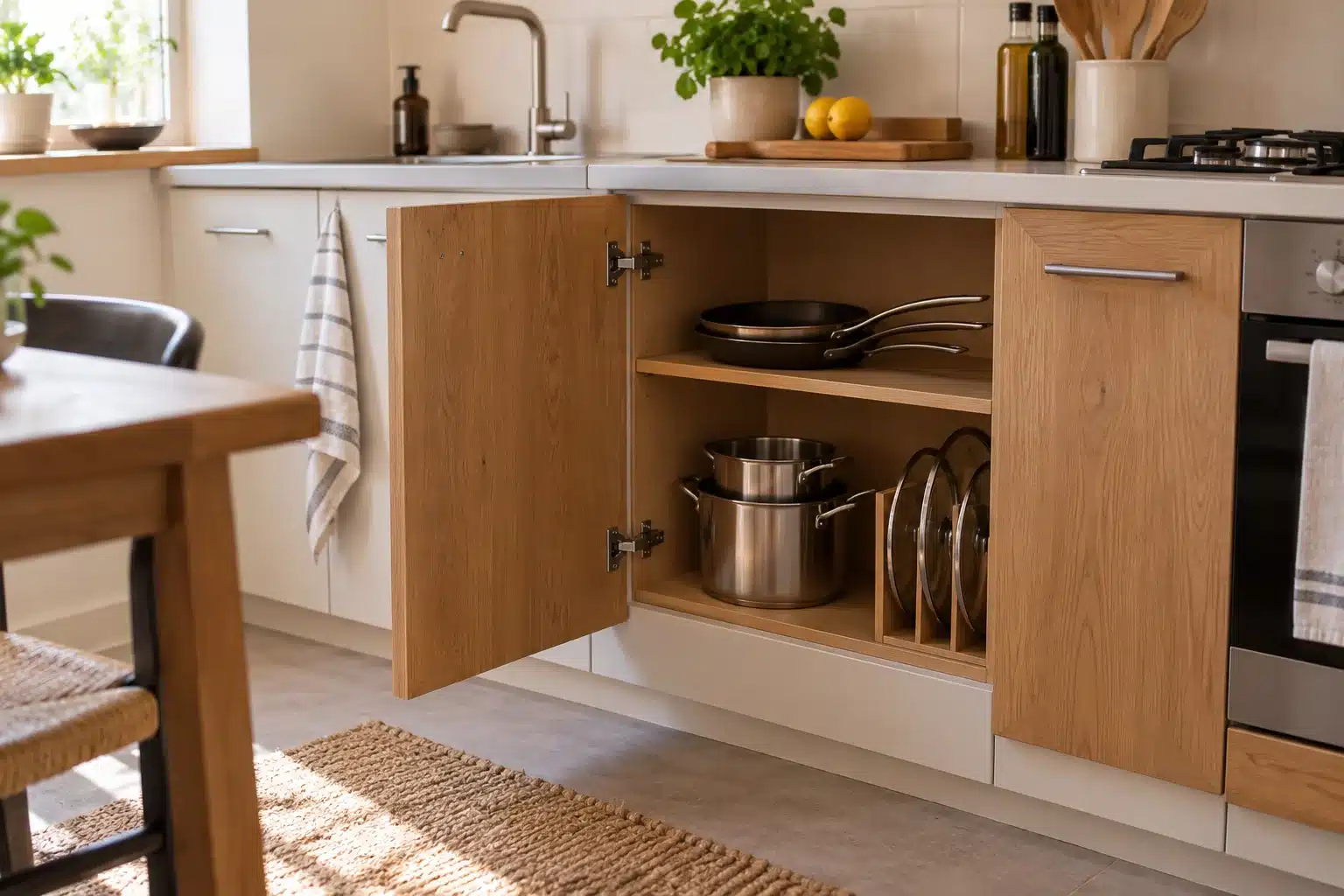
Pots and pans storage for small kitchens works when the pan you need comes out without a balancing act. Start with a lower cabinet or suitably rated drawer, measure handles and lids, and give everyday cookware the easiest access. A shorter stack with a separate lid home often solves more than a complicated rack.
This guide focuses on cookware. If the worktop is your main bottleneck, pair it with our small-kitchen counter-space guide. Keep food allocation separate using our guide to a small kitchen without a pantry.
In this guide
1. Prioritize pots and pans storage for small kitchens
Begin pots and pans storage for small kitchens by laying out clean, cool, dry cookware. Identify the pieces used during an ordinary week: perhaps a frying pan, saucepan and larger pot. Put occasional roasting dishes and specialty pans in a second group. You are deciding access priority, not imposing a particular number of possessions. A household that batch-cooks needs a different collection from one that mostly prepares single portions.
Plan pan storage by matching each lid to a pan and checking whether any lids serve several pieces. Keep a small note of those pairings if they are difficult to recognize. A lid with no matching pot should not claim the same convenient position as the one you reach for nightly. Avoid disposing of cookware during a rushed reset; first establish whether another household member uses it.
For cookware storage, notice weight as well as frequency. A heavy casserole used once a month may still need a low, easy lifting position. Putting it above head height because it is occasional trades convenience for an awkward lift. The light seasonal baking tin can take a less convenient shelf instead.
2. Measure the opening, handles and full stack
Record clear opening width, interior depth and usable shelf height. Include a center stile, hinges and any shelf lip. Then measure the largest pan from handle tip to opposite rim. A nominal 10-inch pan can occupy substantially more storage depth once its handle is included. Measure a two-handled pot across both handles too.
For example, an opening 15 inches wide might lead into an 18-inch-wide cabinet. A 16-inch organizer may fit inside but fail to pass through the opening as assembled. Check assembly instructions before assuming that installing it inside solves the problem; a pull-out component still needs to travel through the doorway. These figures illustrate a fit check and do not describe a standard cabinet.
Measure the complete nested stack with the protectors you intend to use. Leave enough room to grasp the top item and lift it clear. For lids, include the knob’s projection and the height needed to lift a lid out of its slot. A photograph showing flat discs cannot tell you whether your domed glass lids will fit.
Worked example: a cabinet with one awkward handle
Imagine a lower cabinet with a 38 cm clear opening, 44 cm interior depth and two supported levels. The frying pan measures 29 cm across its rim but 48 cm from handle tip to the opposite edge. These example dimensions explain the check; they are not product specifications. The pan body fits the shelf, yet the whole pan does not fit straight front to back. Measure a diagonal orientation if the shape and retrieval permit it, or choose another position.
Add the everyday saucepan and its lid to the test. The saucepan fits beneath a shelf riser when empty, but its upward handle catches the riser during removal. A photograph of the pot beneath the riser would miss that movement. Cookware storage needs the full retrieval route, including hand space and the path taken by the handle. Reject a riser that turns every meal into lifting and rotating a loaded collection.
Now test a shorter nested group without the riser. Put suitable surface protection between compatible pans as their care instructions recommend. Measure the complete stack and try retrieving the pan used most often. If the frying pan sits at the bottom, the arrangement may save shelf area but require moving several pieces to the worktop. Pan storage should consider that temporary landing space too, especially when the counter is already scarce.
Move the everyday pan to its own supported position and keep occasional compatible cookware in the other group. Put matching lids in a stable nearby section with their knobs included in the measurement. This cookware storage plan uses a little more width for the frequent pan but reduces handling during cooking. Judge it by the meal routine, not by whether every object forms one compact stack.
| Record for each item | Example entry | Check during retrieval |
|---|---|---|
| Full pan size | 29 cm rim; 48 cm including handle | Can the whole shape pass the opening? |
| Stack height | Measure with suitable protectors | Can the top item lift clear? |
| Lid projection | Include knob and rim | Does it leave its slot independently? |
| Temporary landing | Top pieces moved off a stack | Is there a stable suitable place for them? |
3. Compare pots and pans storage for small kitchens
| Arrangement | Useful when | Main tradeoff | Fit check |
|---|---|---|---|
| Short nested stack | A few compatible pans share a cabinet | Lower pans require lifting the top items | Stack height and handle direction |
| Separate shelf levels | Cabinet height is underused | A riser occupies width and has its own load limit | Supports, weight and grip space |
| Vertical divider | Lids, trays or suitable pans need individual access | Uses more width than nesting | Slot width, knobs and rack stability |
| Deep drawer | Cookware can be lifted from above | Loaded weight may be considerable | Runner capacity and closing height |
| Installed hanging rail | A suitable wall and approved fixings are available | Cookware projects into the room | Support rating and occupied route |
Choose pots and pans storage for small kitchens by the handling it saves for your actual collection. Vertical pan storage looks orderly but can consume the width needed for a large stockpot. A shallow drawer suits lids yet may not close over a deep saucepan. Combining two simple methods usually beats forcing every item into one organizer.
4. Build a low stack that protects surfaces
Start with the largest compatible pan on a stable, supported surface, then nest smaller pieces only when their shapes and care instructions permit. Avoid wedging handles between rims or loading a small, delicate pan with a heavy pot. If retrieving the bottom pan requires holding several heavy pieces in one hand, separate that pan onto another shelf.
Use suitable pan protectors where the manufacturer recommends them for a coated or enameled surface. They belong between cool, dry pans; they are not a place to set hot cookware. Do not assume every liner is heat resistant because it is sold near kitchen accessories. Check that protector edges do not catch on hinges when the stack moves.
Cast iron needs material-specific care. Lodge’s cast-iron bakeware guidance stresses keeping pieces dry and seasoned, and making both cookware and removable grips fully dry to avoid rust. Apply your own cookware maker’s instructions. Choose a suitable dry cookware zone rather than a cabinet beneath a sink that has recurring dampness.
Try pan storage with the existing collection
Start with a clean, cool collection and assign the cabinet before choosing accessories. Keep the pieces used during an ordinary week in front. Give an occasional lightweight baking tin a less convenient suitable location if that releases space for a heavy everyday pot. Cookware storage should accommodate weight as well as frequency; moving a heavy casserole high above the user is not a helpful exchange.
Use a stable existing container only for lids or other items it can support appropriately. Check its base, width and edges, then test removing a lid without pulling neighboring pieces forward. A makeshift container that slides, tips or presses on glass is a failed trial. Pan storage does not need a purchased divider, but it does need a reliable arrangement. Keep the least stable idea out of everyday use until you have a suitable alternative.
Write down the one unresolved obstruction. It may be handle interference, a lid knob catching the shelf above, a deep rear row or lifting effort. Compare accessories against that obstruction. A vertical divider addresses individual removal of suitable flat items; it will not make a deep pot shallower. A shelf riser can separate levels where geometry and load permit; it cannot increase the cabinet or shelf capacity beyond its documented limits.
When a product appears useful, compare its entire frame and installed footprint with the cabinet sketch. Include feet, side rails, mounting hardware and travel for any pull-out. For cookware storage in a rental, distinguish a removable organizer from an alteration to the cabinet. Use approved installation where required. Try only one change at a time so you can tell whether the pan storage improves or whether the extra frame merely consumes the space you needed.
5. Give lids a separate, visible address
Keep pan lids near the corresponding cookware without resting a loose tower of glass on top. A low freestanding divider can work if the base is stable and slots hold each lid without pressure on its rim. Arrange knob projections so neighboring lids can slide out individually. Keep the largest or heaviest lid where it can be lifted without reaching over fragile pieces.
A door-mounted rack is another possibility, but measure its projection with lids loaded and the door closed. Check the cabinet door’s construction, hinge capacity and the rack’s installation instructions. A rack that clears an empty shelf may collide with a pan handle once the cabinet is stocked. Mounting hardware also needs permission where the cabinet belongs to a landlord.
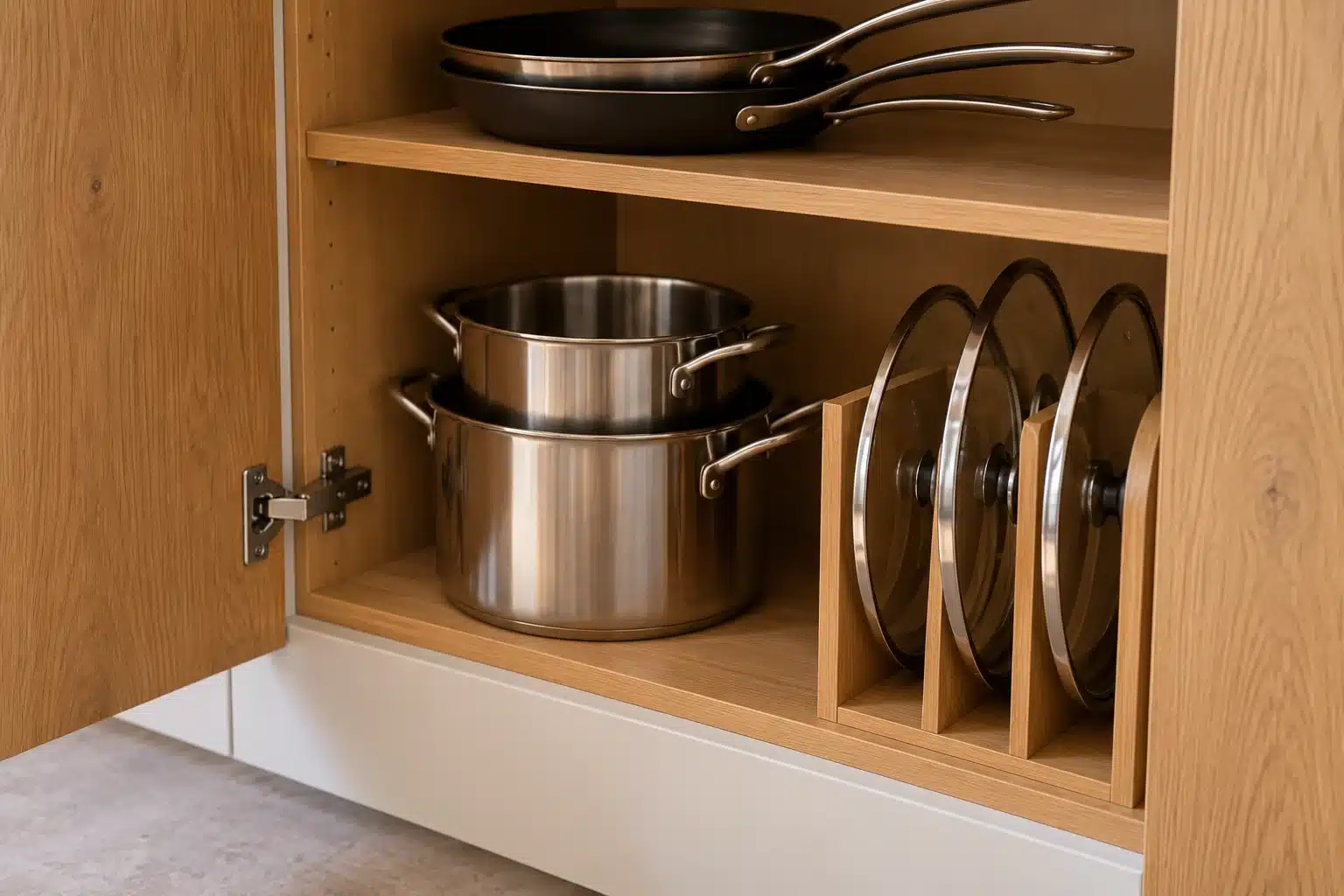
To trial pots and pans storage for small kitchens without buying a divider, place suitable lids upright in a stable existing container that holds their weight and keeps them from rolling. Test removal with one hand while the other holds a pot. If the container slides, tips or squeezes lids together, change the arrangement before treating it as permanent storage.
6. Use drawers and racks within their actual limits
A drawer can make cookware storage easier to see at the rear, but its rated load includes everything stored inside. Add cookware weights when they are available, including lids and the organizer itself. If the cabinet documentation gives no reliable capacity, avoid treating a smooth-moving empty drawer as proof that it can carry a dense cast-iron collection. Ask the cabinet supplier about suitable use.
A shelf riser can create two retrieval levels for light or moderate cookware when it is rated for that load. Its legs must sit firmly on the shelf rather than against a hinge or pipe. Measure the space beneath it: pan handles may prevent a saucepan sliding out even when the pot body fits. Keep heavy pieces on the cabinet’s appropriately supported base when that is the better arrangement.
Hanging rails require suitable fixings and installation. Adhesive hooks with an unspecified cookware capacity are not a useful shortcut for a heavy pot. Position any approved rail so hanging pans avoid burners, door swings and the normal walking route. Open storage also exposes cookware to dust and cooking residue, which adds cleaning work.
7. Test pots and pans storage for small kitchens during a meal
Return the everyday collection to the proposed setup and make a dry run of a typical meal. Retrieve the frying pan, find its lid, then take out the saucepan. Notice what has to leave the cabinet temporarily. If three displaced pieces cover your only preparation area, give the frequently used item its own position even if the resulting arrangement appears less compact.
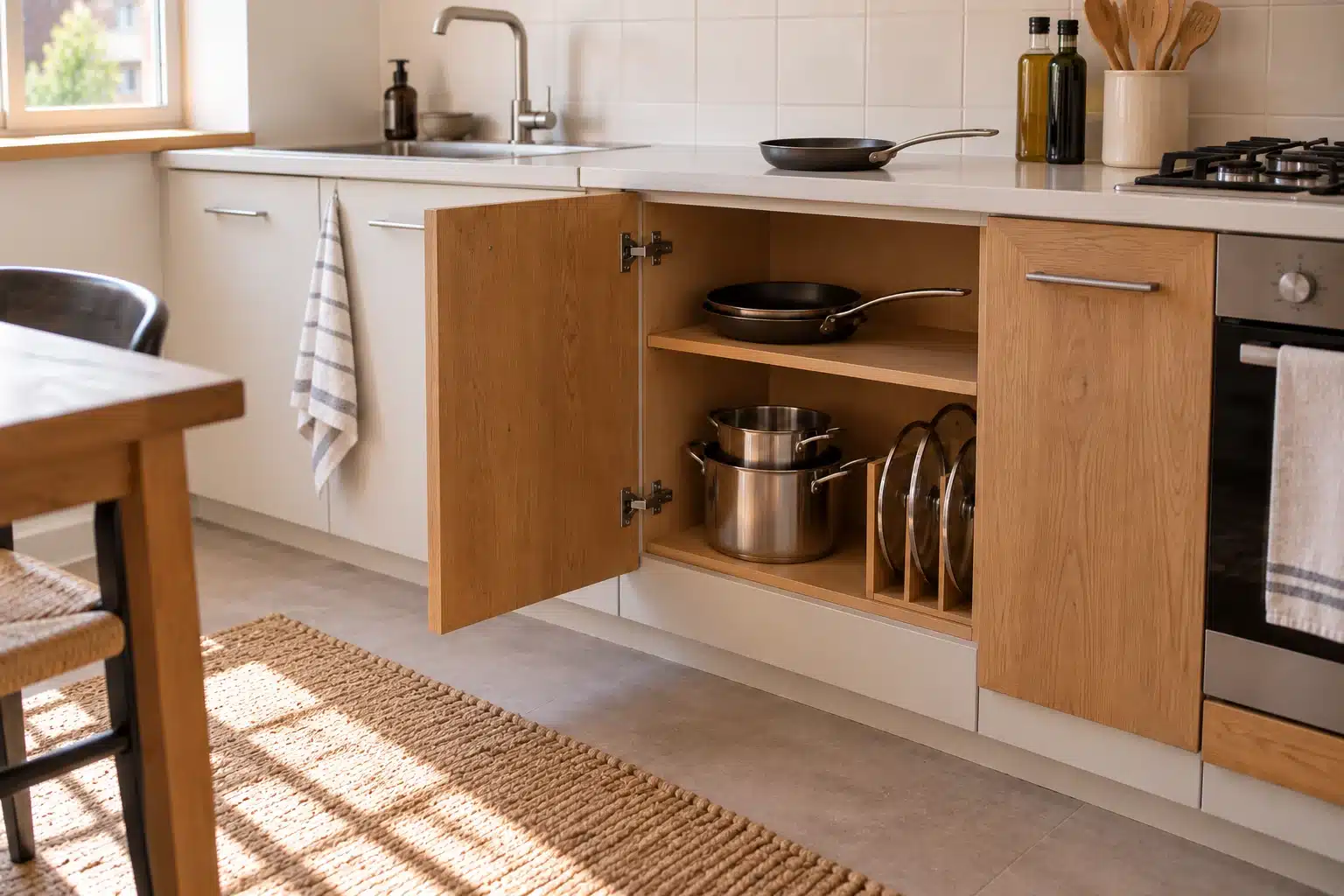
Next, simulate returning clean cookware. The arrangement should work when several pans need putting away, not only when one comes out. Let washed pieces dry properly before storage and keep cleaning methods appropriate to their materials. Do not use an oven as an automatic overflow cupboard; forgotten stored items create a problem when someone preheats it.
Make a cabinet note for the three pieces you reach for most: pan and handle dimensions, matching lid position, and which items must move to retrieve it. If the everyday frying pan requires moving two heavy pots, give it a separate supported position before adding another divider.
Review pots and pans storage for small kitchens after a normal week, then move only the item that caused repeated trouble. Keep handles consistently oriented, remove a divider that makes access worse, and move a rarely used piece if it occupies the best shelf. A useful reset leaves a repeatable routine rather than requiring the household to reconstruct a display after every meal.
A cookware storage worksheet for the meal trial
Choose a familiar meal requiring two or three pieces. Record which pan comes out first, where its matching lid sits and what temporarily leaves the cabinet. Cookware storage that passes an empty-cabinet demonstration may become awkward when one piece is in use and another needs retrieval. Try the sequence with clean cool cookware as a planning exercise before judging the final layout during ordinary cooking.
Check the return sequence too. After washing and drying in a way appropriate to each material, can you replace one pan without unpacking the whole shelf? Does its handle go to a consistent position? Does the lid section remain recognizable? Pan storage should work when different household members return different pieces. A plan that depends on a hidden nesting order needs a simpler allocation or an easy visible explanation.
If a drawer strains or cannot close over the stack, unload and check geometry and documented limits. Do not take smooth movement of an empty drawer as evidence that a heavy collection is suitable. If the cabinet condition or capacity is unclear, use supplier guidance before assigning the load. The alternative may be changing which pieces live there, not buying hardware advertised as heavy duty without checking the complete installation.
Keep a brief review note after several ordinary meals: piece, obstruction and one adjustment. Use it to move a frequent pan forward, change lid orientation or reduce an unnecessary nested group. Stop adding pan storage accessories once the everyday collection comes out and returns reliably. The purpose of pots and pans storage for small kitchens is useful access; a full cabinet with no workable hand space has missed that purpose.
| Meal task | Write what happens | Decision |
|---|---|---|
| Retrieve first pan | What must move first? | Separate a frequent piece if handling is excessive |
| Find its lid | Is the match visible? | Give lids a stable recognizable section |
| Retrieve second pot | What landing space is used? | Preserve a suitable temporary surface |
| Return dry cookware | Does the same order work? | Simplify the group or orientation |
Record the final cookware allocation
Draw two simple shelf outlines and write the name of each pan in its proposed position. Add its lid location, handle direction and any suitable protector used. Cookware storage is easier to maintain when another household member can see which group receives a clean item. Avoid a diagram that assumes all pieces are present; check that the arrangement also works when the frying pan is on the stove and only its lid needs returning.
For pan lids, record which lids share a pot and which need their own slot. If a lid will be stored inside an occasional pot, check that this is compatible with the finish and shape. Pan storage should not need a separate divider for every object when a suitable simple grouping works.
Retain the load and installation information for any new drawer or rack with the cabinet notes. Compare pan storage again if the collection changes, especially when a new heavy item replaces a lighter one. The meaningful stopping point is predictable retrieval and return, not using every empty centimeter of the cabinet.
Questions about cookware in a small kitchen
Is it better to stack pans or store them upright?
Stacking uses less width; upright storage can provide easier individual retrieval. Compare the weight, material, handles and available cabinet dimensions. Use the method that suits each group rather than applying one method to every pot and pan.
Can I store lids inside their pots?
Yes, where the lid and pot can sit safely without damaging a finish or making the stack awkward. It can be useful for an occasional pot. A separate lid section is often easier for everyday cookware because it avoids unpacking several pieces to find a match.
Will a new nesting cookware set solve the cabinet?
It may help if your existing collection is due for replacement and the new set fits your cooking needs. First measure what you own and try a simpler arrangement. Buying a second set creates more storage demand unless the original cookware has another appropriate destination.
What if no organizer fits?
Use individually placed pans, a small lid container and an adjusted shelf where permitted. The cabinet does not need to contain a commercial organizer to function well. Reassigning a light serving bowl can free a better cookware position with no installation.