
The smartest suitcase storage in a small apartment is to stop treating suitcases as empty boxes. Nest the smaller bags inside the largest one, fill the gaps with things you rarely use, like spare bedding or winter sweaters, and put the whole set in one spot you only open a few times a year: the top closet shelf, under the bed, or the back of the closet floor.
One large checked bag holding a carry-on, a duffel and a winter blanket takes the same space as the large bag alone. That is the whole trick, and it works in any apartment size.
In this article
Start with the sizes you actually own
Luggage comes in a fairly predictable range, which makes suitcase storage easy to plan.
| Bag | Typical outside size | Where it usually fits |
|---|---|---|
| Carry-on spinner | About 22 x 14 x 9 in | Under most beds, top closet shelf, inside a large suitcase |
| Medium checked bag | About 24 to 26 in tall | Closet floor, top shelf of a deep closet |
| Large checked bag | About 28 to 30 in tall | Closet floor, behind a door, or as the outer shell for the others |
| Soft duffel | Folds nearly flat | Anywhere; inside another bag or in a drawer |
Measure your bags before you pick a spot, because “carry-on” means different things to different brands. The depth is the number that matters most for under-bed storage, and the height matters most for closet shelves.
Nest your bags before you find them a home
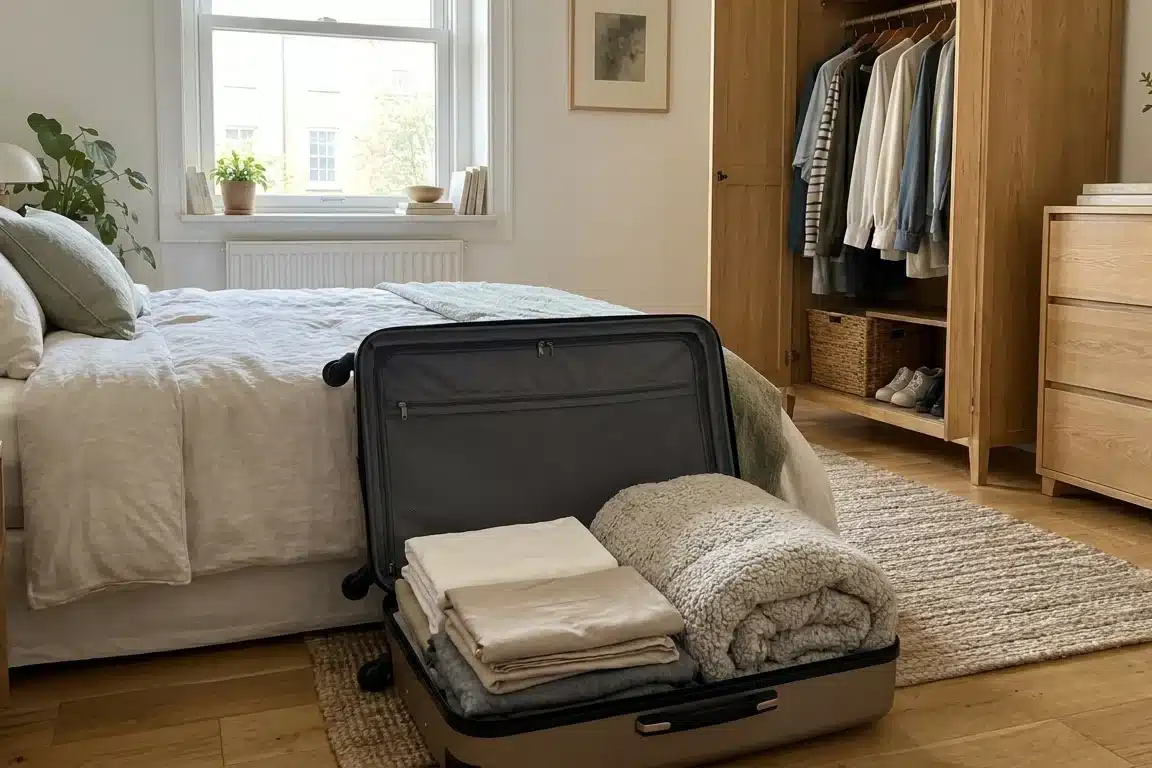
Nesting cuts the suitcase storage problem down to one object. Here is the order that works for most sets:
- Open the largest suitcase flat on the floor.
- Put the next size down inside it. Most medium bags fit inside a large one if the wheels and handles are on the same end.
- Fold soft duffels and packing cubes flat and slide them into the gaps.
- Fill the remaining space with soft, light items you only need once or twice a year: spare sheets, a guest duvet, off-season sweaters, swimsuits in winter.
- Close it and put a note on the handle listing what is inside, so you do not unpack the whole thing looking for a beach towel in July.
Skip anything heavy, anything you need often, and anything with food or strong scents. A suitcase is a closed box, and closed boxes hold onto smells.
The best spots for suitcase storage in a small apartment
Which spot is best depends on your closet and your bed, not on what looks nicest. Here they are in the order I would try them.
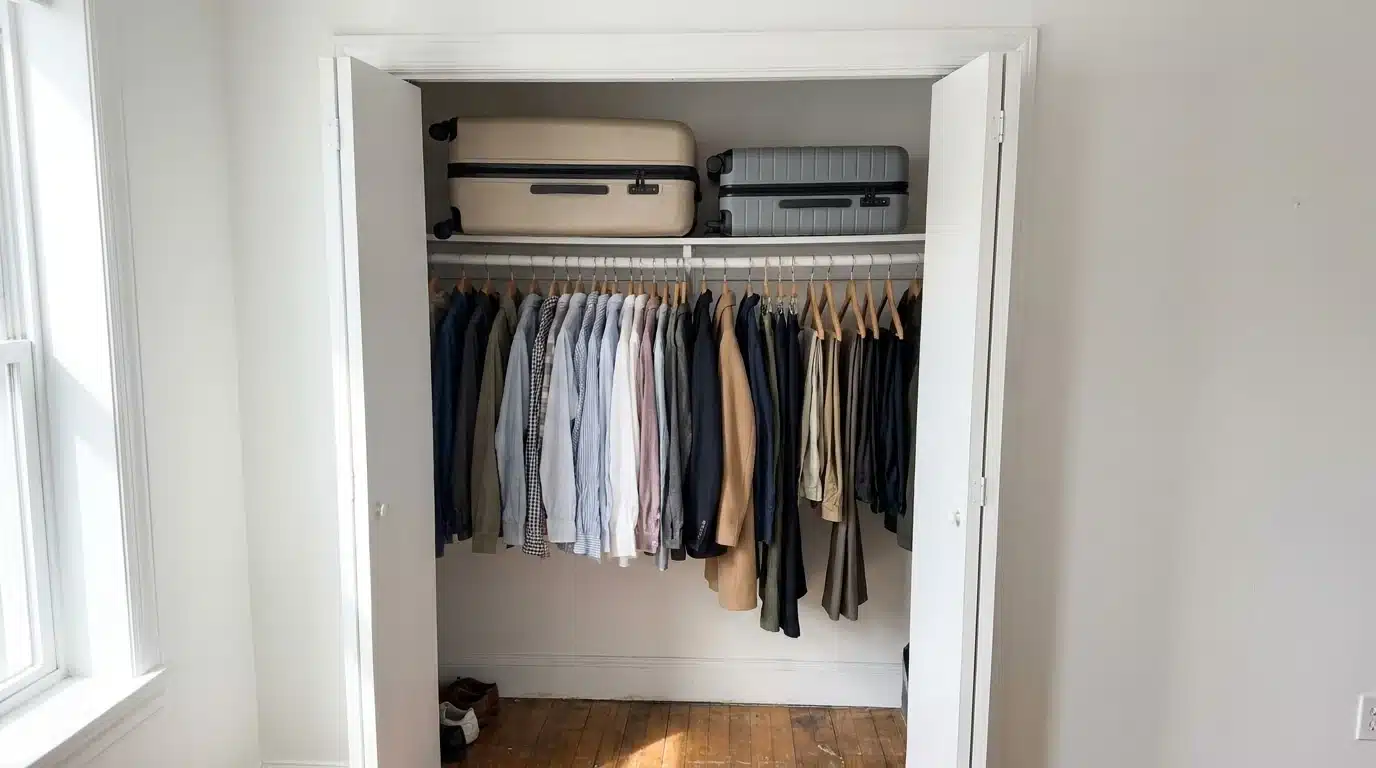
The top shelf of a bedroom or hall closet
The shelf above the hanging rod is the most wasted space in most reach-in closets, and suitcases suit it well because you rarely need them. A standard reach-in closet is about 24 inches deep, and many closet shelves are a little shallower, around 12 to 16 inches. A 16 inch shelf holds a carry-on lying flat; on a 12 inch shelf it will stick out a couple of inches, which is usually fine. A large checked bag will hang well over the edge of either.
If the shelf is shallow, store the carry-on there and the large bag on the floor. If it is deep and solidly supported, the whole nested set can go up there. Lifting a full large suitcase overhead is awkward and heavy, so keep anything stored on a high shelf light enough to lift with one hand.
Under the bed
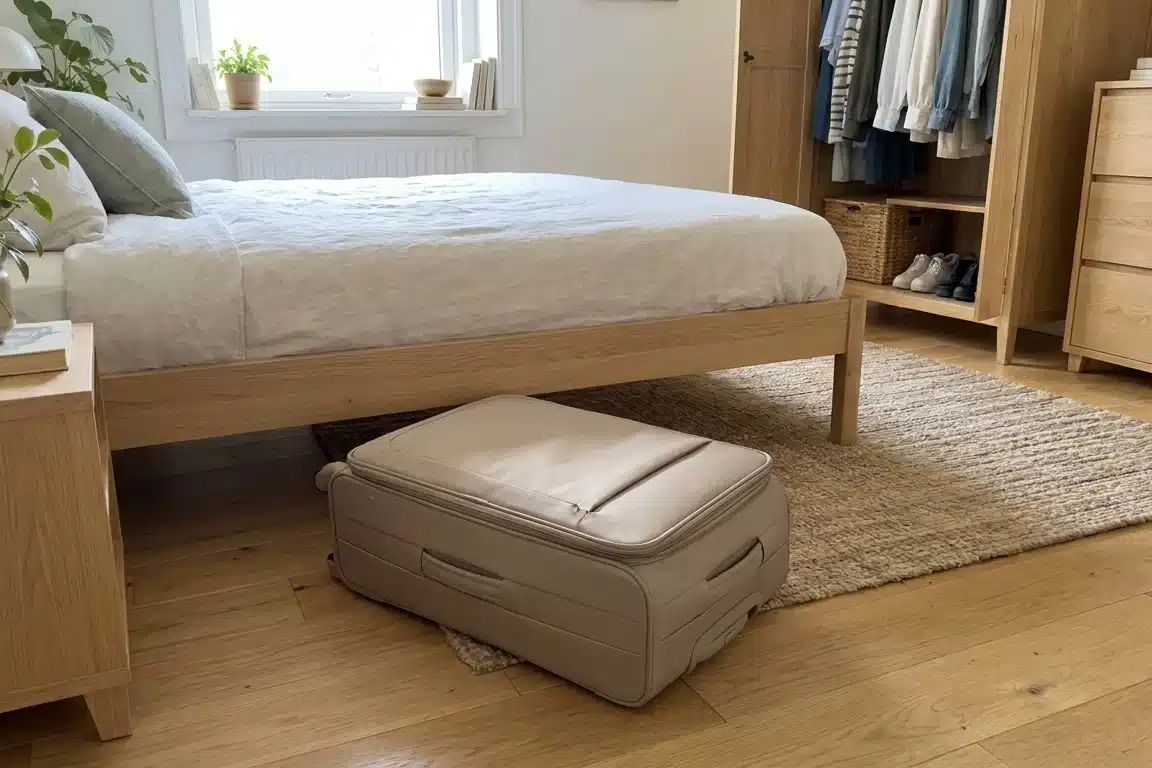
A carry-on is about 9 inches deep, so it only slides under a bed with 10 or more inches of clearance. Many standard metal frames leave about 7 inches, which is not enough. Platform beds and frames on taller legs often leave more. Measure from the floor to the lowest part of the frame.
Soft-sided bags give you an inch or two of squash, hard shells give you none. If your bed is close, a soft carry-on may fit where a hard one does not. For more on what belongs under a bed, see our guide to under-bed storage in a small bedroom.
The back of the closet floor
A large suitcase standing upright at the back of the closet floor, behind the hanging clothes, takes about a 2 by 1 foot footprint. Hanging coats and long dresses will hide it, and it stays easy to roll out. This is the most practical suitcase storage spot for the biggest bag in most apartments.
Behind a door or in a dead corner
If your closets are full, the space behind a bedroom door that opens against a wall can hold a large bag standing up. Check that the door still opens fully and that the bag does not block a vent or radiator.
Inside other furniture
A storage ottoman, a deep bench or a wardrobe base can hold a carry-on. Measure the inside, not the outside, since lids and frames eat a few inches. It is the least obvious suitcase storage spot, and often the easiest one to reach.
One closet, one low bed, three bags
Picture a one bedroom apartment with a 6 foot wide reach-in closet in the bedroom, a bed frame with 7 inches of clearance, and three bags: a large 29 inch checked bag, a carry-on and a soft duffel.
- The carry-on is 9 inches deep, so it will not slide under a 7 inch frame. Under the bed is out.
- The duffel folds flat and goes inside the carry-on, along with packing cubes.
- The carry-on goes inside the large bag, wheels at the same end. A spare duvet fills the space around it.
- The nested set stands upright in the back right corner of the closet floor, behind the long coats. It takes roughly a 2 by 1 foot piece of floor.
Result: three bags and a duvet in one spot, the closet shelf still free for folded clothes, and nothing under the bed but the things you use more often.
No closet at all?
If your bedroom has no closet, suitcase storage competes with everything else that needs a home, and the order of priority changes. Put daily clothes in the easy spots and push luggage to the edges: under the bed, on top of a wardrobe, or in a building storage locker if you have one. Our guide to small bedroom storage without a closet walks through how to divide that space.
A suitcase on top of a wardrobe is a reasonable fallback, as long as it is light and you can reach it safely with a step stool. A large bag stuffed with blankets is the wrong thing to put up there.
What to skip
These habits make suitcase storage harder than it needs to be.
- Storing bags in a damp basement unit or a building cage near a laundry room. Fabric luggage picks up musty smells and mildew. Use the cage for hard shells only, and wipe them dry first.
- Leaving bags in the entryway after a trip. A suitcase by the door becomes furniture within a week. Unpack it the same day, wipe the wheels and put it away. If your entryway is already crowded, our small apartment entryway storage guide helps keep that zone clear.
- Keeping bags you do not use. If you own four suitcases and travel with one, keep the one you use plus one larger bag for long trips. Donate the rest.
- Vacuum bags full of clothes inside the suitcase. They save space, but they wrinkle clothes badly and the compressed bundles are heavy. Stick to soft items you would not mind finding creased.
Things people ask about storing luggage
Is it okay to store things inside suitcases?
Yes, and in a small apartment it is the best use of them. Store clean, dry, soft items you rarely need, and label what is inside.
Where should I store a large suitcase in a studio apartment?
Upright in a closet corner if you have one. Without a closet, under a bed with enough clearance, or on top of a wardrobe if the bag is light. Nest smaller bags inside it either way, so all of your suitcase storage stays in one place.
Should suitcases be stored open or closed?
Closed, so dust stays out. Make sure the bag is completely dry inside before you zip it, especially after a trip with damp clothes or a rainy day at the airport.
How do I keep stored luggage from smelling musty?
Air the bag out for a day after each trip, store it somewhere dry, and drop in a small cedar block or a packet of baking soda in a breathable pouch.