
Good wrapping paper storage in a small apartment comes down to one number: the width of your rolls. Most standard rolls are about 30 inches wide, so any container or spot that holds a 30 inch roll without bending it will work, and anything shorter will crush the ends by January. Measure one roll, then pick a spot that clears it by an inch or two.
After that, the decision is simple. If you have a closet with a few inches of floor in a corner, store the rolls standing up. If you do not, store them lying flat under the bed. Everything else, from ribbon to gift bags, goes in one small bin next to them.
In this article
Measure first: the numbers that decide everything
Roll widths are fairly standard across stores, which makes planning wrapping paper storage easy.
| Roll type | Typical width | What it means for storage |
|---|---|---|
| Standard roll | About 30 in | Needs a container or space at least 31 to 32 in long or tall |
| Narrow roll | About 24 in | Fits most tall bins and shorter under-bed boxes |
| Jumbo or wide roll | About 36 in | Usually too long for under-bed boxes; store standing up |
| Kraft or plain roll | Varies, often 30 in | Check the label before you buy a container |
Take two more measurements while you have the tape out. Count how many rolls you actually own, and measure their diameter. A roll of thin paper might be 2 to 2.5 inches across, while a roll with a lot of paper or a thick cardboard tube can be closer to 3. Ten rolls standing upright need roughly a 10 by 10 inch footprint if they pack tightly, which is less space than most people expect.
That footprint is the real reason upright storage wins in small homes. Laid flat, the same ten rolls cover a long stretch of floor or bed space. Stood up, they take a corner the size of a small wastebasket.
Where wrapping paper storage fits in a small apartment
There are four places that work in most apartments. Pick the one that matches the space you can spare and how often you wrap gifts.
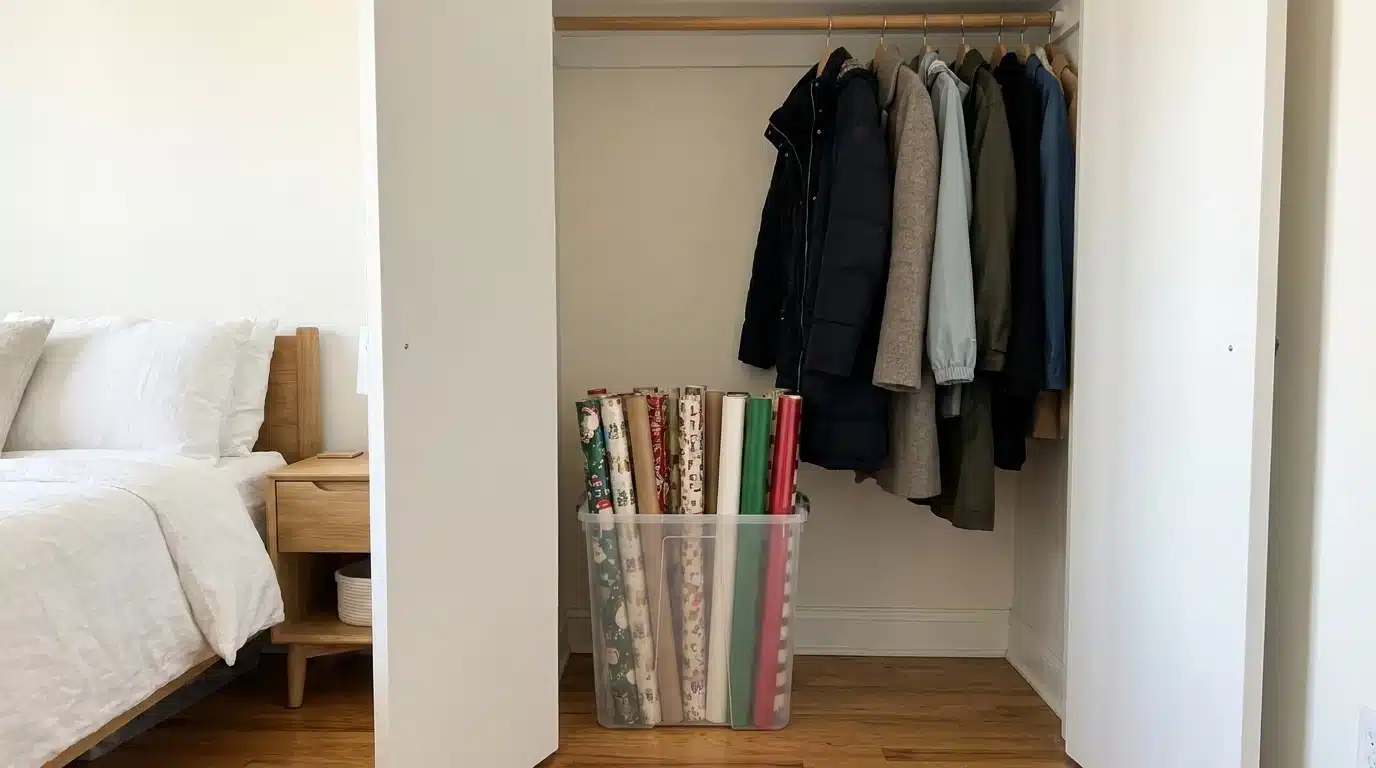
1. Standing upright in a closet corner
This is the best default for wrapping paper storage. A tall container about 32 inches high or more sits on the closet floor in a back corner, behind the hanging clothes. The rolls stay straight, you can see them, and pulling one out takes two seconds.
Tall clear plastic containers made for wrapping paper are common, but a tall laundry hamper or a clean wastebasket can do the same job for a few rolls. The only requirement is that the container is taller than about two thirds of the roll so the paper cannot flop over and crease.
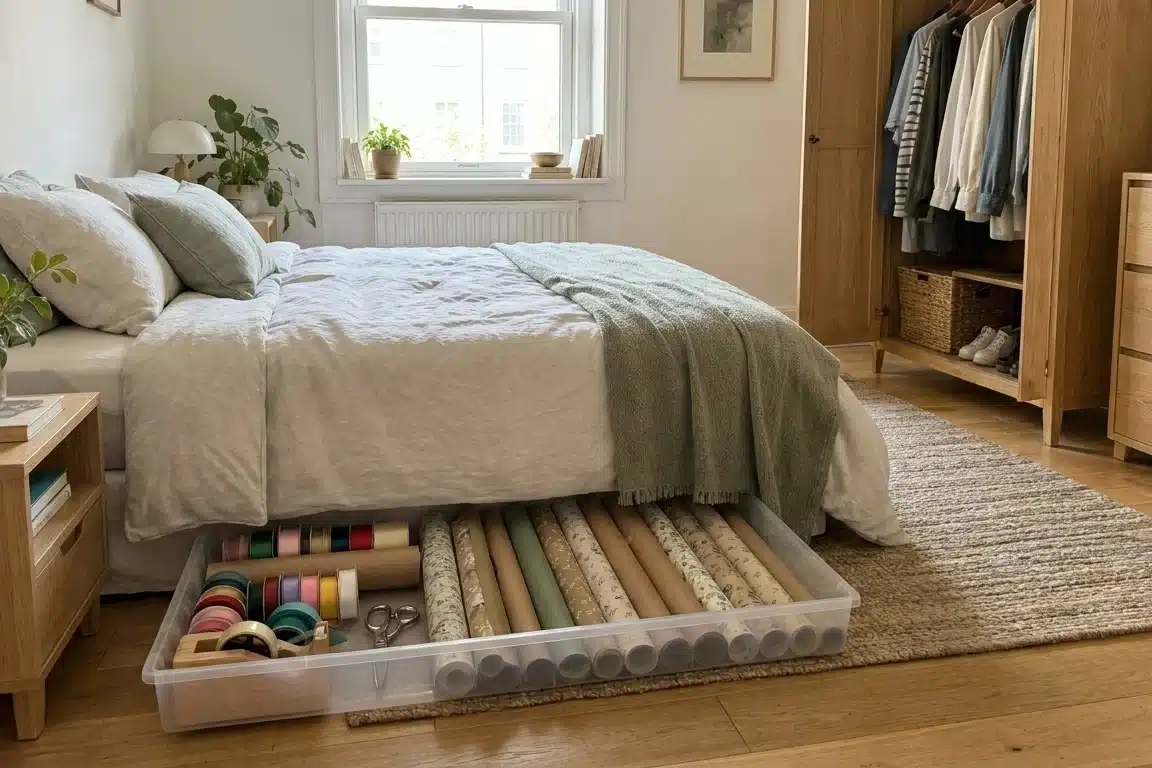
2. Flat under the bed
If your closet floor is full, a long under-bed box is the next best option. Look for one at least 32 inches long inside so 30 inch rolls lie flat with no bending at the ends. Most under-bed boxes are around 6 to 7 inches tall, which holds a single layer of rolls plus tape and scissors on the side.
Check your bed clearance first. Many standard frames leave about 7 inches, and a box that is listed at 6 inches tall will just clear. If you are already planning the space under the bed for clothes and linens, our guide to under-bed storage in a small bedroom helps you decide what deserves that spot.
3. Hanging in the closet
A hanging organizer with long pockets hooks over the closet rod like a garment bag and holds rolls vertically. It costs you a few inches of hanging space instead of floor space, which is a good trade if your closet floor is packed with shoes and bins. Make sure the bag is long enough for full width rolls; some hold only narrow ones.
4. On the back of a door
Over-door organizers made for gift wrap exist, but they are the wrapping paper storage option I would choose last. A door that holds ten rolls plus a pocket of ribbon carries real weight, and if the door is hollow core, an over-door hanger can rub the edge and the top of the door every time it swings. They also stop some closet doors from closing fully. Use this only if the door is solid and the organizer clears the frame.
A whole season of wrap in one corner and one shelf
Here is a wrapping paper storage plan for a typical one bedroom apartment with a 24 inch deep reach-in closet:
- 12 rolls, 30 inches wide, stand upright in a tall container in the back left corner of the closet floor. Footprint: about 11 by 11 inches.
- Ribbon, tape, scissors, gift tags and a pen go in a shoebox sized bin on the closet shelf, directly above the rolls, so everything you need is in one place.
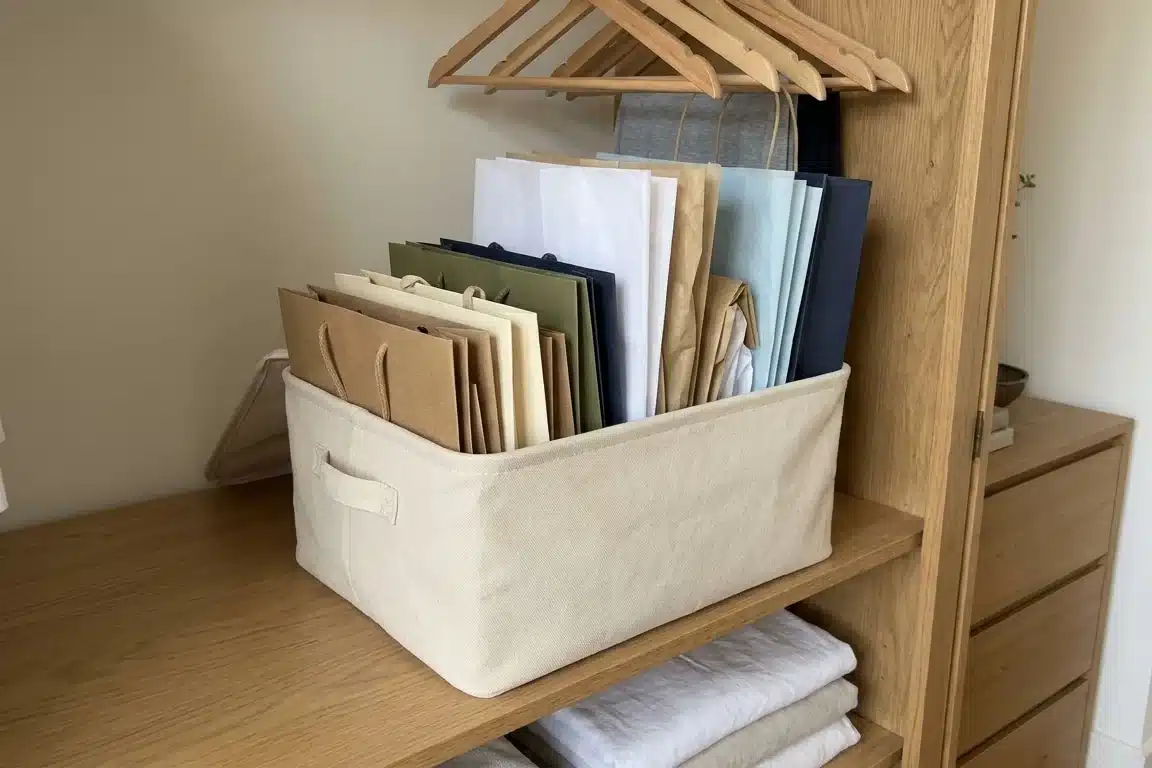
- Gift bags and tissue paper are flattened and filed upright in a second bin on the same shelf, like folders in a drawer. Tissue paper stored flat inside a gift bag stays smooth.
- Gift boxes are broken down flat and slid behind the bins. If you cannot flatten them, keep only two or three of the most useful sizes.
Total: one corner of the closet floor and about two feet of one shelf. That is enough to wrap for a whole holiday season.
Ribbon, tape and the small stuff
Rolls get all the attention in wrapping paper storage, but the small supplies are what make wrapping slow. When the tape is in a kitchen drawer, the scissors are on the desk and the ribbon is in a bag somewhere, wrapping one present takes three trips across the apartment.
Keep every small supply in one box, and keep that box with the rolls. A shoebox or a bin about the size of one works for most households. Wind loose ribbon around a strip of cardboard so it does not tangle, keep spools upright so you can see the colors, and drop in a pen and a roll of gift tags. Add a spare roll of tape before the season starts; running out at 11 at night on December 23 is a classic small apartment problem, because there is no garage workbench to raid.
If you wrap gifts at the dining table or on the bed, the box should be light enough to carry there in one hand. That is a better test of a good setup than how it looks on the shelf.
The mistakes that ruin wrapping paper
Most damaged rolls are not damaged by age. They are damaged by poor wrapping paper storage, and usually the container is to blame.
- A container that is too short. If a 30 inch roll leans in a 24 inch bin, the top 6 inches bend over and crease. You lose the first sheet every time you wrap.
- Rolls stacked loose under other things. Paper rolls flatten under weight. Never put a box of decorations on top of loose rolls.
- Open ends. Paper unrolls a little every time the roll moves. A rubber band, a hair tie or a strip of the clear sleeve the roll came in stops it.
- Damp spots. Paper warps in humidity. Avoid storing rolls against an outside wall in a basement level unit, or under a bathroom sink.
- Keeping every scrap. A pile of leftover pieces takes more space than a new roll. Keep scraps big enough to wrap a small box and recycle the rest.
Keep it with the rest of the holiday gear
Wrapping supplies spend most of the year unused, so they belong with your other seasonal storage, not in the space you use every day. If you already have a plan for holiday bins, put the wrap station next to it. Our guide to seasonal storage in a small apartment explains how to sort and label those bins, and if the tree is also looking for a home, see where to store an artificial Christmas tree without a garage.
For the closet shelf itself, the same rules that keep folded clothes neat apply to bins of ribbon and bags. Our closet shelf organization guide covers shelf depth and how high is too high to reach comfortably.
Short answers
What is the best way to store wrapping paper?
For most homes, the best wrapping paper storage is upright in a container taller than about two thirds of the roll, with each roll banded so it cannot unroll. It takes the least floor space and keeps the paper straight.
Will wrapping paper fit in an under-bed box?
Only if the box is at least about 32 inches long inside for standard 30 inch rolls. Check the interior length in the listing, not the outside dimensions.
Should I keep gift bags or recycle them?
Keep the ones that are still clean and sturdy, flattened and filed upright. Limit the stash to what fits in one bin; the rest is clutter.