
Put the tree in the corner farthest from the door and from any heat source. Then check the floor it needs: a 7.5 foot full tree takes about 5 by 5 feet, a slim about 3.5 by 3.5, a pencil about 2 by 2. Keep 24 inches of clear walkway and stay out of every door swing.
Most advice on where to put a Christmas tree in a small living room stops at “try a corner.” A corner only works if the tree fits it, so this page gives you the numbers to find out before you carry anything in. The sizes are typical figures from retailer listings, so check the listing for your own tree. Where the tree lives in January is a separate job, and our Christmas tree storage plan covers it.
In this article
How much floor space does a Christmas tree need?
Tree widths are measured at the widest point, usually the lowest ring of branches, tip to tip. Treat that width as a square on your floor, because you cannot walk through branch tips and you will not put anything else under them.
A full tree usually runs 55 to 65 percent as wide as it is tall. A slim tree is closer to 45 percent. A pencil tree stays around 2 feet wide at almost any height.
| Tree | Typical width | Floor square to plan | Share of a 10 by 12 ft room |
|---|---|---|---|
| 7.5 ft full | 52 to 64 in | About 5 x 5 ft (25 sq ft) | 21% |
| 6.5 ft full | 43 to 51 in | About 4 x 4 ft (16 sq ft) | 13% |
| 7.5 ft slim | 40 to 43 in | About 3.5 x 3.5 ft (12 sq ft) | 10% |
| 6 ft slim | About 32 in | About 3 x 3 ft (9 sq ft) | 8% |
| 7 ft pencil | 19 to 24 in | About 2 x 2 ft (4 sq ft) | 3% |
| 7 ft flat-back | About 50 in wide, roughly half as deep as a round tree | About 4.5 x 2.5 ft (11 sq ft) | 9% |
| 3 ft tabletop | About 20 to 24 in | None if it sits on furniture | 0% |
Look at the last column before you fall for a big tree. One 7.5 foot full tree takes a fifth of a 120 square foot room, and it takes it from the part of the room you were already using.
Check the ceiling too. The stand and the topper both add height, so on a standard 8 foot ceiling aim for a 6 to 7 foot tree. A 7.5 foot tree leaves almost no room for a star.
Where to put a Christmas tree in a small living room
These spots are in the order worth trying. Stop at the first one that passes the checks in the next section.
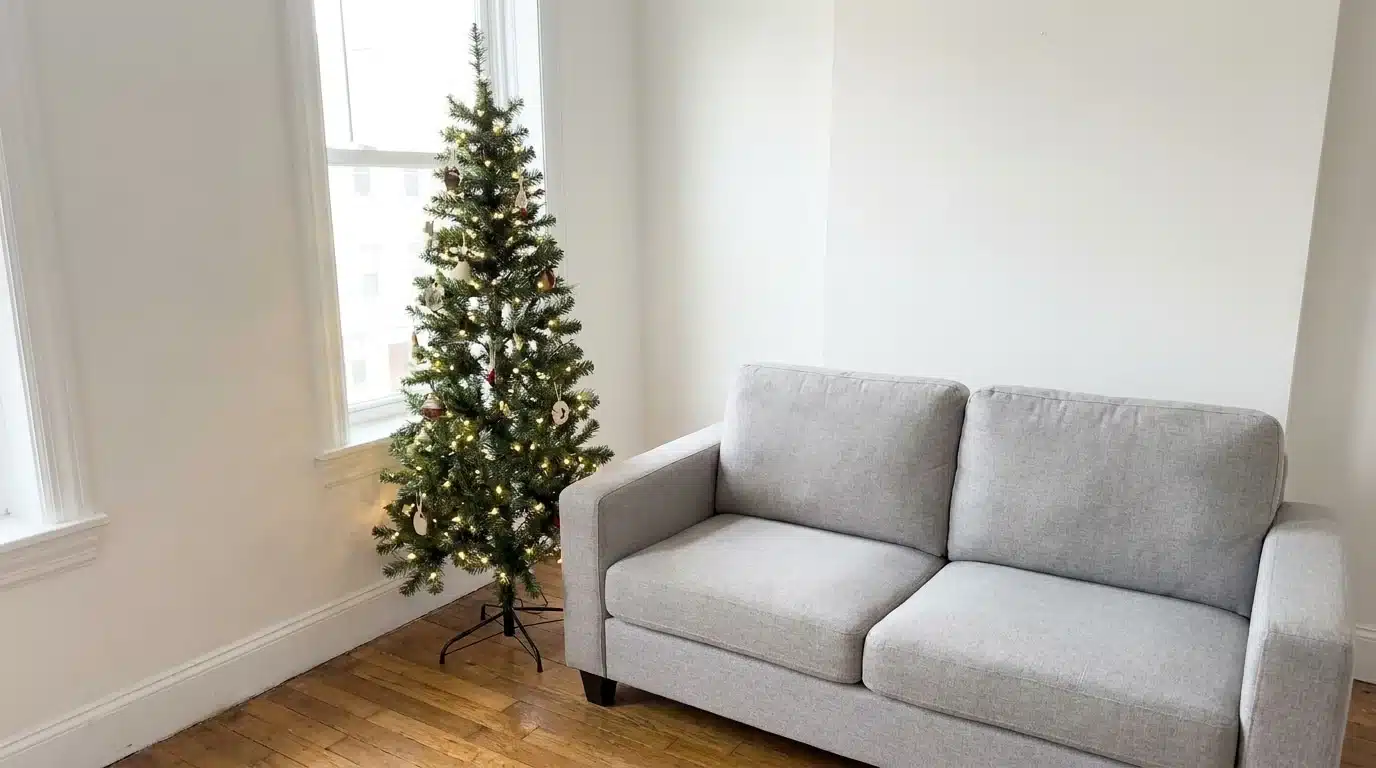
- The corner past the end of the sofa. Usually the best answer. That corner tends to hold a lamp or a side table you can move for a month, and the tree sits with the seating instead of across a path.
- The corner diagonal from the front door. It is the first thing you see when you walk in, and it is the corner a door swing is least likely to reach.
- A window wall with no heater under it. Lights read well from outside and the room stays bright behind the tree. Older apartments often put a radiator under the window, which rules this out. Make sure the curtains can still close, and leave a balcony door completely clear.
- The chair swap. Take an armchair out of the room for the month and give its floor to the tree. A chair footprint of roughly 3 feet square is almost exactly a 6 foot slim tree. The chair can go to the bedroom until January.
- Flat against a clear stretch of wall. This only works with a flat-back tree. A round tree in the middle of a wall sticks out into the room on every side.
Rule these out straight away: anywhere inside a door swing, anywhere on the only route to the front door, within 3 feet of a radiator, heat vent, fireplace or space heater, and any corner where the cord would have to cross a walkway.
If you are also trying to clear the room for the season, our notes on small living room storage explain why deep furniture costs you so much more walkway than tall furniture does.
How much clearance does a tree need around a door?
This is the check that most advice skips, and it is the one that decides whether a corner really works. Do these in order, with a tape measure.
- Measure each door that opens into the room. An open door sweeps a quarter circle as wide as the door itself. Interior doors are usually 28 to 32 inches wide, and apartment entry doors are often 36.
- Do the wall math. On the wall the door opens against, the center of the tree has to sit at least this far from the hinge corner: door width, plus half the tree width, plus 2 inches. A 32 inch door and a 6 foot slim tree need 32 + 16 + 2 = 50 inches. A 36 inch door and a 7.5 foot full tree need 36 + 30 + 2 = 68 inches, more than 5.5 feet of wall gone. That is why big trees rarely work near a door.
- Measure the walkway from the branch tips, not the trunk. Keep at least 24 inches to the nearest furniture, and 30 to 36 inches if this is the main route through the room.
- Leave 2 to 4 inches behind the tree. Branches pressed against a wall bend, and you still need to reach in to plug the lights in.
- Tape it before you commit. Mark the floor square with painter’s tape and leave it for a day. Walk around it carrying a full laundry basket. Open every door. Sit on the sofa and get up again. Tape costs nothing, while moving a decorated tree costs you an evening.
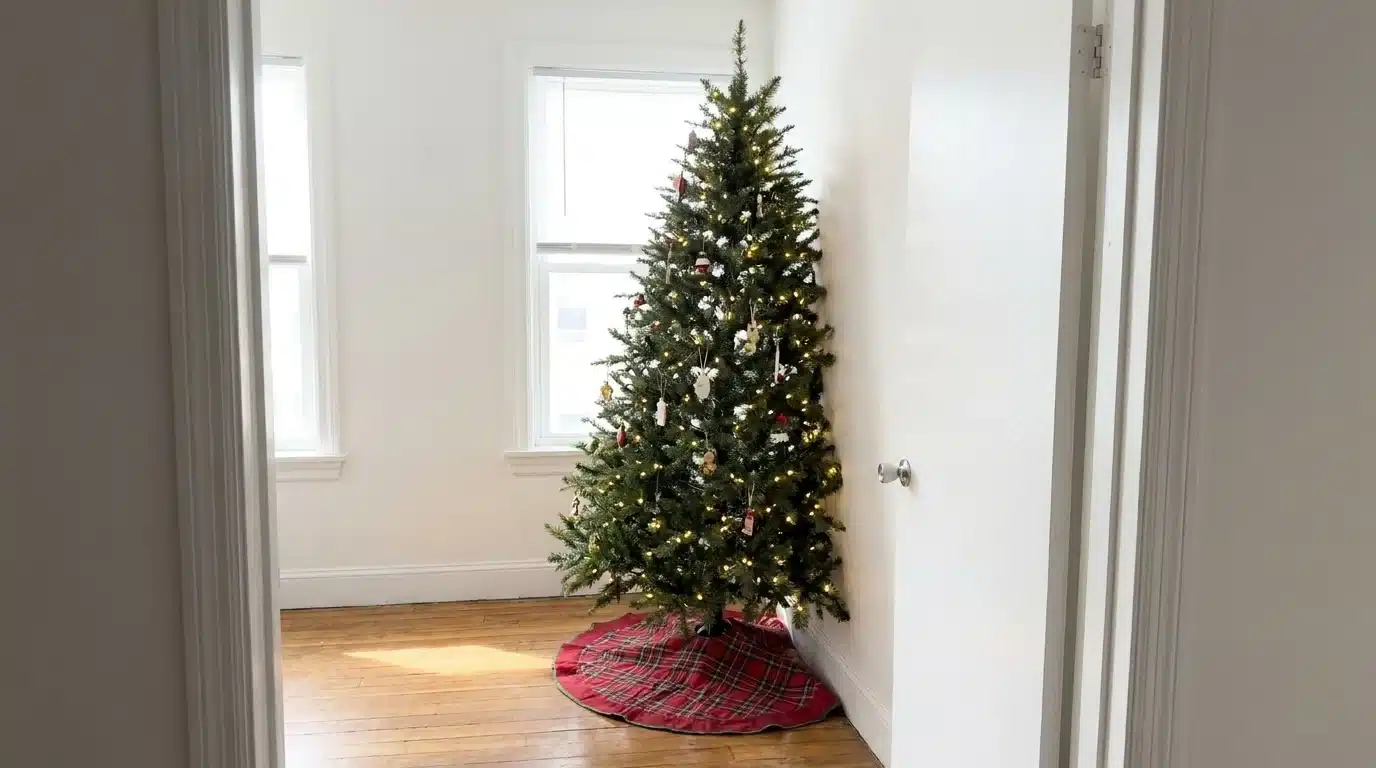
A worked example: one 10 by 12 foot room
Say the room is 120 by 144 inches. A 78 inch sofa, 36 inches deep, sits against one long wall at the far end. An 18 inch deep console sits on the opposite long wall. The 36 inch front door is in the short wall on the console side, hinged at the console wall, so the free corner is across the room from it. That corner has 66 inches of wall beside the sofa arm.
Allow 2 inches of wall gap each way and here is how the trees compare.
| Tree | Space left beside the sofa | Gap from the tips to the door swing | Verdict |
|---|---|---|---|
| 7.5 ft full (60 in) | About 4 in | About 22 in | Just under the 24 inch minimum, and the side table has to go |
| 7.5 ft slim (43 in) | About 21 in | About 39 in | The best trade: a tall tree, and a small side table still fits |
| 6 ft slim (32 in) | About 32 in | About 50 in | Barely changes the room |
Now move the door to the sofa side of that short wall, hinged at the sofa wall, so it opens flat against the same 66 inches. The door takes 36 of them, and the tree needs its own width plus 2 inches beyond that. A full tree needs 98 inches, a 7.5 foot slim 81 and a 6 foot slim 70. Only a 7 foot pencil tree, at about 62 inches, fits. One door moved and the answer changed, so run your own numbers before you buy.
Where to put a Christmas tree in a studio apartment
A studio has no separate living room, so the tree competes with the bed, the table and the only route to the front door. Three rules keep it from taking over.
- Protect the route to the door. It is usually your only exit. Nothing goes on it, and it stays 24 inches wide at the very least, branch tips included.
- Stay out of the kitchen end. A stove counts as a heat source, and a studio kitchen is rarely 3 feet from anything.
- Buy the footprint, not the height. In a 14 by 14 foot studio, a full 7.5 foot tree takes 13 percent of the floor. A 7 foot pencil takes 2 percent and still reaches almost as high.
The spot to try first is the window end of the room, past the sofa or beside the bed, as long as no heater sits under the window. The next best is the end of a sofa that floats out from the wall. There the tree marks the edge between the living area and the sleeping area, and it does a small divider’s job for a month. Our square studio layout and long, narrow studio layout show where those zones usually fall.
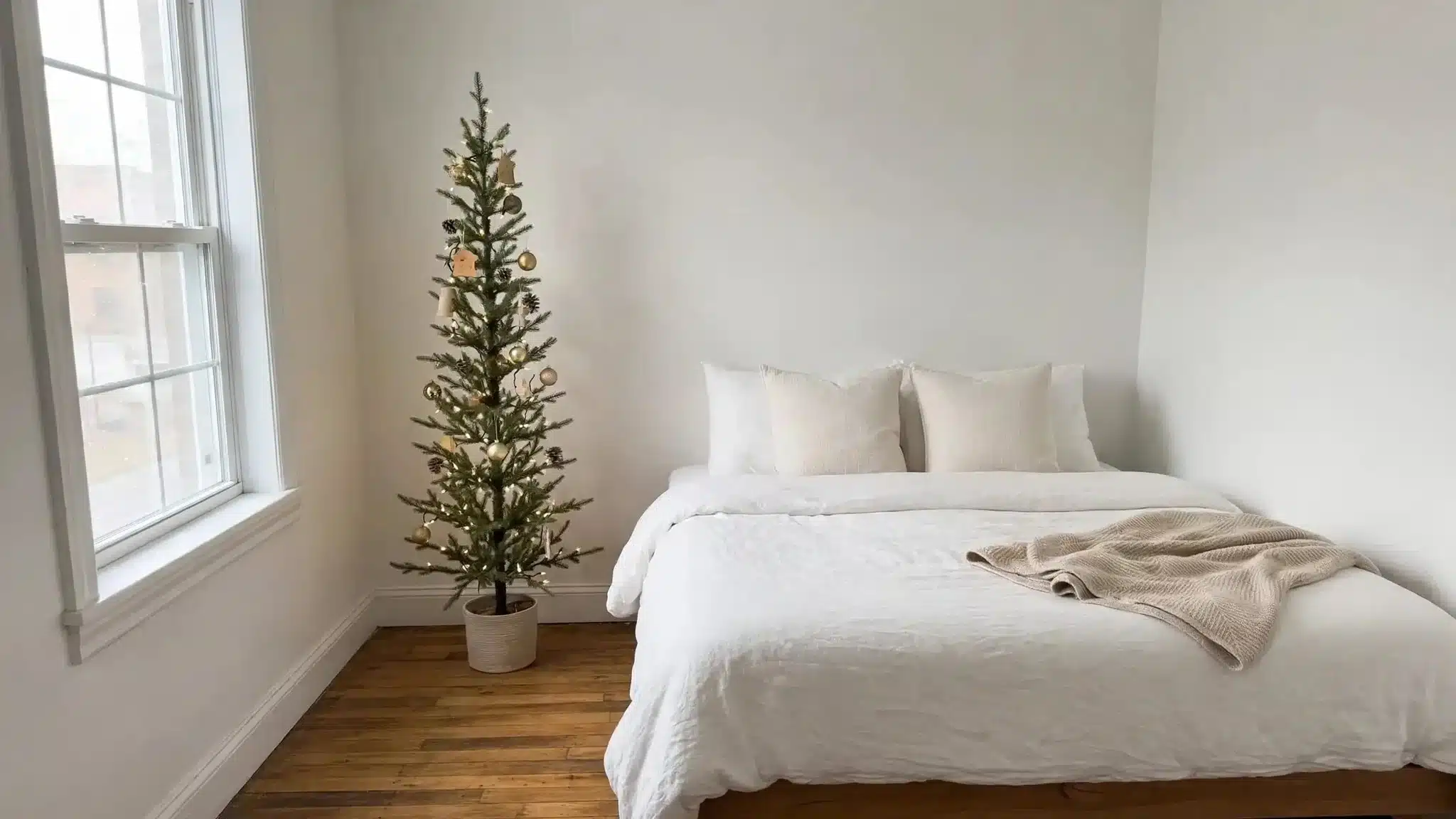
Sleeping a few feet from the tree changes one habit: turn the lights off before bed, every night, the same as you would in a separate room. A smart plug makes that automatic.
Outlets, cords and heat
Find the outlet first, because it can veto a corner that passes everything else. The cord should run along the wall behind furniture, not across a walkway and not under a rug, where it gets stepped on and you cannot see the damage.
The U.S. Fire Administration’s holiday fire safety advice is short and clear: keep the tree at least 3 feet from heat sources such as fireplaces, radiators, space heaters, candles and heat vents, and make sure it does not block exits. In a small room, 3 feet from a radiator can knock out a whole wall, so check this early. Look for floor vents and baseboard heaters too, since a sofa can easily hide them.
A real tree adds one more job. You need to reach the stand every day to add water, so leave a gap on one side that you can actually get an arm through.
If no spot passes, change the tree
Some rooms cannot take a floor tree without losing something you use every day. That is a reason to change the tree, not to squeeze past it for a month.
- A pencil tree solves most door and walkway failures, because it needs about a quarter of the floor of a 6.5 foot full tree.
- A flat-back tree sits against a wall and suits rooms that are short on depth more than width.
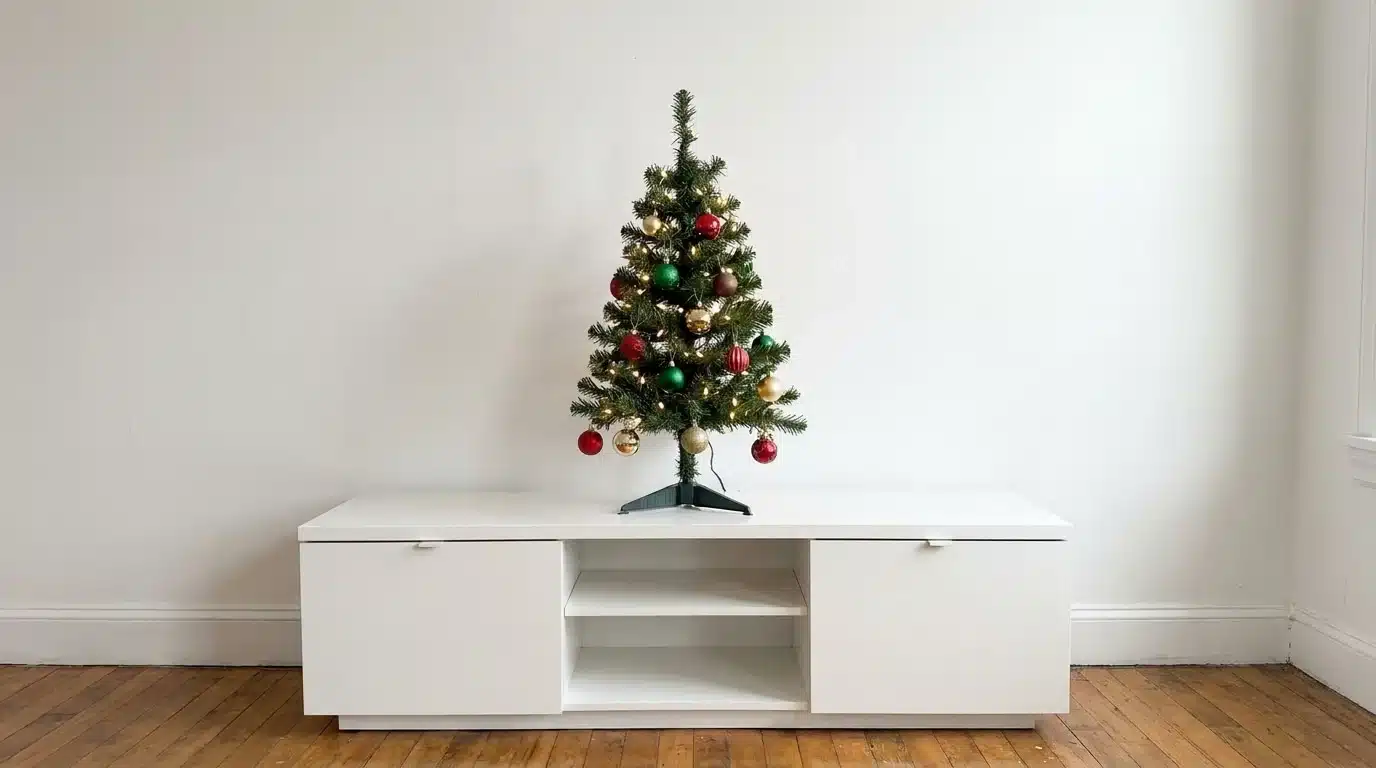
- A tabletop tree needs no floor at all. Media consoles are often only 15 to 20 inches deep, so measure first or choose a tree about as wide as the top of the furniture.
Before you buy anything new, measure the other end of the year as well. Any tree that fits the room still has to go somewhere for eleven months, and a tree that fails the seasonal storage test is a problem you will have every January.
Christmas tree placement questions
Should a Christmas tree go in a corner?
In a small living room, usually yes. A corner uses two walls to hide the back of the tree and takes the fewest square feet out of the walking space. Choose a different spot only if the corner has a heater, a door swing or no outlet in reach.
Can I put a Christmas tree in front of a window?
Yes, as long as there is no radiator or heat vent under that window and the tree does not block a door to a balcony. Keep the curtains clear of the lights.
How far should a Christmas tree be from the wall?
About 2 to 4 inches from the branch tips, which keeps the branches from bending and leaves room to reach behind for the plug.
What size Christmas tree fits an 8 foot ceiling?
A 6 to 7 foot tree is the safe range. Once you add the stand and a topper, a 7.5 foot tree leaves very little room.
How wide is a 7 foot Christmas tree?
A full 7 foot tree is typically about 46 to 55 inches wide, a slim one about 38, and a pencil about 2 feet. Widths vary by brand, so check the listing.