
The best closet door alternatives for a small bedroom are a curtain on a ceiling track or tension rod, bifold doors, sliding bypass doors, or simply removing the doors. A swinging door needs a clear arc as wide as the door itself, often 24 to 36 inches (61 to 91 cm). A curtain needs none, a bypass slider needs none but opens only half the closet, and a bifold needs about half of a swinging door.
In a small bedroom the closet door usually decides where the bed and dresser can go. If the door hits the bed frame, opens only halfway, or forces the dresser onto the one wall with the window, the door is the problem, not the furniture. Below is how much floor each option needs, what it costs, how much of the closet you can reach, and which ones a renter can try without asking anyone. For the bigger picture of where furniture fits, see our guide to small bedroom layout ideas that leave room to walk.
In this article
How much floor does your closet door take now?
A swinging door sweeps a quarter circle with a radius equal to its width. Measure it before deciding anything.
- Measure the door width. Common reach-in closet doors are 24, 30 or 36 inches (61, 76 or 91 cm). Wider closets often have a pair of doors.
- Open the door fully and mark where its edge sits on the floor. That arc is floor you cannot use for furniture.
- Measure from the closed door to the bed or dresser. Anything closer than the door width blocks the swing.
- Note what you need to reach: the whole rod at once, or one half at a time.
A pair of 18 inch doors on a 36 inch closet sweeps less floor than one 36 inch door, which is why double doors are common on wider closets. They still need 18 inches clear in front.
Closet door alternatives compared
| Option | Floor it needs in front | Access | Typical cost | Rental friendly |
|---|---|---|---|---|
| Swinging door (what you have) | Full door width, 24 to 36 in | Whole closet | n/a | n/a |
| Curtain on a tension rod | None | Whole closet | $20 to $45 | Yes, no holes |
| Curtain on a ceiling track | None | Whole closet | $35 to $80 | Small screw holes, ask first |
| Bifold doors | About one panel width, 12 to 18 in | Almost the whole closet | $80 to $250 plus installation | Only with permission |
| Sliding bypass doors | None | Half at a time | $150 to $400 plus installation | Only with permission |
| Barn door | None in front, but clear wall beside the opening | Whole closet | $150 to $500 | Only with permission |
| No doors at all | None | Whole closet | $0 | Yes, if you keep the doors safe |
Curtains: the closet door alternative renters can do today
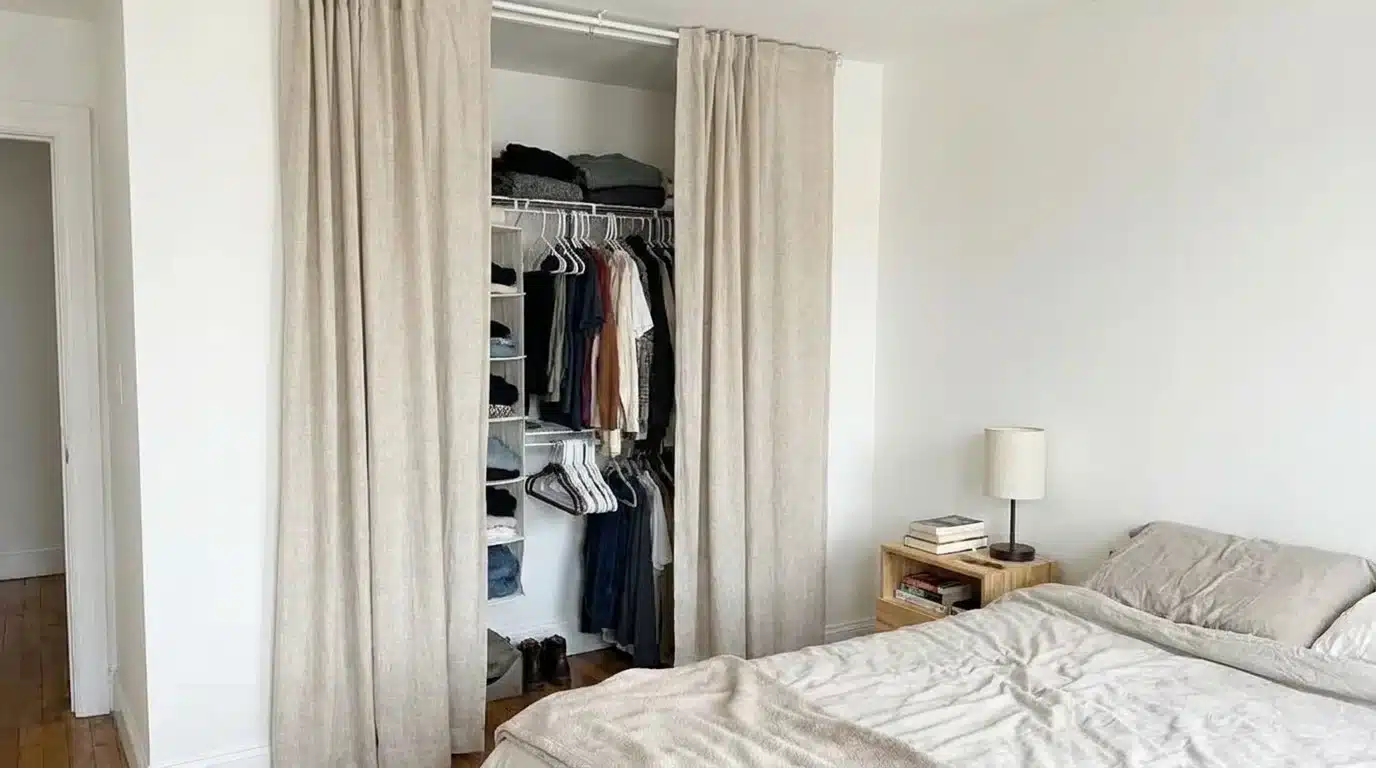
A curtain is the cheapest and most flexible option, and the only one that needs no floor and no permission when it hangs from a tension rod.
Tension rod inside the opening
Fit the rod inside the closet frame, just below the top trim. Measure the inside width and choose a rod whose adjustable range puts your width in the middle. A rod at the very end of its range grips weakly and slips under the weight of heavy fabric. For an opening up to about 48 inches (122 cm), a heavy duty tension rod rated for 15 to 25 pounds holds a lined curtain easily.
Ceiling track
A ceiling track mounts with small screws and lets the curtain glide the full width, stacking neatly to one side. It looks more finished and works for openings wider than a tension rod can span. Ask your landlord first, since it leaves small holes that need filling when you move out.
How much fabric
For a curtain that looks full rather than flat, use fabric 1.5 to 2 times the width of the opening. A 36 inch closet needs a panel 54 to 72 inches wide. Hang it so it clears the floor by about half an inch (1 cm), so it does not drag when you slide it. A medium-weight linen or cotton hides the clothes without making the room feel heavy. Blackout fabric is not needed.
Bifold doors: half the swing
Bifolds hinge in the middle and fold against the side of the opening. Each folded pair projects into the room by about one panel width. On a 30 inch closet with two 15 inch panels, that is roughly 15 inches. On a 60 inch closet with four 15 inch panels split into two pairs, it is still about 15 inches on each side.
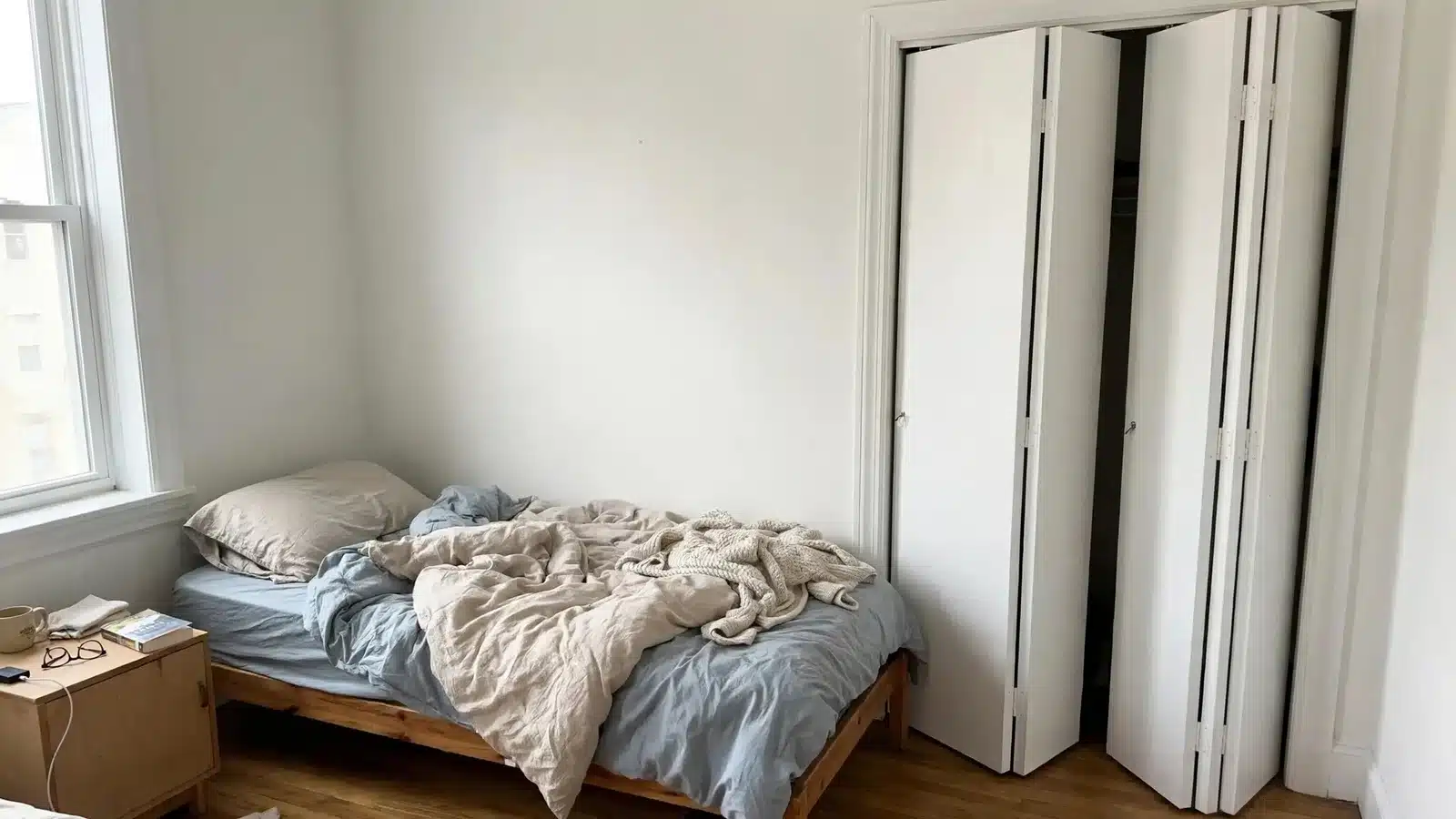
They suit a bedroom where the bed sits 18 to 24 inches from the closet. The downsides are a top track that can jump if the pivots are loose, and panels that stick out at each end of the opening, so the corners of the closet are slightly harder to reach. Tighten the top pivot and the guide wheel once a year and they run smoothly.
Sliding bypass doors: no floor, half the access
Two panels slide past each other on parallel tracks. They need zero floor in front, which makes them ideal when the bed is right up against the closet. The trade-off is access: on a 60 inch closet you see 30 inches at a time. Put everyday clothes on the side you open most, and seasonal or rarely used things behind the other panel.
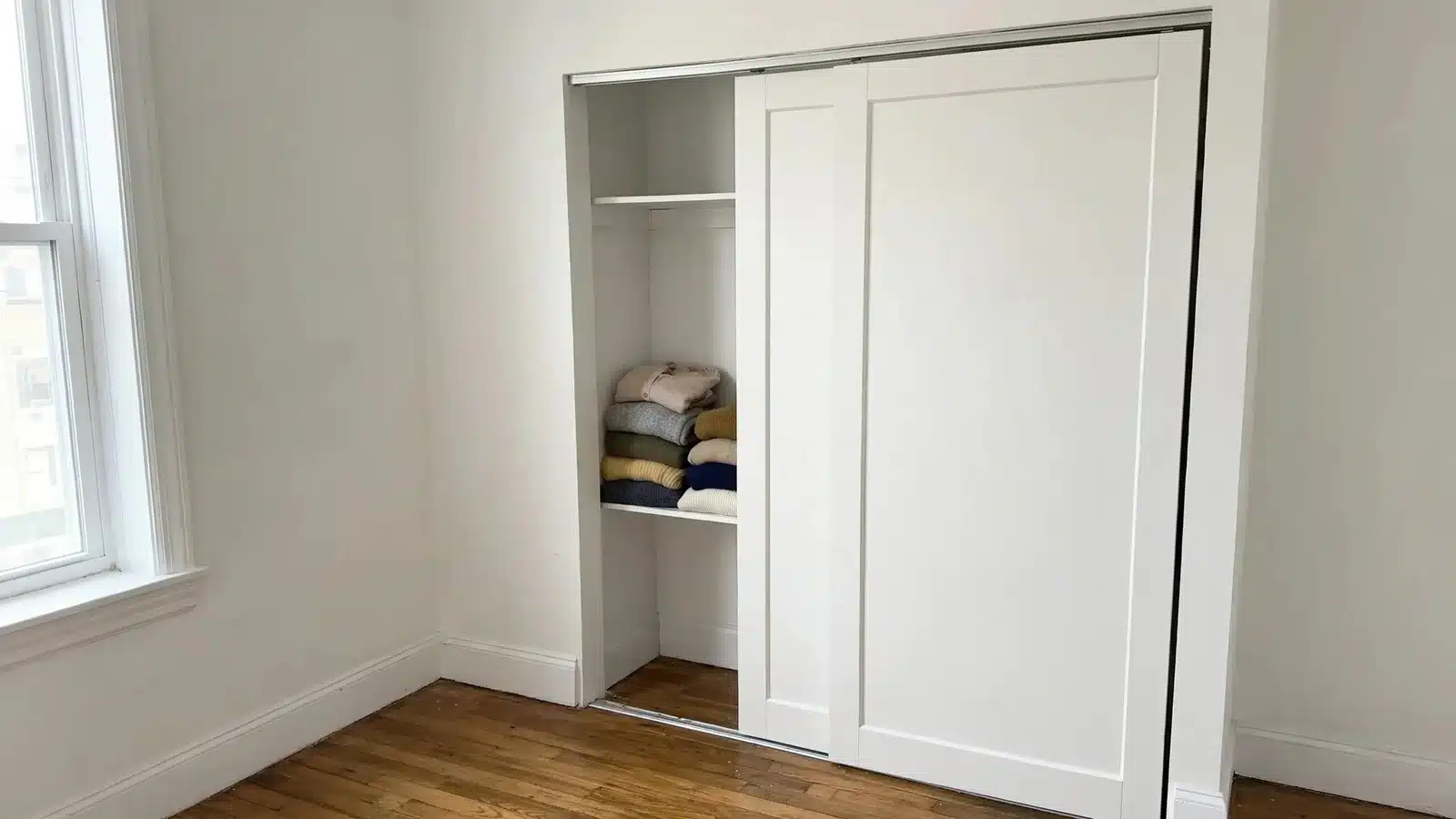
Bypass doors work best on closets at least 48 inches (122 cm) wide. On a narrow 30 inch closet, each opening is only 15 inches, which is too tight to reach in comfortably.
Barn doors: check the wall, not the floor
A barn door slides along a rail mounted above the opening, so it takes no floor in front. It needs clear wall beside the closet at least as wide as the door, with no light switch, outlet, window or thermostat in the way. The rail and door also sit 2 to 3 inches (5 to 7.5 cm) off the wall, so the door can catch on a nightstand or a headboard that sits close to that wall.
In a small bedroom, that clear wall is often the problem: a 36 inch door needs 36 inches of empty wall beside a 36 inch opening. Barn doors also leave gaps at the sides, so they do not close as tightly as a regular door.
Removing the doors entirely
Taking the doors off costs nothing and gives the most access. Most closet doors come off by tapping out the hinge pins from below with a screwdriver and a hammer. In a rental, keep the doors and every hinge pin and screw, label them, and store the doors flat under the bed or behind a sofa. They go back on before you move out.
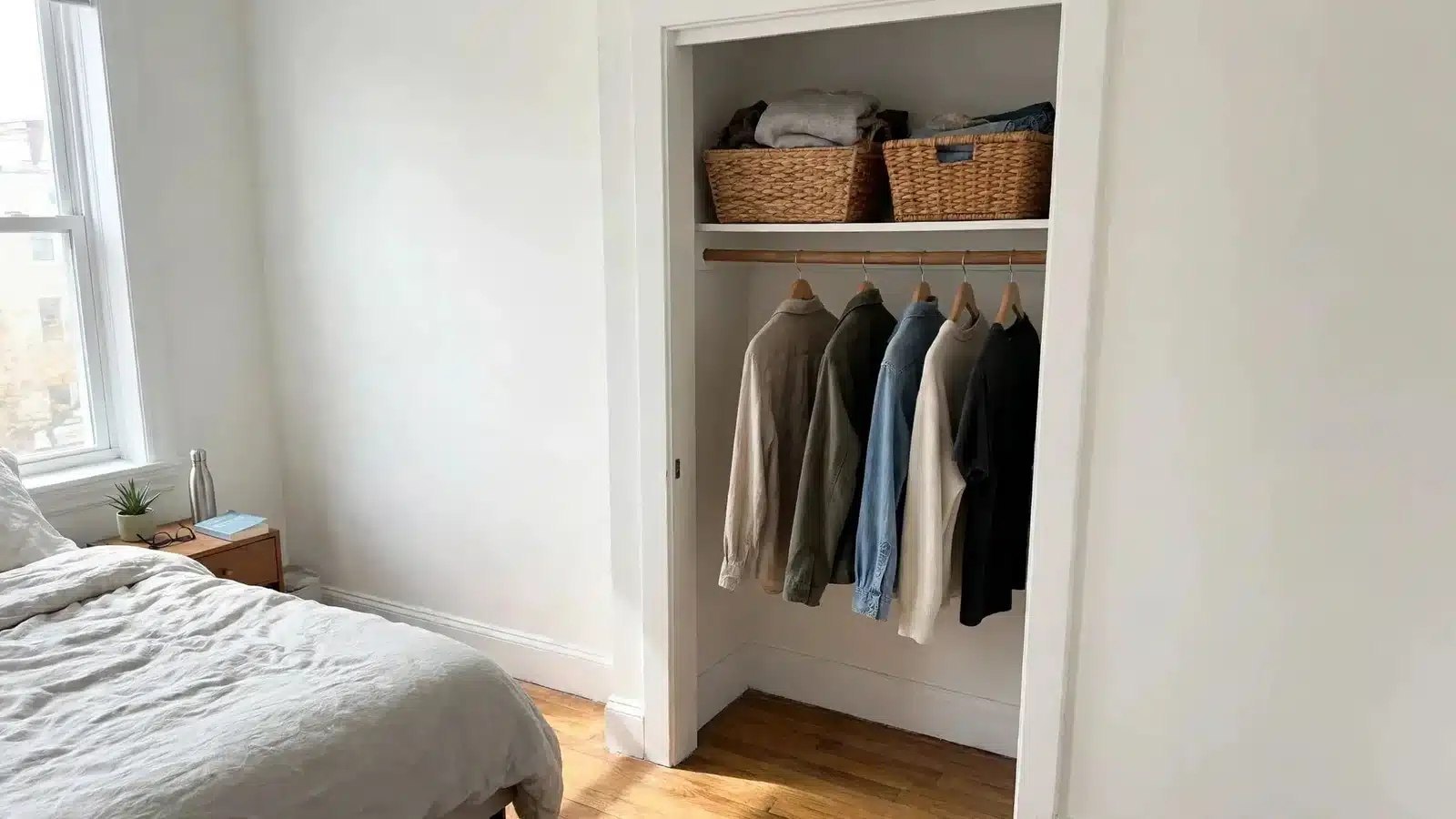
An open closet becomes part of the room, so it needs to look tidy. Three things help most: matching slim hangers, the same color baskets on the top shelf, and folded stacks that line up. Our guide to keeping folded stacks neat on closet shelves covers the shelf part. If you want a little cover without doors, add a curtain that stays open most of the time.
Light, dust and noise
Each option changes more than the floor plan. A solid door hides everything and blocks light, which matters if the closet faces the bed and you get dressed while someone else is asleep. A curtain softens the look of the room and lets you light the inside of the closet with a battery puck light without the glow spilling across the bed. An open closet shows everything and collects dust on the shoulders of hanging clothes, so keep a few garment bags for jackets and suits you wear rarely.
Bypass and bifold doors rattle slightly when the building shakes or a door slams nearby. A strip of felt where panels meet quiets them. Barn doors leave a gap of about half an inch around the opening, so they do not hold back dust or light as well as a fitted door.
Which closet door alternatives fit your bedroom
| Your situation | Best choice |
|---|---|
| Bed within 12 inches of the closet | Sliding bypass doors or a curtain |
| Bed 18 to 24 inches away | Bifold doors or a curtain |
| Renting, no permission for changes | Curtain on a tension rod, or doors removed and stored |
| Clear wall beside the closet and you own the place | Barn door |
| Closet narrower than 36 inches | Curtain or bifold, not bypass |
| You want the closet hidden at all times | Bifold, bypass or barn door |
Once the door question is settled, the inside of the closet is the next win. Our guide to laying out a small reach-in closet shows how to split the rod and shelves.
Common mistakes
- Buying a barn door before checking for switches and outlets on the wall beside the opening.
- A curtain that is too narrow, so it gapes in the middle.
- Bypass doors on a narrow closet, leaving two openings too small to use.
- Removing rental doors and losing the hinge pins.
- A tension rod at the very end of its range.
Quick answers
What can I use instead of closet doors in a rental?
A curtain on a tension rod is the simplest. Removing the doors and storing them safely also works, as long as they go back before you move out.
Do bifold doors save space?
Yes. They need about one panel width in front, roughly half of what a swinging door needs.
Is an open closet a good idea in a small bedroom?
It works if the contents look tidy. Matching hangers and baskets make it read as storage, not clutter.