
Good spice storage for a small kitchen starts with counting your jars, then fitting them into space that is usually wasted: the inside of a cabinet door, a stepped riser in an upper cabinet, a shallow drawer, a turntable in a corner, or magnetic tins on the side of the fridge. Most home cooks own 20 to 40 jars. Each of those options holds 12 to 24, so many kitchens need two of them. The one place to avoid is the wall above the stove.
The problem is rarely too many spices. It is that a standard jar is about 2 inches (5 cm) across and 4 inches (10 cm) tall, and a 12 inch deep cabinet lets it hide three rows back. Below are the real capacities and clearances for each option, so you can buy the right one the first time. If your kitchen is also short on shelf space for food in general, our guide to where food goes in a kitchen without a pantry is the companion to this one.
In this article
Count first: how many jars do you have?
Pull every spice out onto the table and sort it into three groups: weekly, monthly and rarely. Throw out anything with no smell when you crush a pinch between your fingers. As a general guide, ground spices keep good flavor for about 2 to 3 years and whole spices for 3 to 4. Duplicates are common, so combine half-empty jars of the same thing.
Now you have two numbers: the total, and the weekly group. The weekly group goes where you can reach it while cooking. Everything else can go somewhere less convenient.
Spice storage for a small kitchen: five options compared
| Option | Space it needs | Typical capacity | Cost | Best for |
|---|---|---|---|---|
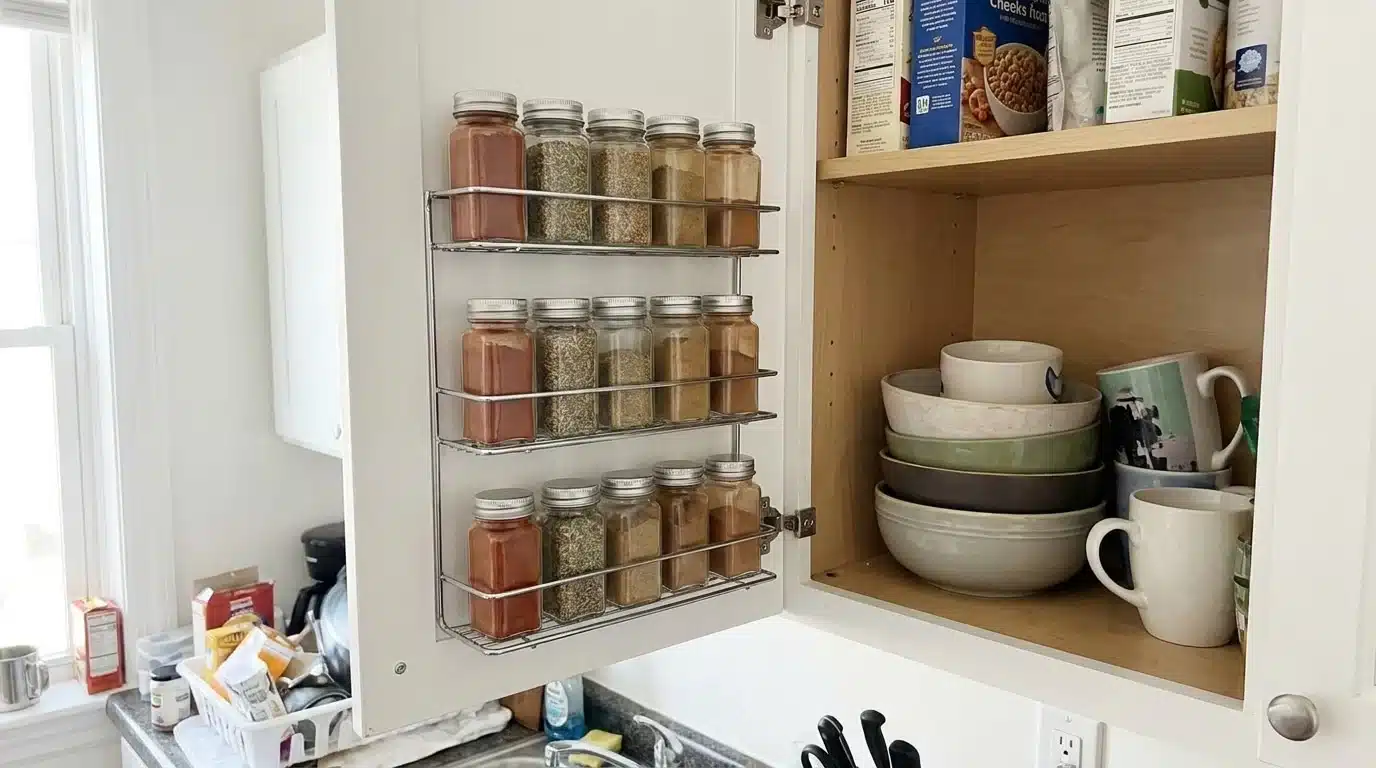
| Inside a cabinet door | Door 12 in (30 cm) wide, 2.5 in (6.5 cm) clearance to the shelves | 15 to 18 jars | $15 to $30 | Weekly spices near the stove |
| Stepped riser in a cabinet | Cabinet 15 in (38 cm) wide, 9 in (23 cm) of shelf height | 18 to 21 jars on 3 steps | $12 to $25 | Upper cabinets with tall shelf gaps |
| Drawer insert, jars lying flat | Drawer at least 2.5 in deep inside, 12 by 18 in (30 by 46 cm) | About 24 jars | $15 to $30 | Anyone with one shallow drawer to spare |
| Turntable | Corner or deep cabinet, 10 in (25 cm) circle | 12 to 15 jars | $10 to $20 | Awkward corner cabinets |
| Magnetic tins | Side of the fridge or a strip of bare wall | 12 to 30 tins | $25 to $45 for 12 tins | Kitchens with no cabinet space at all |
Capacities assume standard round jars about 2 inches across. Square jars pack tighter, so expect a few more.
Inside a cabinet door
The back of an upper cabinet door is empty in nearly every kitchen. A slim rack there holds 15 to 18 jars in three tiers, at eye level, right next to the stove. The catch is clearance. When the door closes, the rack swings into the cabinet, so it must clear the front edge of the shelves.
- Open the door and measure from the inside face of the door to the front edge of the shelves when the door is closed. Most cabinets give 1.5 to 3 inches (4 to 7.5 cm).
- Buy a rack that is at least half an inch shallower than that gap.
- Check where the shelves sit. If a shelf lines up with a rack tier, the rack still clears, but jars cannot stick up above the tier rail.
- Use screws only if the door is solid wood. On a thin or hollow door, choose a rack that hangs over the top of the door or uses adhesive strips rated for the weight. A full rack of 18 jars weighs about 4 to 5 pounds (2 kg).
If you rent, the over-the-door or adhesive versions leave no holes.
A stepped riser inside a cabinet
A riser lifts the back rows so you see every label from the front. In a standard 12 inch deep upper cabinet, a three-step riser takes up the front 9 to 10 inches, which leaves a little room behind it for a backstock of refills. A 15 inch wide cabinet fits about seven jars per step, 21 in all. Expanding risers adjust from about 12 to 20 inches wide, so measure the cabinet opening, not the outside of the cabinet.
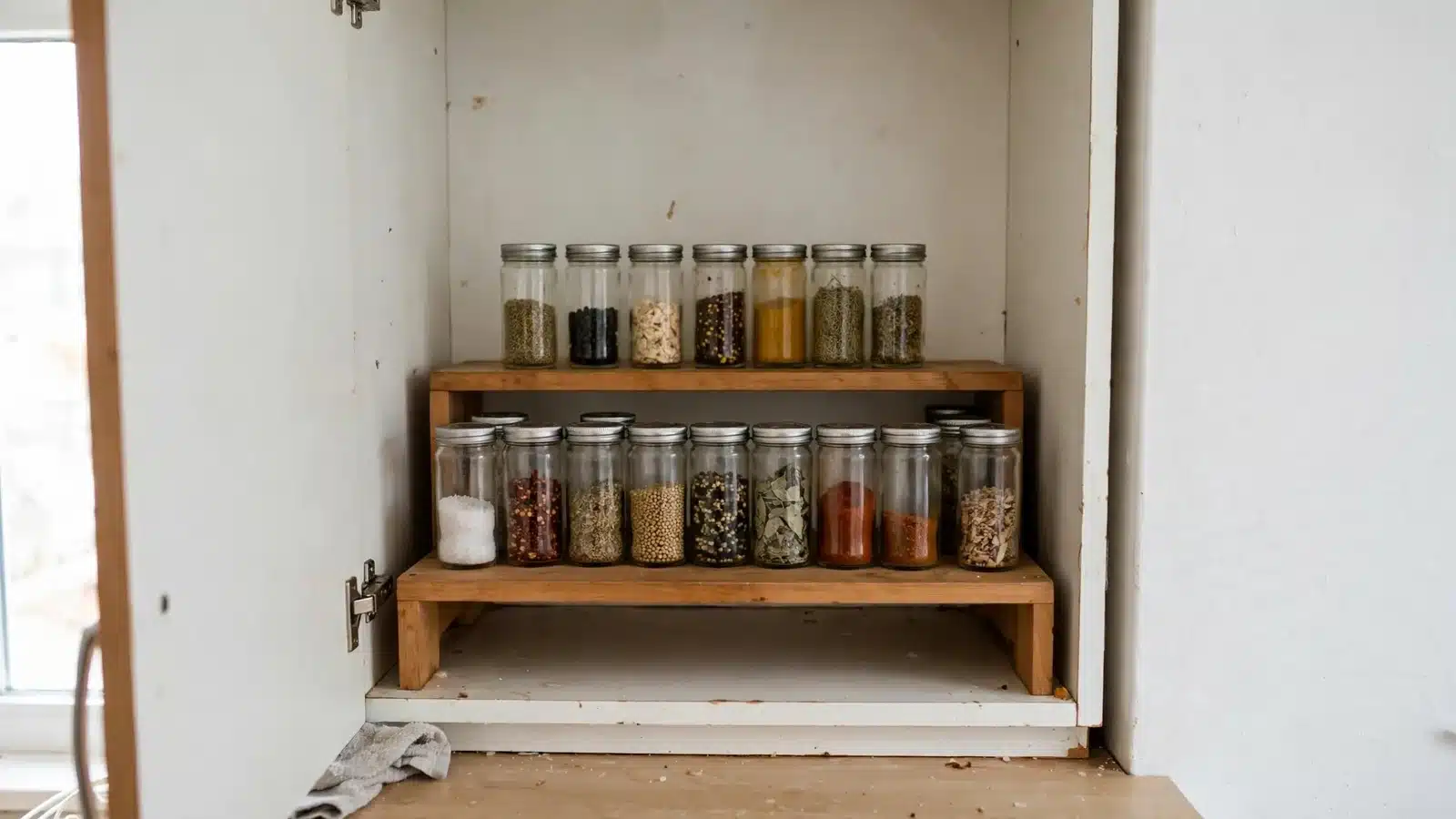
The weekly spices go on the top step at the front edge. The lower steps can hold the monthly group. Put the tallest bottles, such as vanilla or soy sauce, on the floor of the cabinet in front of the riser, not on it.
Jars lying flat in a drawer
If you have one drawer at least 2.5 inches (6.5 cm) deep inside, this is the easiest system to use. Jars lie on their sides on a tiered insert, labels on the lids, and you read the whole collection from above in one glance. A 12 by 18 inch drawer holds about 24 jars in four rows.
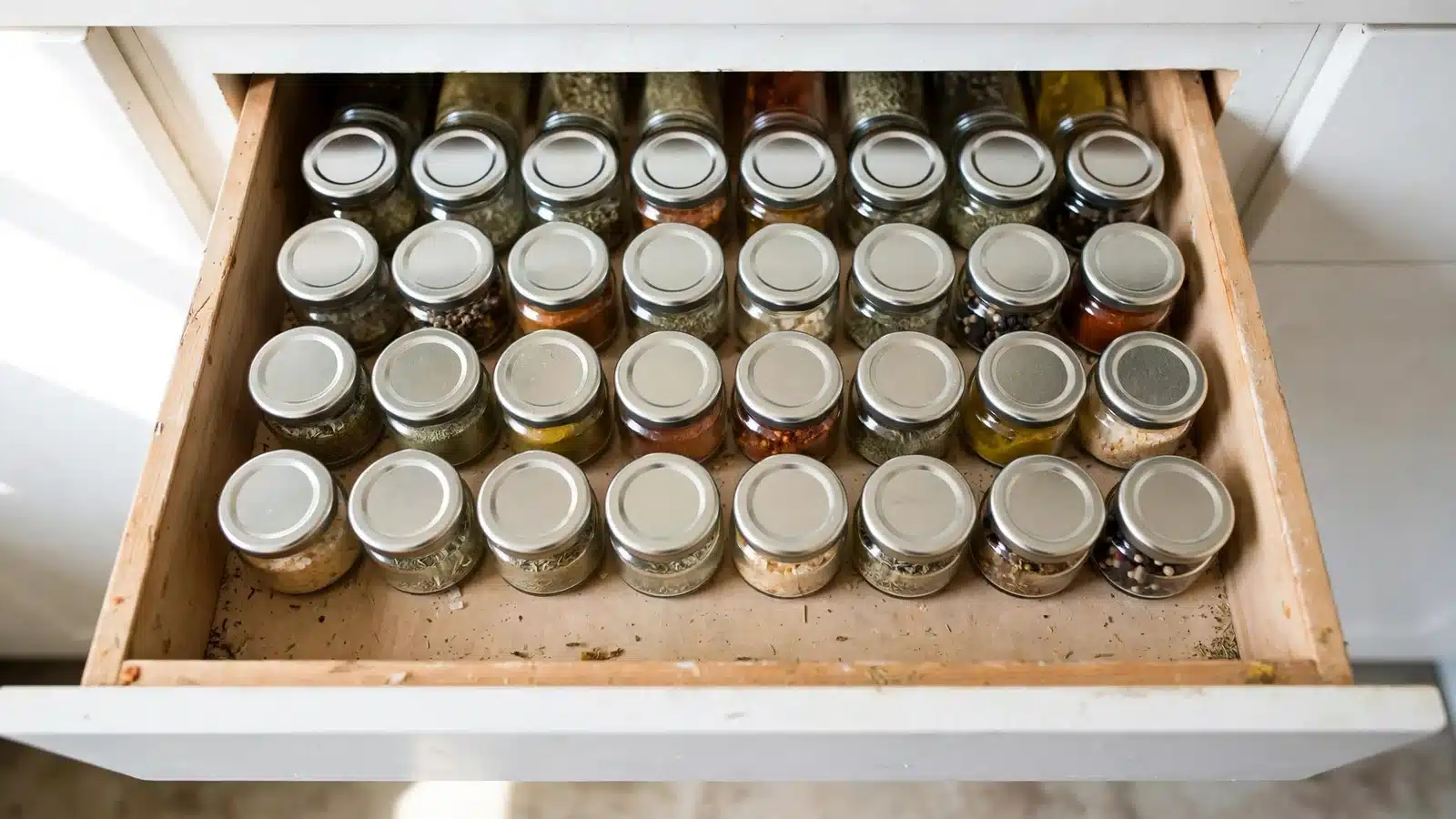
Label the lids, not the sides. A simple round label or a paint marker on the lid is enough. Sort alphabetically if you have more than about 20, or by cuisine if you cook the same few styles. Drawers are also the safest place for spices, because they stay dark and away from the heat of the stove.
A turntable in a corner cabinet
Corner cabinets lose space in the back corner, where nothing can be reached. A 10 inch (25 cm) turntable brings the back to the front with a spin. It holds 12 to 15 jars in one layer, or about 20 on a two-tier turntable if the shelf height allows 9 inches. Use a turntable with a raised edge, so jars do not fly off when it spins.
Magnetic tins on the fridge or a wall strip
When there is no cabinet space at all, the side of the refrigerator is often the largest empty surface in the kitchen. Magnetic tins with clear lids stick to it directly. A 24 by 36 inch area of fridge side holds 30 or more 2.5 inch (6 cm) tins. If the fridge side is hidden or not magnetic, a steel strip on a bare stretch of backsplash works the same way.
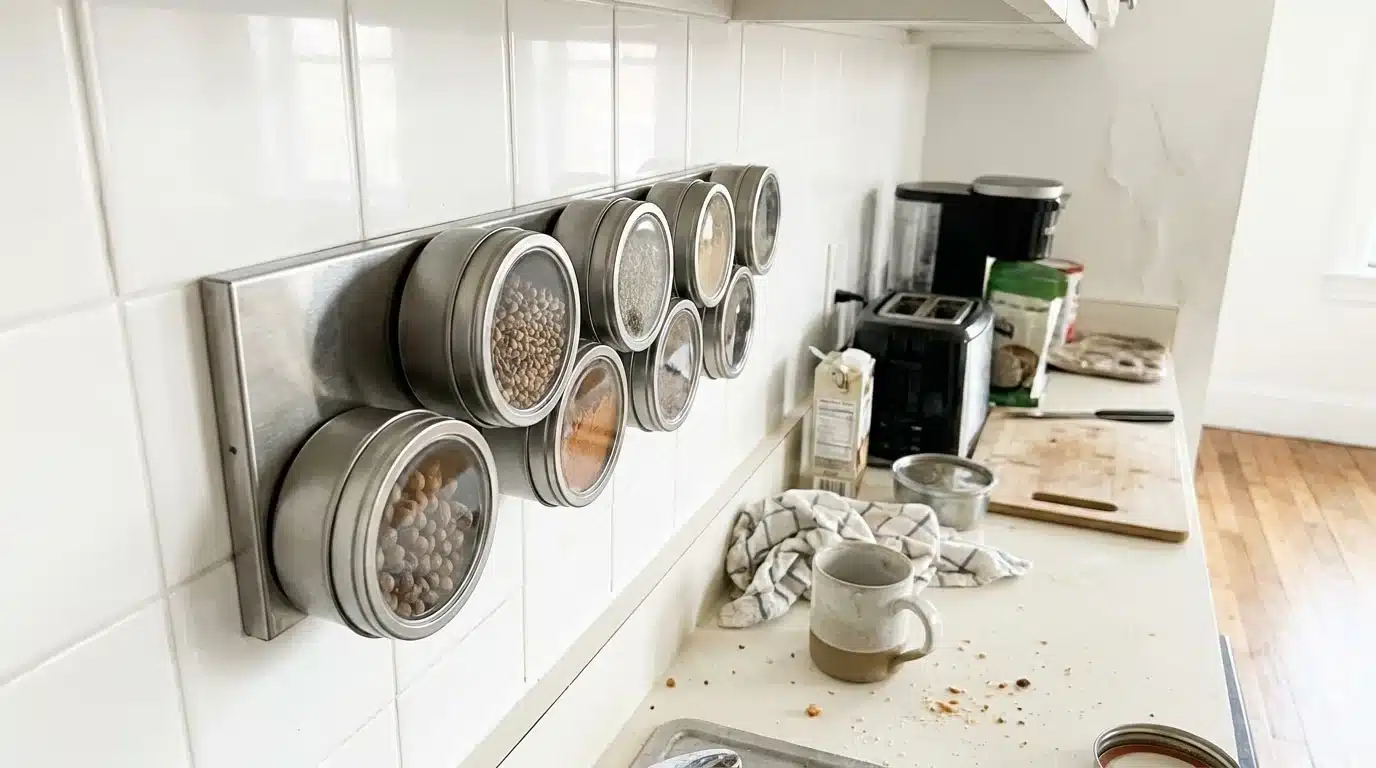
Tins hold about 2 ounces (55 g) each, so they suit everyday spices rather than bulk buys. Refill them from the original packet and keep the backstock in a drawer or a pantry bin. Magnetic tins also free counter space, which matters if you are already squeezed: see our page on what to do when your kitchen has no counter space.
Where not to keep spices
- Above the stove. Heat and steam rise straight into that cabinet or shelf. Spices lose flavor faster, and humid ground spices clump.
- In a sunny window. Light fades color and flavor. Clear jars in the sun are the worst case.
- Next to the dishwasher vent or the kettle. The same steam problem in a smaller dose.
- On an open shelf in a hot kitchen. If the room runs warm, keep spices behind a door.
Where the refills and bulk bags go
Buying spices in bags is cheaper, but a 1 pound bag of cumin does not fit any rack. Keep one small jar in the everyday spot and the bag elsewhere. Fold the bag down, clip it, and stand it upright in a shoebox-sized bin about 6 by 11 inches (15 by 28 cm). One bin holds 8 to 12 bags and lives on a high shelf, in a closet or under the bed if the kitchen has no room. Refill the small jar when it gets low, and check the bin twice a year for anything that has lost its smell.
Whole spices such as peppercorns, cumin seed or cinnamon sticks keep longer than ground ones, so they are the better bulk buy. Grind small amounts as you need them.
Decant into matching jars or keep the originals?
Matching jars save space because they are the same width and stack in neat rows. Mixed original containers vary from 1.5 to 3 inches across, so a rack built for one size wastes space with the others. Decanting is worth it if you have more than about 15 spices and buy in bags. If you buy small jars and use them up, keep the originals and skip the work.
When you decant, write the date on the bottom of the jar. That one habit tells you what to replace next spring.
Spice storage for a small kitchen, in three zones
- Weekly spices, about 10 to 15 jars: inside the cabinet door nearest the stove, or a magnetic strip on the side of the fridge.
- Monthly spices, about 10 to 20 jars: a riser or a drawer insert.
- Rarely used and refills: a bin on a high shelf or in the pantry area.
Spices often share a cabinet with oils and vinegars, and cooking tools compete for the rest. For the bigger items, our guide to storing pots and pans when cabinets are tight shows how to free a shelf.
Common mistakes
- Buying a door rack without measuring the shelf clearance.
- Storing spices in three different places, so nobody knows where the paprika is.
- Keeping the weekly spices in the back row.
- Overbuying jars before counting what you own.
- Labeling the side of jars that lie flat in a drawer.
Quick answers
How do you store spices with no cabinet space?
Use magnetic tins on the side of the fridge, a narrow wall rack away from the stove, or an over-the-door rack on a pantry or closet door.
How many spice jars fit in a standard cabinet?
A 15 inch wide upper cabinet holds about 21 jars on a three-step riser, plus a few refills behind it.
Is it bad to keep spices above the stove?
Yes. Heat and steam from cooking shorten their flavor life and make ground spices clump.