
The best storage solutions for small apartments use height and dead space instead of floor: a tall bookcase 12 inches deep, a clothing rail with a dresser, lidded containers under the bed, a slim cart in a 6 inch gap. Which one you need depends on what your apartment is missing.
So start with the problem, not the product. The table below sorts storage by what your place lacks, and every row points to a longer page if you want the full plan. This page recommends types of storage and how to choose them. It does not name brands, and nothing here has been lab tested, because the right piece depends on your measurements far more than on the label.
In this article
Best storage solutions for small apartments, problem by problem
Find the row that describes your apartment. Most places have two or three of these problems at once, so fix the one that annoys you daily and leave the rest for later.
| What you are missing | Type of storage to look at | Check this first | Go deeper |
|---|---|---|---|
| A bedroom closet | Clothing rail or wardrobe plus one dresser, on the same wall | Rod length: about 1 in per shirt, 2 to 3 in per coat | No closet in the bedroom |
| Room in a small closet | Second rod under short clothes, a shelf column, bins | Door opening width, which decides what you can reach | Laying out a reach-in |
| A pantry | One main food cabinet, a heavy-items drawer, a slim gap cart | Upper cabinets give about 11 in of usable shelf | A kitchen without a pantry |
| Counter or cabinet room | Wall rail, rolling cart, racks that stand pans on edge | Clear walkway of about 36 in in front of any new piece | No counter space |
| An entry closet | Two to four hooks, a shallow ledge, a two-tier shoe rack | The full swing of the front door | A small entryway |
| Bathroom cabinets | Slim unit over the toilet, narrow cart, hooks on the door | Bottom shelf at least 6 in above the tank lid | No bathroom cabinets |
| A garage, attic or basement | Under-bed containers, high closet shelf, top of a wardrobe | Clearance under the bed, often only about 7 in on metal frames | Rotating seasonal stuff |
| A laundry room | One shelf above the machines, a narrow cart, a fold-flat rack | Shelf about 12 in deep, with room to lift a basket | A laundry closet |
| Living room storage | A closed console, a tall narrow bookcase, a storage ottoman | Console 15 to 20 in deep, so the walkway survives | Small living room storage |
Three rules that apply to all of it
- Depth costs more than height. A bookcase 36 inches wide and 12 inches deep takes 3 square feet of floor however tall it is. A deep cabinet of the same width takes twice that and eats the walkway too. When two pieces hold about the same amount, buy the taller, shallower one.
- Store by how often you reach. Daily things go between hip and eye level near where you use them. Monthly things go high or low. Things you use twice a year leave the main rooms altogether.
- Count before you shop. Pull out what the piece has to hold and measure it. A storage piece bought for “stuff” fills up with whatever is nearest, and the original problem stays.
What is the best storage for an apartment with no closet?
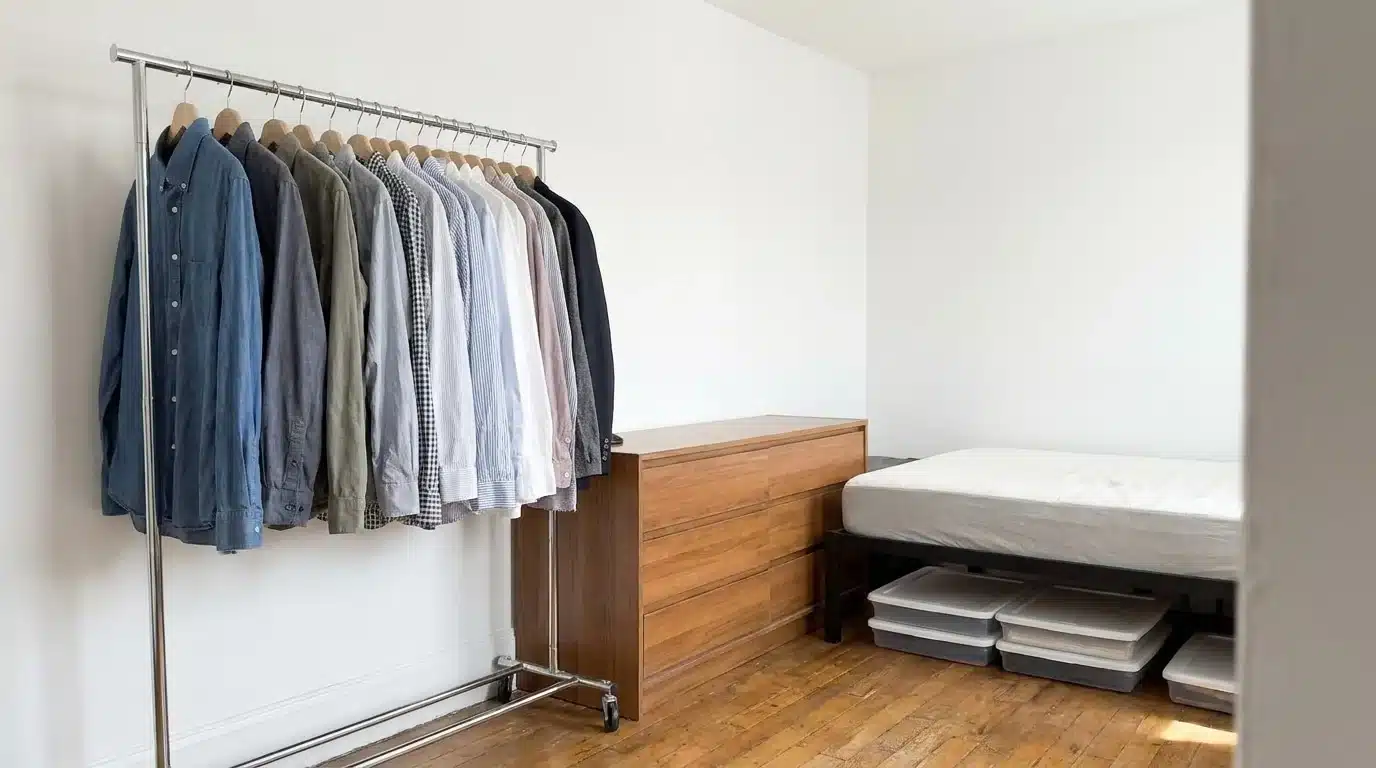
A clothing rail or a freestanding wardrobe, plus one dresser, lined up on the longest clear wall. Your clothes need one home for what hangs and one for what folds. Keep those two side by side and getting dressed happens in one place.
Off-season clothes then go under the bed in lidded containers, which takes them out of the count and shrinks the problem. The full plan, including how to size the rail, is in our guide to bedroom storage without a closet. If you do have a closet and it is just badly set up, read how to lay out a reach-in closet first, and keep folded stacks on the shelves short and sorted by type.
Where does food go without a pantry?
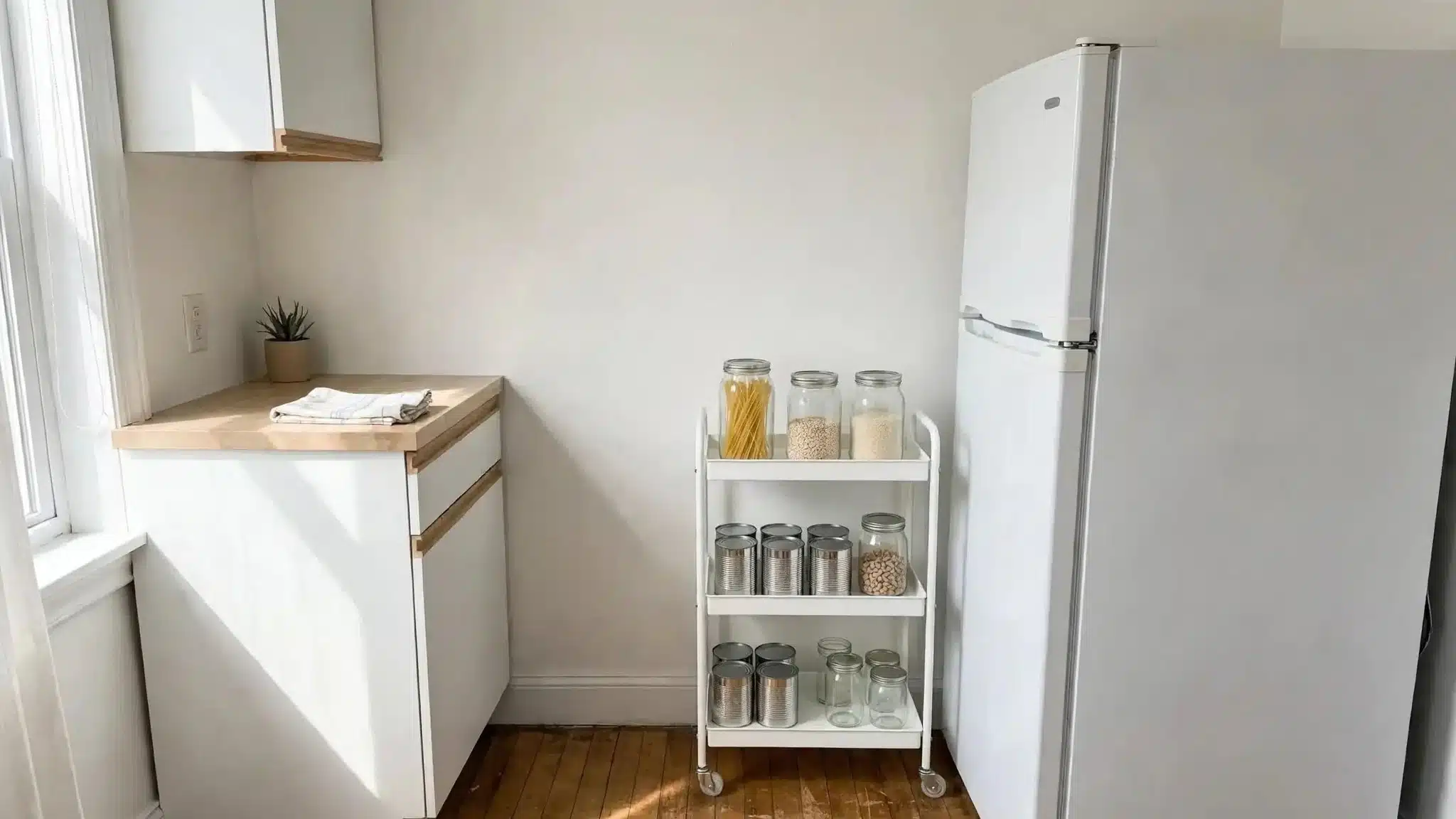
Usually into cabinets you already have, once you stop spreading it around. Choose one upper cabinet near the counter for light daily food, one deep drawer or low shelf for cans and oil, and one small overflow spot for unopened backups.
If you truly need more, a rolling cart made for the gap beside a fridge is usually only 5 to 7 inches wide and holds a surprising number of cans and jars. A shallow cabinet about 12 inches deep is the next step up. Our page on the kitchen without a pantry sizes all of this. Cookware has its own plan in storing pots and pans, and the space below the sink gets its own in organizing under the kitchen sink.
Where do big things go with no garage or basement?
Big, rarely used things go in the high and low spots of the apartment: the shelf above the closet rod, the top of a wardrobe and under the bed. Then cut how much of it you keep. Swap seasonal things in and out twice a year, and store something only if you will use it within the next twelve months.
A few items are awkward enough to deserve their own plan:
- Suitcases nest inside each other, and the largest goes on a closet shelf.
- An artificial Christmas tree usually stores upright in a closet corner or in a soft bag under a raised bed.
- Wrapping paper is ruled by its roll width, about 30 inches.
- Under-bed containers need measuring, because a center rail and a low frame can cut the space to two or three boxes.
A rented unit makes sense for large things you truly will use again, such as furniture between moves. Paying every month to keep boxes you have not made a decision about rarely makes sense.
How do you add storage to a tiny bathroom?
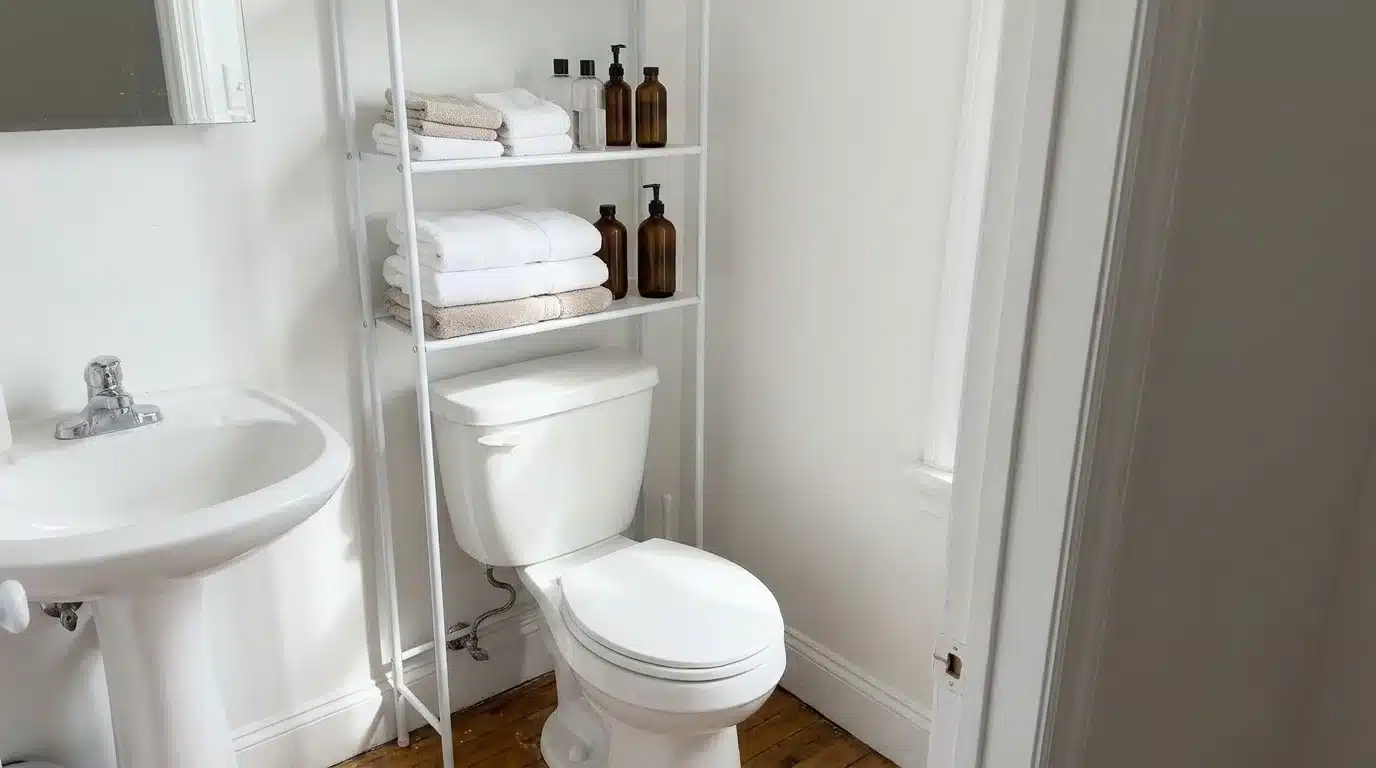
Split the job into small zones, since no single piece will solve it. The wall over the toilet is usually the largest empty stretch in the room, so a slim freestanding unit 8 to 10 inches deep, strapped to the wall, is a good start. Measure it against the three numbers that matter over a toilet, since the common mistake is a shelf too low to lift the tank lid.
From there: hooks on the door for robes and hand towels, a narrow cart in the driest corner for daily items, and only the open bottles in the shower. Our guides cover the space under a bathroom sink, towels when you have one bar and shower storage with no drilling.
What about the front door, the laundry and a studio?
The front door. A door only has a few jobs: keys, today’s coat, the everyday bag and the shoes you are wearing this week. Hooks and a shallow ledge handle most of that. Keep two or three pairs per person at the door and send the rest to the bedroom. See what an entryway actually needs and where shoes can go.
Laundry. Use the wall above the machines, keep one basket per job, and give the empty basket and the drying rack a real home. Laundry basket storage and drying clothes without a dryer cover both.
A studio. Every storage piece also shapes the room, so choose ones that do a second job. A low open shelf can divide the sleeping area from the living area, and a bed with space underneath replaces a dresser’s worth of off-season storage. Our room divider guide explains which pieces keep the daylight moving. Then decide where the desk and the table go before you add anything tall.
Storage for small apartments when you can’t drill
Almost every option above has a version that needs no holes. Freestanding units, tension rods, adhesive hooks rated for the weight, clamp-on shelves and carts all leave the walls alone.
The one exception to keep in mind is tall furniture. Tall, narrow pieces can tip, especially with a heavy top shelf or a child climbing on them. Keep heavy things low and use the anti-tip strap that comes with the piece. It does need one small anchor in the wall, so ask your landlord; a hole that size is easy to patch when you leave. The CPSC’s Anchor It guidance explains why it matters.
What to look for when you buy storage
Once you know the type, these checks separate a piece that works from one that ends up on the curb.
- Outside dimensions, not inside. Compare the listing with your tape measure, and allow for baseboards, which often push a piece an inch off the wall.
- The path in. Measure your narrowest door and any turn. Most interior doors are 28 to 32 inches wide.
- Weight rating per shelf. Books and cans are heavy. A shelf with no listed rating is a guess.
- Lids. Anything stored for months should have a lid, or you will wash it before you can use it.
- Locking wheels. A cart needs at least two, or it will roll every time you pull something out of it.
- Backs and doors. Closed storage hides visual clutter, which matters more in a small room. Open shelves are fine for books and lidded boxes.
- Clearance to open. Drawers and doors need room. Plan on about 30 to 36 inches in front of a dresser.
Storage that rarely earns its space
- Bins deeper than the shelf. They hang off the edge or stop the door closing.
- Matching sets of organizers. Six of them bought before you have counted anything usually means four sit half empty.
- Over-door racks on hollow-core doors, at least for anything heavy. The door takes the load, and it was not built for that.
- Storage furniture that is deep but low, such as a bulky bench in a narrow hall. You give up the path through the hall and gain very little.
- Vacuum bags for things that need to keep their shape, such as a pre-lit tree or a good wool coat you care about.
What this adds up to: about 6 square feet
Here is what those choices can look like in one small one bedroom with a single reach-in closet. The sizes are typical, so swap in your own.
| Piece | Floor it takes | What it solves |
|---|---|---|
| Bookcase, 36 x 12 in, full height | 3 sq ft | Books, lidded boxes, and overflow from the closet |
| Gap cart beside the fridge, 7 x 28 in | About 1.4 sq ft | Cans, jars and backups |
| Two-tier shoe rack, 24 x 12 in | 2 sq ft | Everyday shoes at the door |
| Under-bed containers | None new | Off-season clothes and spare bedding |
| Unit over the toilet | None new, its legs stand around the toilet | Bathroom spares and towels |
| Hooks on the wall and door | None | Coats, bags and robes |
That is about 6.4 square feet of floor for six storage moves. A single sideboard 60 inches wide and 18 inches deep takes 7.5 on its own. This is why starting with height and dead space beats shopping for one large piece.
Small apartment storage questions
How do you store things in a small apartment with no storage at all?
Start under the bed and on top of anything tall, since those spaces are already there and cost no floor. Then add one tall shallow bookcase, and only after that look at anything else. Before you do any of this, take out what you will not use within a year.
What furniture has the most storage for a small apartment?
For the floor it takes, a tall shallow bookcase or wardrobe. After that, a bed frame that sits high enough for containers underneath, and a storage ottoman that replaces a coffee table. Those two take space you were already giving up.
Are storage units worth it for a small apartment?
For furniture between moves or large gear you really use, they can be. For boxes you have not opened in two years, they rarely are. Sort those boxes first and see what is left.
What are good storage ideas for a small apartment on a budget?
Start with the things that cost little: hooks, lidded bins that fit a shelf you already have, risers under a low bed, and clearing out what you do not use. Buy furniture only once those are used up.